Why Can't Forces Replace Energy Conservation for Spring Stretch?

Click For Summary

Homework Help Overview

The discussion revolves around a problem involving the stretching of a spring when a mass is released, specifically questioning the use of forces versus energy conservation principles in determining the maximum stretch of the spring.

Discussion Character

  • Conceptual clarification, Assumption checking

Approaches and Questions Raised

  • Participants explore the distinction between maximum stretch and equilibrium position, questioning the role of kinetic and static friction in the context of the problem.

Discussion Status

The conversation is ongoing, with participants offering insights into the implications of friction types and the interpretation of the problem's wording. There is no explicit consensus, but various interpretations and considerations are being discussed.

Contextual Notes

Participants note ambiguity in the problem statement regarding the stopping condition of the mass and the relevance of static versus kinetic friction, which may affect their approaches to finding a solution.

CaglarKorkmazgoz
Messages
4
Reaction score
0
Homework Statement
Find the stretch of spring (x=L)
Relevant Equations
mg=T
mg=mgu+kx
mg=(mg/4)+kx
(3mg/4k)=x=L
Hello, I am new on this forum, so if I make any mistakes please inform me. Thank you.

I wonder why I cannot use forces instead of energy conservation in this question.
The question is:
"How far (x = L) does the spring stretch before the masses stop moving? Express your answer in terms of m, k and some constants as needed."
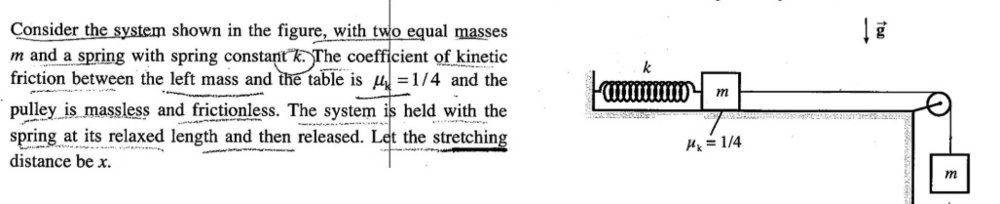
Screenshot_1.jpg


Here is my attempt but of course it is wrong (I imagined the last situation which is equilibrium), the answer should be (3mg)/2k:
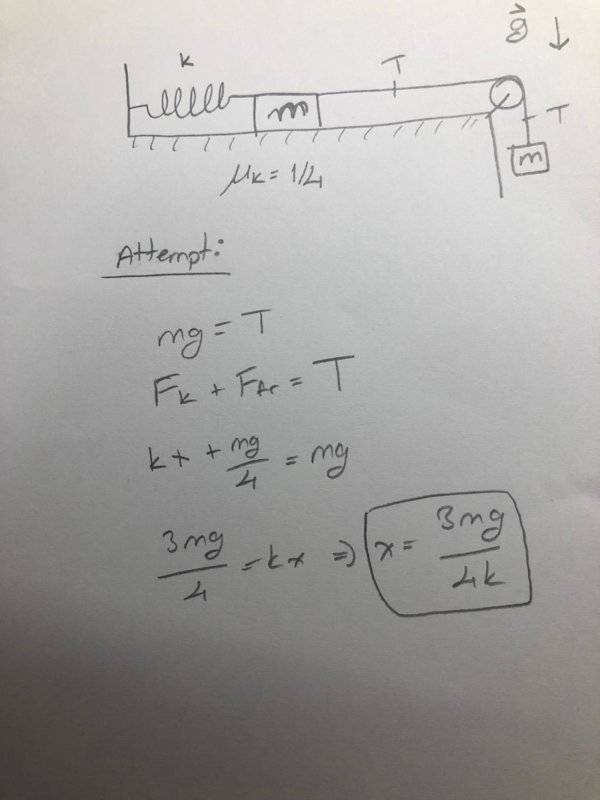
WhatsApp Image 2019-12-30 at 23.55.45.jpeg
 
Physics news on Phys.org
CaglarKorkmazgoz said:
I wonder why I cannot use forces instead of energy conservation in this question.
Because once released, the hanging mass will drop beyond the equilibrium point. You are solving for the maximum stretch, not the equilibrium position. (At least that's what I presume they are asking for.)
 
  • Like
Likes   Reactions: CaglarKorkmazgoz
Doc Al said:
Because once released, the hanging mass will drop beyond the equilibrium point. You are solving for the maximum stretch, not the equilibrium position. (At least that's what I presume they are asking for.)
I think the problem is the difference between the coefficient of kinetic and static frictions, but I will think about that. Thank you
 
CaglarKorkmazgoz said:
I think the problem is the difference between the coefficient of kinetic and static frictions, but I will think about that. Thank you
The request "How far (x = L) does the spring stretch before the masses stop moving?" is a bit ambiguous. I assumed they meant momentarily stop moving, but it's unclear. (I see no mention of static friction here.)
 
  • Like
Likes   Reactions: CaglarKorkmazgoz
Doc Al said:
(I see no mention of static friction here.)

At final, it will stop moving, so there will not be any kinetic friction, it will be static friction I guess. But the only given quantity is about coefficient of kinetic friction so that when I try to use "Force equality" it gives me a wrong answer.
 
If you interpret the question as I did, you'll get the "right" answer. :wink:
 
CaglarKorkmazgoz said:
At final, it will stop moving, so there will not be any kinetic friction
Until it has stopped moving, at least instantaneously, it is kinetic friction. So static friction has no relevance to how far it moves. You would need to know the static friction if you wanted to find out whether it then starts to move back again.
CaglarKorkmazgoz said:
when I try to use "Force equality" it gives me a wrong answer
That's because that method overlooks the momentum built up during the expansion of the spring.
If, instead, you wanted to know how far away you could carefully position the mass without its then moving to the left you would have used spring force balancing static friction.
 
  • Like
Likes   Reactions: Doc Al and CaglarKorkmazgoz
haruspex said:
Until it has stopped moving, at least instantaneously, it is kinetic friction. So static friction has no relevance to how far it moves. You would need to know the static friction if you wanted to find out whether it then starts to move back again.

That's because that method overlooks the momentum built up during the expansion of the spring.
If, instead, you wanted to know how far away you could carefully position the mass without its then moving to the left you would have used spring force balancing static friction.
Thank you so much for the explanation
 

Similar threads

  • · Replies 14 ·
Replies
14
Views
2K
  • · Replies 7 ·
Replies
7
Views
2K
Replies
24
Views
4K
  • · Replies 8 ·
Replies
8
Views
1K
  • · Replies 22 ·
Replies
22
Views
2K
  • · Replies 20 ·
Replies
20
Views
4K
  • · Replies 3 ·
Replies
3
Views
2K
  • · Replies 3 ·
Replies
3
Views
2K
Replies
3
Views
2K
  • · Replies 5 ·
Replies
5
Views
2K