flyingpig
- 2,574
- 1
Why can't I add the voltage drop??
What are the expected readings of the ammeter and voltmeter for the circuit in the figure below? (R = 6.00Ω , ΔV = 6.00 V.)
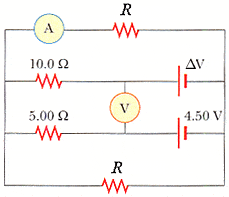
I already solve for the ammeter, but the voltmeter is confusing me.
Sorry for the difference in pic size, Imageshack has gotten greedy and I can only attach some image files now
http://img156.imageshack.us/img156/692/p1863alt.th.gif
Uploaded with ImageShack.us
[PLAIN]http://www3.wolframalpha.com/Calculate/MSP/MSP646619f154e92fe29514000016e30c7af875h3e4?MSPStoreType=image/gif&s=20&w=152&h=56
[PLAIN]http://www3.wolframalpha.com/Calculate/MSP/MSP318819f1579c665h3gc900001dbf341h0bihh22e?MSPStoreType=image/gif&s=17&w=151&h=56
So IA = 0.395A = IC and IB = 0.0315789A
Since we are only concerned with the magnitudes, I am going to leave out the signs for now.
So the current flowing into the 10Ω resistor is 0.395A - 0.0315789A = 0.363A and current down the 5.0Ω is 0.427A
So 5.0Ω * 0.427A = 2.133V and 10Ω * 0.363A = 3.63V
3.63V + 2.133V = 5.763V
Apparently the answer is 1.50V, which suggests it is 3.63V - 2.133V = 1.50V
Or that we could do 6.00V - 4.50V = 1.5V
Now the question, what is the real solution? And?
Homework Statement
What are the expected readings of the ammeter and voltmeter for the circuit in the figure below? (R = 6.00Ω , ΔV = 6.00 V.)
The Attempt at a Solution
I already solve for the ammeter, but the voltmeter is confusing me.
Sorry for the difference in pic size, Imageshack has gotten greedy and I can only attach some image files now
http://img156.imageshack.us/img156/692/p1863alt.th.gif
Uploaded with ImageShack.us
[PLAIN]http://www3.wolframalpha.com/Calculate/MSP/MSP646619f154e92fe29514000016e30c7af875h3e4?MSPStoreType=image/gif&s=20&w=152&h=56
[PLAIN]http://www3.wolframalpha.com/Calculate/MSP/MSP318819f1579c665h3gc900001dbf341h0bihh22e?MSPStoreType=image/gif&s=17&w=151&h=56
So IA = 0.395A = IC and IB = 0.0315789A
Since we are only concerned with the magnitudes, I am going to leave out the signs for now.
So the current flowing into the 10Ω resistor is 0.395A - 0.0315789A = 0.363A and current down the 5.0Ω is 0.427A
So 5.0Ω * 0.427A = 2.133V and 10Ω * 0.363A = 3.63V
3.63V + 2.133V = 5.763V
Apparently the answer is 1.50V, which suggests it is 3.63V - 2.133V = 1.50V
Or that we could do 6.00V - 4.50V = 1.5V
Now the question, what is the real solution? And?
Last edited by a moderator: