Undergrad Why can't we just integrate a simple function?

Click For Summary
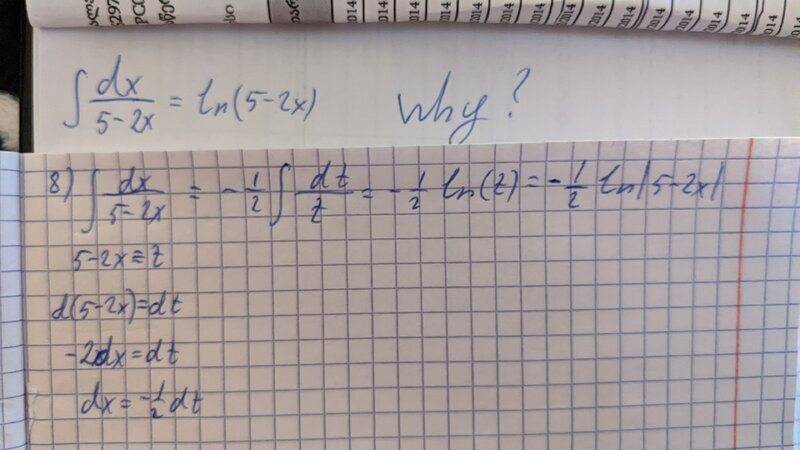
The discussion centers on understanding the integration of a function and the concept of the anti-derivative. Participants explore why the integral of a function, specifically ##\ln(5 - 2x)##, involves a multiplier of ##-1/2##. The relationship between differentiation and integration is emphasized, highlighting that the integral is essentially the anti-derivative. Clarification is provided on how differentiating the logarithmic function leads to the appearance of the multiplier. The conversation concludes with a sense of understanding regarding the integration process.
NODARman
Messages
57
Reaction score
13
TL;DR
.
Can anyone explain to me why the second one is the right?
(See the attachment)
PXL_20221016_130317184.jpg
 
Physics news on Phys.org
The integral is the anti-derivative. What happens when you differentiate ##\ln(5 - 2x)##?
 
Your question is where does the ##-1/2## multiplier come from?
 
PeroK said:
The integral is the anti-derivative. What happens when you differentiate ##\ln(5 - 2x)##?
Just got it 🙂 👍
 
There are probably loads of proofs of this online, but I do not want to cheat. Here is my attempt: Convexity says that $$f(\lambda a + (1-\lambda)b) \leq \lambda f(a) + (1-\lambda) f(b)$$ $$f(b + \lambda(a-b)) \leq f(b) + \lambda (f(a) - f(b))$$ We know from the intermediate value theorem that there exists a ##c \in (b,a)## such that $$\frac{f(a) - f(b)}{a-b} = f'(c).$$ Hence $$f(b + \lambda(a-b)) \leq f(b) + \lambda (a - b) f'(c))$$ $$\frac{f(b + \lambda(a-b)) - f(b)}{\lambda(a-b)}...

Similar threads

  • · Replies 4 ·
Replies
4
Views
1K
  • · Replies 8 ·
Replies
8
Views
3K
  • · Replies 49 ·
2
Replies
49
Views
7K
  • · Replies 31 ·
2
Replies
31
Views
4K
  • · Replies 1 ·
Replies
1
Views
2K
  • · Replies 11 ·
Replies
11
Views
3K
  • · Replies 10 ·
Replies
10
Views
2K
  • · Replies 3 ·
Replies
3
Views
2K
  • · Replies 14 ·
Replies
14
Views
4K