Why do both Block A and B have a zero acceleration in this scenario?

Click For Summary

Homework Help Overview

The problem involves three blocks (A, B, and C) connected by massless strings and pulleys, with blocks A and B having the same weight and coefficient of kinetic friction. Block C descends at a constant speed, leading to questions about the acceleration of blocks A and B.

Discussion Character

  • Conceptual clarification, Assumption checking

Approaches and Questions Raised

  • Participants explore the relationship between the blocks' distances from C and their velocities, questioning how constant speed of C affects the acceleration of A and B.

Discussion Status

The discussion is ongoing, with participants examining the implications of the blocks being equally distant from C and the role of friction in determining their velocities. Some guidance has been offered regarding the relationship between the blocks' velocities and the inextensibility of the connecting strings.

Contextual Notes

There is a mention of friction acting on blocks A and B, which raises questions about how this affects their velocities relative to block C.

mamadou
Messages
24
Reaction score
1
1. Homework Statement
3 blocks A,B and C are attached between them by massless and frictionless strings , that passes through frictionless , massless pullies , the blocks A and B have the same weight 25 N and the same coefficient of kinetic friction 0.35 , the bloc C goes down with a constant speed .

Using Newton's 2nd law we get : [tex]a_{C} = 0[/tex] because the speed is constant ,

what I can't figure out is why in the correction they said that : [tex]a_{B} = 0[/tex] and [tex]a_{A} = 0[/tex]
why both of block A and B have ALSO a zero acceleration , how do we know that ?
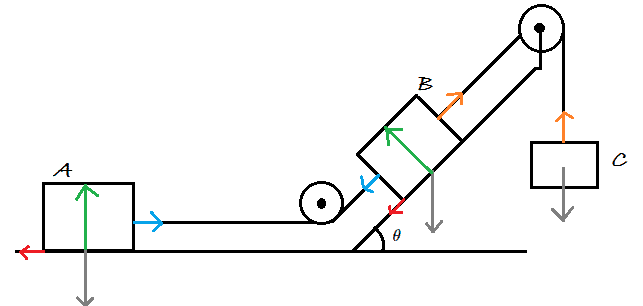
Capture555.PNG
 
Last edited:
Physics news on Phys.org
They are attached by a string to C, meaning that they cannot get further from C. But because they would slide to the other side, they cannot get closer to C. Thus, they will be equally far from C. This means that they don't accelerate.
 
why being equally far from C means that they don't accelerate , they could be equally far but their speed is increasing so accelerating .
 
mamadou said:
they could be equally far but their speed is increasing so accelerating
But you know that c isn't acclerating. So it goes with a constant velocity (v) at any time. But B and A have to have the same velocity at any time, because as you said:
mamadou said:
being equally far from C.
So A and B have to have v at any time. But v is constant => no acceleration
 
does it means that A and B have the same velocity as C ?
 
yes. do you understand why?
 
truthly no , because there is also friction that acts on A and B , so how could they have the same velocity ?
 
okay. so:
if you have a train, with coaches connected to each other with "ropes", all coaches have the same velocity, right?
 
A and B cannot be slower because the rope is inextensible, right?
 
  • #10
yes ,sure .
 
  • #11
okay, let's do this in private convreastion. i sent you messages
 
  • #12
Replusz said:
okay, let's do this in private convreastion. i sent you messages
Be aware that Physics Forum rules don't allow homework related technical discussions to be moved to private messages. The purpose of the forums is to allow others to benefit from and contribute to the discussion.
 
  • Like
Likes   Reactions: Replusz and berkeman

Similar threads

  • · Replies 33 ·
2
Replies
33
Views
2K
Replies
1
Views
4K
  • · Replies 3 ·
Replies
3
Views
2K
Replies
8
Views
2K
  • · Replies 7 ·
Replies
7
Views
3K
  • · Replies 4 ·
Replies
4
Views
2K
  • · Replies 10 ·
Replies
10
Views
4K
  • · Replies 5 ·
Replies
5
Views
2K
Replies
26
Views
5K
  • · Replies 3 ·
Replies
3
Views
4K