Undergrad Why do planets follow the same curvature at both foci?

Click For Summary
SUMMARY

Planets and comets orbit the sun in elliptical paths as described by Kepler's laws, with the curvature of their orbits remaining consistent at both foci due to the interplay of gravitational force and velocity. Although gravitational force diminishes with distance (1/r²), the increased speed of a planet at perihelion compensates for this, resulting in symmetrical curvature. Einstein's general relativity emphasizes that gravity is not a force but a consequence of curved spacetime geometry, which aligns with Newton's laws under certain conditions. The additional term in Einstein's energy equations accounts for phenomena like the precession of Mercury's orbit, illustrating the nuanced differences between the two theories.

PREREQUISITES
  • Understanding of Kepler's laws of planetary motion
  • Familiarity with Newtonian mechanics and gravitational force
  • Basic knowledge of Einstein's general relativity and spacetime geometry
  • Concept of centripetal acceleration and its relation to orbital motion
NEXT STEPS
  • Study the mathematical derivation of orbital motion solutions in classical mechanics
  • Explore the implications of Einstein's additional term in energy equations
  • Investigate the precession of Mercury's orbit as a case study in general relativity
  • Learn about the differences between curved space and curved spacetime in gravitational theory
USEFUL FOR

Astronomers, physicists, students of astrophysics, and anyone interested in the dynamics of celestial mechanics and gravitational theories.

StandardsGuy
Messages
148
Reaction score
9
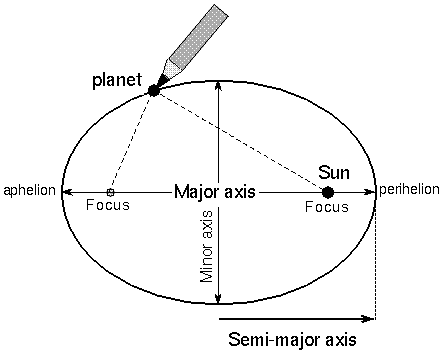
We are told that planets and comets orbit the sun in an ellipse (Kepler's 3 laws) as shown below:
ellipse.gif

We are also told that according to Einstein's theory of gravity, there is no force applied. Implied is that the planets move in straight lines through curved space. We know that the effect of gravity drops off as the square of the distance. Why then does the planet follow the exact same curvature on the far away focus (where the space-time curvature is relatively flat) that it does by the sun (where the curvature is extreme)?
 
Astronomy news on Phys.org
StandardsGuy said:
We are told that planets and comets orbit the sun in an ellipse (Kepler's 3 laws) as shown below:
ellipse.gif

We are also told that according to Einstein's theory of gravity, there is no force applied. Implied is that the planets move in straight lines through curved space. We know that the effect of gravity drops off as the square of the distance. Why then does the planet follow the exact same curvature on the far away focus (where the space-time curvature is relatively flat) that it does by the sun (where the curvature is extreme)?

Many years ago, in my first year at secondary school, we had an engineering drawing lesson to draw conic sections. The teacher, Mr Garvie, had a model cone with removable sections to reveal an ellipse, parabola and hyperbola. He pointed out that as one side of the ellipse was at a narrower part of the cone than the other, you might expect an asymmetrical egg-shaped section instead of the symmetrical ellipse.

Anyway, in answer to your question, the curvature of the orbit is the same because although the gravitational force is stronger at the perihelion, the planet is traveling faster at this point and nature conspires to produce symmetry where you may not expect it.
 
StandardsGuy said:
Why then does the planet follow the exact same curvature on the far away focus (where the space-time curvature is relatively flat) that it does by the sun (where the curvature is extreme)?
Just adding to what PeroK has said, the answer lies in the mathematical solution, which Newton was the first to work out. It was very complicated to do as he did it before the practice of solving differential equations was developed. Feynman did a very good lecture on this using Newton's method.

The answer you may be looking for may be this: the planet is moving faster when it is prescribing the closer curve (perigee) than it is when prescribing the more distant one (apogee). It just works out mathematically that where the force varies as 1/r2, the increased force near the perigee is just enough to cause the body (now traveling at higher speed compared to the apogee) to move along a path with the same curvature as at the apogee.

AM
 
Last edited:
Andrew Mason said:
Just adding to what PeroK has said, the answer lies in the mathematical solution, which Newton was the first to work out. It was very complicated to do as he did it before the practice of solving differential equations was developed. Feynman did a very good lecture on this using Newton's method.

The answer you may be looking for may be this: the planet is moving faster when it is prescribing the closer curve (perigee) than it is when prescribing the more distant one (apogee). It just works out mathematically that where the force increases as 1/r2, the increased force near the perigee is just enough to cause the body (now traveling at higher speed compared to the apogee) is just enough to move along a path with the same curvature as at the apogee.

I see that PeroK has

AM
Both of you mentioned force which is not part of Einstein's theory (which is supposed to replace Newton's). I have no problem with the description of how it works with Newton's laws of force. But curvature doesn't change with speed (IMHO). The focus of the aphelion is more than 4 times as far away from the planet as is the perihelion. If you were to draw the curvature there based on what it is at the perihelion, it would be almost a straight line (less than 1/16 of perihelion curvature). Traveling in a straight line through curved space doesn't work there. Do you see what I am getting at?
 
Einstein's theory of gravitational is not based on curved space. The theory is based on the geometry of spacetime. In particular, the geometry around a spherical star in this case.

The key energy equations in the two theories differ by an additional term in the Einstein theory, which is usually negligible. You could start by analysing the energy equation at the two points you are interested in. There may be a clue to the symmetry there.
 
StandardsGuy said:
Both of you mentioned force which is not part of Einstein's theory (which is supposed to replace Newton's). I have no problem with the description of how it works with Newton's laws of force. But curvature doesn't change with speed (IMHO). The focus of the aphelion is more than 4 times as far away from the planet as is the perihelion. If you were to draw the curvature there based on what it is at the perihelion, it would be almost a straight line (less than 1/16 of perihelion curvature). Traveling in a straight line through curved space doesn't work there. Do you see what I am getting at?

PS you have perhaps been led astray by the "rubber sheet analogy" which does indeed suggest that space has a definite curvature at each point and objects are compelled to move through space in a particular path. If you think about the simple example of a ball being thrown: The trajectory of the ball depends on the speed and direction it is thrown. Clearly, therefore, there is no definite curvature of space at each point.
 
Centrifugal force is a=v2/r
Now, note that while the gravitational force is proportional to inverse square of distance, the speed under to Kepler's second law is proportional to inverse of distance.
Therefore v2 changes with inverse square of distance, just like the gravitational force. Therefore the curvature radius in denominator must be the same.
 
snorkack said:
Centrifugal force is a=v2/r
Now, note that while the gravitational force is proportional to inverse square of distance, the speed under to Kepler's second law is proportional to inverse of distance.
Therefore v2 changes with inverse square of distance, just like the gravitational force. Therefore the curvature radius in denominator must be the same.
But if you use energy: ##\Delta\left(\frac{1}{2}mv^2\right) = -\Delta \left(m\frac{GM}{r}\right)##, so ##\Delta v^2 \propto - \Delta \frac{1}{r}##

The centripetal acceleration is toward the centre of curvature i.e. the radius of curvature is not necessarily the same as r, the radial distance from the centre of the sun or other gravitating body.

AM
 
Andrew Mason said:
The centripetal acceleration is toward the centre of curvature i.e. the radius of curvature is not necessarily the same as r, the radial distance from the centre of the sun or other gravitating body.
We had another thread raising this exact point not so long ago. You are right that conservation of energy alone is not sufficient to make the curvature of the orbit come out the same; but we have an additional constraint from conservation of angular momentum, and when you include that it will come out as expected. If you google for "orbital motion solution" you'll find some derivations, although you will need some calculus to to follow them. That's for the classical Newtonian approach in which gravity is treated as a force.

In general relativity, the important thing to remember is that it is curved space-time, not curved space, that we're working with. Objects are following different paths through space-time if they are moving at different speeds in space. An object moving slowly through a less curved region of spacetime may have its path through space curved just as much as a faster-moving object in a more curved region of spacetime.
 
  • #10
PeroK said:
Einstein's theory of gravitational is not based on curved space. The theory is based on the geometry of spacetime. In particular, the geometry around a spherical star in this case.

The key energy equations in the two theories differ by an additional term in the Einstein theory, which is usually negligible. You could start by analysing the energy equation at the two points you are interested in. There may be a clue to the symmetry there.
OK it's space-time not just space. The additional term that is negligible seems to support my contention that the curvature is a minimal part of the picture, not a replacement of Newton's laws completely. Explanations of Einstein's gravity that I have seen do not present it that way, though. How do you see it?
 
  • #11
PeroK said:
PS you have perhaps been led astray by the "rubber sheet analogy" which does indeed suggest that space has a definite curvature at each point and objects are compelled to move through space in a particular path. If you think about the simple example of a ball being thrown: The trajectory of the ball depends on the speed and direction it is thrown. Clearly, therefore, there is no definite curvature of space at each point.
I may indeed have been misled. Analogies are always imperfect, and this one leaves out time. But I'm not sure your conclusion is right, but I think Nugatory is saying about the same thing.
 
  • #12
Nugatory said:
In general relativity, the important thing to remember is that it is curved space-time, not curved space, that we're working with. Objects are following different paths through space-time if they are moving at different speeds in space. An object moving slowly through a less curved region of spacetime may have its path through space curved just as much as a faster-moving object in a more curved region of spacetime.
It's hard to conceive time, since I don't know what it looks like. So I think you are saying that due to time (speed of the planet) the curvature is not fixed in space, so it doesn't behave as I suggested. If this is correct, then the problem may be solved. I thank you all for your insights and answers.
 
  • #13
StandardsGuy said:
OK it's space-time not just space. The additional term that is negligible seems to support my contention that the curvature is a minimal part of the picture, not a replacement of Newton's laws completely. Explanations of Einstein's gravity that I have seen do not present it that way, though. How do you see it?
Einstein's theory is a complete replacement for Newton's gravity, where the force of gravity is replaced by the effects of curved space time geometry. The fact that Newton's theory so accurately models the solar system implies that once you do the maths, the same equations of planetary motion should emerge from both theories.

This is the case, although there is a small difference between the two. There is an extra term in the Einstein energy equation that leads to a precession of the elliptical orbit. This is negligible for the Earth, but the precession of Mercury's orbit is explained by Einstein's theory.
 

Similar threads

  • · Replies 12 ·
Replies
12
Views
3K
  • · Replies 5 ·
Replies
5
Views
7K
  • · Replies 16 ·
Replies
16
Views
2K
  • · Replies 7 ·
Replies
7
Views
3K
  • · Replies 5 ·
Replies
5
Views
2K
  • · Replies 1 ·
Replies
1
Views
2K
  • · Replies 10 ·
Replies
10
Views
6K
  • · Replies 34 ·
2
Replies
34
Views
8K
  • · Replies 27 ·
Replies
27
Views
7K
  • · Replies 9 ·
Replies
9
Views
2K