James2018
- 123
- 12
Hello. I have asked Andrew Truscott of the Australian National University on why do lasers not manifest photon bunching like incoherent light does and BEC not manifest any atom bunching.
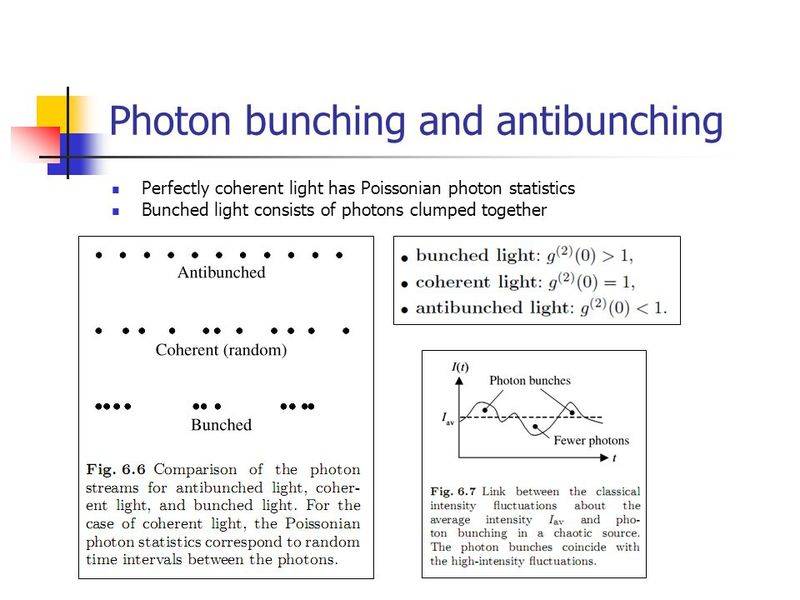
His e-mail reply contains an answer that is a it confusing to me. Can you explain it to me please?
"Bunching is an effect where (at the most fundamental level) two (or more) quantum wavefunctions overlap and interfere. However you only see this interference if the particles are detected within a length scale that we call the correlation length. Within this length - the particles are said to be indistinguishable (i.e. they are coherent) - and so they interfere. The length scale for bunching (read as the length scale the particles are identical (coherent)) is thus a measure of the coherence of the source of particles.
Now as a thermal gas of atoms is cooled, the correlation length grows, and thus so does the length scale for bunching. However once they are cooled beyond the Bose-Einstein condensation critical temperature and achieve an effective T = 0 distribution the idea of individual particles is replaced with the idea that the source is one large wave. In this scenario, the source has an infinite correlation length, so all the particles behave identically and the correlation length across the cloud is uniform and equal to 1. So no bunching signal is observed."
His e-mail reply contains an answer that is a it confusing to me. Can you explain it to me please?
"Bunching is an effect where (at the most fundamental level) two (or more) quantum wavefunctions overlap and interfere. However you only see this interference if the particles are detected within a length scale that we call the correlation length. Within this length - the particles are said to be indistinguishable (i.e. they are coherent) - and so they interfere. The length scale for bunching (read as the length scale the particles are identical (coherent)) is thus a measure of the coherence of the source of particles.
Now as a thermal gas of atoms is cooled, the correlation length grows, and thus so does the length scale for bunching. However once they are cooled beyond the Bose-Einstein condensation critical temperature and achieve an effective T = 0 distribution the idea of individual particles is replaced with the idea that the source is one large wave. In this scenario, the source has an infinite correlation length, so all the particles behave identically and the correlation length across the cloud is uniform and equal to 1. So no bunching signal is observed."
Attachments
