Undergrad Why Does an Integrand Equaling Zero at x=1 Not Determine the Integral's Value?

  • Thread starter Thread starter Hornbein
  • Start date Start date
  • Tags Tags
    Integral
Click For Summary
SUMMARY

The discussion centers on the calculation of the integral of the function (1-x²)ⁿ, particularly at the point x=1 where the integrand equals zero. Despite the integrand being zero at this point, the series expansion leads to a value greater than one, indicating that the integral's value cannot be determined solely by the integrand's value at a single point. The series is not defined at x=1, highlighting the importance of evaluating the integral over an interval rather than relying on pointwise evaluation.

PREREQUISITES
  • Understanding of integral calculus and series expansions
  • Familiarity with binomial coefficients and their applications
  • Knowledge of limits and continuity in calculus
  • Experience with mathematical notation and expressions
NEXT STEPS
  • Explore the properties of integrals involving discontinuities
  • Study the concept of pointwise convergence in series
  • Learn about the implications of the Fundamental Theorem of Calculus
  • Investigate the behavior of integrals at boundary points and their limits
USEFUL FOR

Mathematicians, calculus students, and anyone involved in advanced mathematical analysis, particularly those studying integrals and series expansions.

Hornbein
Gold Member
Messages
3,656
Reaction score
2,994
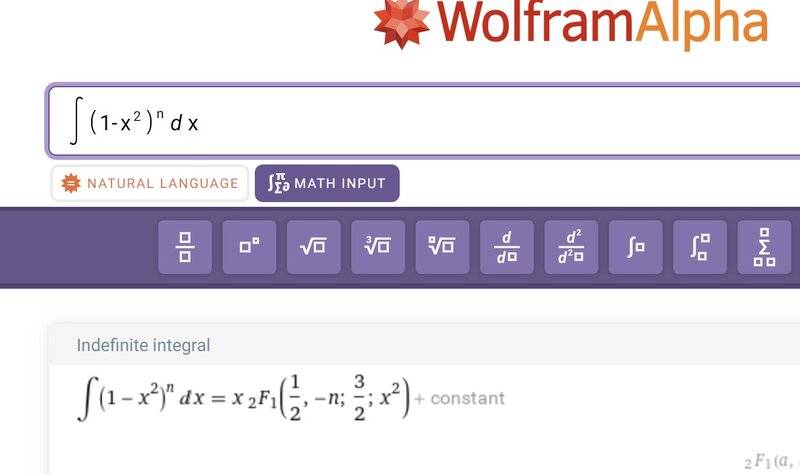
I'm trying to calculate the volume of a truncated hypersphere. As part of it I want this integral.
Integral.jpg

hypergeometric.jpg


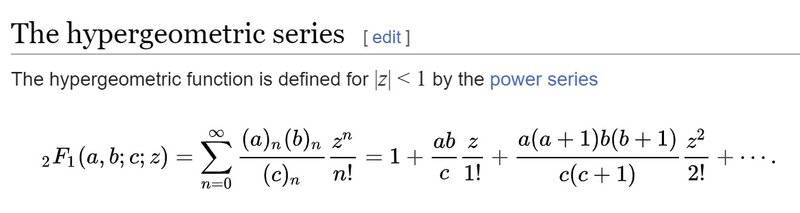
Clearly when x=1 the integrand is zero. But plugging this into the series give me a number greater than one. It is true that the series is not defined for x=1, but subtracting some tiny sum isn't going to make any difference.

I hope I'm missing something obvious.
 
Physics news on Phys.org
I made a mistake in my previous post ( deleted it ).

$$
\begin{align}
\int (1-x^2)^n ~dx &= \int (-x^2+1)^n ~dx \nonumber\\
&=\int \sum_{k=0}^n \binom {n}{k} (-x^2)^k1^{n-k}~dx \nonumber\\
&=\sum_{k=0}^n (-1)^k \binom {n}{k} \int x^{2k}~dx \nonumber\\
&=\sum_{k=0}^n (-1)^k \frac { n!}{k!(n-k)!} \cdot \frac {x^{2k+1}}{2k+1} \nonumber\\
\end{align}
$$
 
Last edited:
Hornbein said:
Clearly when x=1 the integrand is zero. But plugging this into the series give me a number greater than one. It is true that the series is not defined for x=1, but subtracting some tiny sum isn't going to make any difference.

I hope I'm missing something obvious.

Why would the integrand being zero at x = 1 tell you anything about the value of the integral?
 
Relativistic Momentum, Mass, and Energy Momentum and mass (...), the classic equations for conserving momentum and energy are not adequate for the analysis of high-speed collisions. (...) The momentum of a particle moving with velocity ##v## is given by $$p=\cfrac{mv}{\sqrt{1-(v^2/c^2)}}\qquad{R-10}$$ ENERGY In relativistic mechanics, as in classic mechanics, the net force on a particle is equal to the time rate of change of the momentum of the particle. Considering one-dimensional...

Similar threads

Replies
1
Views
2K
Replies
3
Views
2K
  • · Replies 14 ·
Replies
14
Views
3K
  • · Replies 4 ·
Replies
4
Views
4K
  • · Replies 16 ·
Replies
16
Views
4K
  • · Replies 4 ·
Replies
4
Views
2K
  • · Replies 3 ·
Replies
3
Views
3K
  • · Replies 1 ·
Replies
1
Views
3K
  • · Replies 4 ·
Replies
4
Views
3K
  • · Replies 2 ·
Replies
2
Views
2K