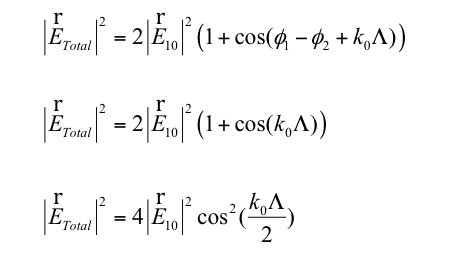
Why does cos(phi1- phi 2 +kX)=cos(kx)?

  • Context: Undergrad 
  • Thread starter Thread starter thegirl
  • Start date Start date
  • Tags Tags
    Algebra Optics Phi
Join the discussion
Ask a follow-up here, or get your own question answered by working scientists, mathematicians and engineers — people, not an autocomplete.
Real named experts · corrections over time · the nuance an AI answer skips
5 replies · 2K views
thegirl
Messages
40
Reaction score
1
In the case of two fields interfering with each other when calculating the total electric field, cos (phi1-phi2 + kx) = cos( kx) where kx is the path difference between the two fields.

How does cos (phi1-phi2 +kx)=cos(kx) Isit just algebra?
Screen Shot 2016-05-05 at 15.32.24.png
 
Physics news on Phys.org
Earlier on a general interference between two waves is obtained and it is assumed that they have the same phase velocity and so phi1=phi2, and the function collapses. Perhaps this is the case here?
 
I don't think it is, as wt is mentioned separately when phi is mentioned. Phi is mentioned when defining the amplitude of the wave Eo= |Eo|e^iphi{Eo}, where {Eo} is the unit vector.