Discussion Overview
The discussion revolves around the stability and accuracy of various numerical differencing techniques for solving the one-dimensional transient heat conduction equation, specifically focusing on the Crank-Nicolson method and its behavior with large time steps.
Discussion Character
- Technical explanation
- Debate/contested
- Mathematical reasoning
Main Points Raised
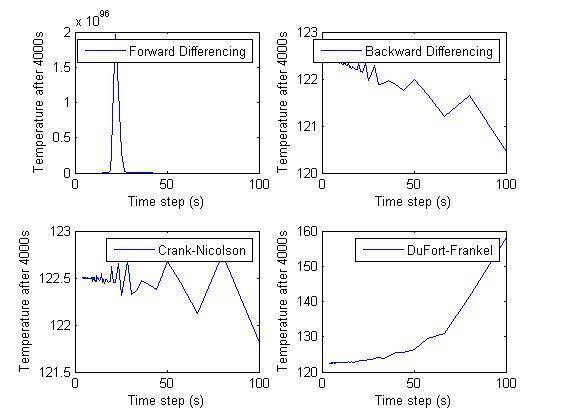
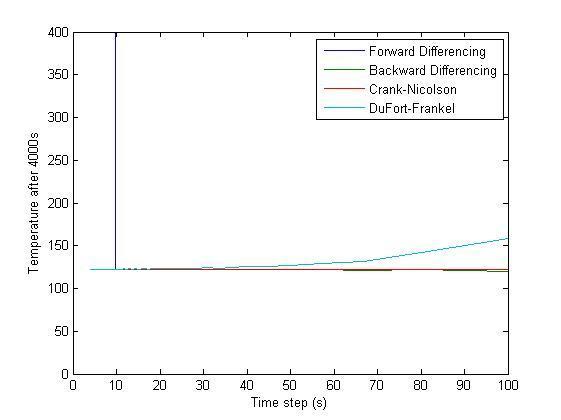
- Matt describes his MATLAB program that calculates surface temperature using Fourier's equation and notes that different differencing techniques show distinct behaviors as time steps increase.
- Matt questions why the Crank-Nicolson method becomes unstable for large time steps while the Forward method does not.
- Chet suggests that Matt should not be experiencing difficulties with the 1D transient heat conduction equation and questions the implementation of the methods, particularly the Backward Euler scheme.
- Chet inquires whether the Backward Euler method returns the steady state solution after one time step with a large time step, indicating its stability.
- Matt confirms that he has double-checked his code and is using a tri-diagonal matrix solver, but does not provide further details on the stability of the Backward Euler method.
Areas of Agreement / Disagreement
Participants do not reach a consensus on the reasons for the instability of the Crank-Nicolson method or the behavior of the Backward Euler method, indicating that multiple views remain regarding the implementation and stability of these numerical techniques.
Contextual Notes
There are unresolved questions regarding the implementation details of the numerical methods, particularly concerning the stability of the Backward Euler method and the conditions under which the Crank-Nicolson method becomes unstable.