Why does electromagnetic induction occur

Click For Summary
SUMMARY

Electromagnetic induction occurs when a conductor moves through a magnetic field, specifically when it cuts through magnetic field lines. This phenomenon is governed by Maxwell's equations, which state that a changing magnetic field generates an electric field, inducing electromotive force (emf) across the conductor. The strength of the induced current is influenced by factors such as the speed of the conductor's movement, the number of turns in the coil, and the strength of the magnetic field. Additionally, the impedance of the circuit, including inductance, plays a crucial role in determining the current produced.

PREREQUISITES
  • Understanding of Maxwell's equations
  • Knowledge of electromotive force (emf)
  • Familiarity with the concepts of impedance and inductance
  • Basic principles of electromagnetic fields
NEXT STEPS
  • Study the applications of electromagnetic induction in bicycle generators
  • Explore the relationship between magnetic field strength and induced voltage
  • Learn about the role of inductance in AC circuits
  • Investigate the effects of coil turns on electromagnetic induction efficiency
USEFUL FOR

Students of physics, electrical engineers, and anyone interested in the principles of electromagnetism and its applications in technology.
tor2006
Greeting

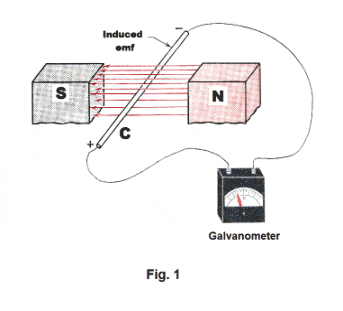
I know the field of electromagnetism is not yet fully clarified but I wonder if there is an idea,theory Why does electromagnetic induction occur only when the conductor cuts the magnetic field lines.
MHtdP.gif
 
Engineering news on Phys.org
tor2006 said:
I know the field of electromagnetism is not yet fully clarified
Classical electromagnetism is perfectly well understood in terms of Maxwell's equations. These are over 150 years old.

tor2006 said:
Why does electromagnetic induction occur only when the conductor cuts the magnetic field lines.
The magnetic force on a charge depends on its sign, velocity, and the magnetic field it moves through. The force on an individual charge will be perpendicular to both the magnetic field and the direction of motion of the conductor. In order for there to be a driving force in the conductor's direction, both the velocity and the magnetic field must have components perpendicular to the conductor's direction and cannot be parallel. As a result, the conductor will need to cut the magnetic field lines to produce a driving emf.
 
  • Like
Likes Asymptotic, davenn and NFuller
tor2006 said:
Why does electromagnetic induction occur only when the conductor cuts the magnetic field lines.
Using your figure as an example, where would the electrical energy come from if there were found to be induced current and voltage in even the stationary case?
 
tor2006 said:
Greeting

I know the field of electromagnetism is not yet fully clarified but I wonder if there is an idea,theory Why does electromagnetic induction occur only when the conductor cuts the magnetic field lines. View attachment 212528
It occurs whenever a magnetic field and an electric conductor move relative to one another so the conductor crosses lines of force in the magnetic field. The current produced by electromagnetic induction is greater when the magnet or coil moves faster, the coil has more turns, or the magnet is stronger.
 
tor2006 said:
Greeting

I know the field of electromagnetism is not yet fully clarified but I wonder if there is an idea,theory Why does electromagnetic induction occur only when the conductor cuts the magnetic field lines. View attachment 212528
People have said what happens but not why.
It is an interesting question, because stationary electrons are not attracted by a magnet.
But Maxwell says that a changing magnetic field creates an electric field. This creates an EMF across the ends of the wire, and so moves electrons which form the current.
It does this because it does this!
 
adaliadella said:
The current produced by electromagnetic induction is greater when the magnet or coil moves faster, the coil has more turns, or the magnet is stronger.
Usually I am not pedantic, but EM induction induces a voltage (emf precisely) in the conductor. So it's the voltage that is greater when, as you said, the magnet or coil moves faster, the coil has more turns, or the magnet is stronger (irrespective of the circuit resistance).

Current simply depends on the impedance of the circuit.
 
  • Like
Likes davenn
cnh1995 said:
Usually I am not pedantic, but EM induction induces a voltage (emf precisely) in the conductor. So it's the voltage that is greater when, as you said, the magnet or coil moves faster, the coil has more turns, or the magnet is stronger (irrespective of the circuit resistance).

Current simply depends on the impedance of the circuit.
Splitting hairs. When a time varying magnetic field is present, current & voltage are both induced. Regarding impedance of the circuit, we must include the inductance of the loop. If the inductive reactance exceeds load impedance, the load current & voltage remain near constant despite speed increasing.
Bicycle generators use this principle. Generator wound so that stator inductance is large. As pedal speed increases, headlight gets brighter. But frequency increases with speed, & stator reactance increases. Once stator reactance Xs, exceeds loiad resistance Rl, increases in pedal speed have little effect on headlight brightness. Generator is in constant current mode. Increasing speed produces increased frequency, which increases voltage dropped across Xs, resulting in c onstant current & voltage in headlight.
cnh1995 said:
Usually I am not pedantic, but EM induction induces a voltage (emf precisely) in the conductor. So it's the voltage that is greater when, as you said, the magnet or coil moves faster, the coil has more turns, or the magnet is stronger (irrespective of the circuit resistance).

Current simply depends on the impedance of the circuit.
 

Similar threads

  • · Replies 16 ·
Replies
16
Views
1K
  • · Replies 6 ·
Replies
6
Views
3K
Replies
3
Views
515
  • · Replies 7 ·
Replies
7
Views
2K
  • · Replies 37 ·
2
Replies
37
Views
4K
Replies
9
Views
2K
  • · Replies 7 ·
Replies
7
Views
2K
  • · Replies 3 ·
Replies
3
Views
2K
  • · Replies 2 ·
Replies
2
Views
2K
  • · Replies 8 ·
Replies
8
Views
2K