Why does flowing water cast a shadow?

  • Context: High School 
  • Thread starter Thread starter Wrichik Basu
  • Start date Start date
  • Tags Tags
    Shadow Water
Click For Summary
SUMMARY

The discussion centers on the phenomenon of flowing water casting a shadow, specifically when water flows from a tap. Participants concluded that the cylindrical shape of the water stream acts as a prism with a higher refractive index than air, causing light to refract and create a shadow. The visibility of the shadow is influenced by the surrounding light conditions and the observer's perspective. Practical experiments with glass tubes or drinking glasses were suggested to further explore this optical effect.

PREREQUISITES
  • Understanding of light refraction and its principles
  • Familiarity with the concept of refractive index
  • Basic knowledge of optical phenomena, such as shadows and light behavior
  • Experience with practical experimentation in optics
NEXT STEPS
  • Conduct experiments with different shapes of glass tubes to observe shadow variations
  • Study the principles of light refraction in various mediums
  • Explore the effects of turbulence on light behavior in flowing liquids
  • Research optical phenomena related to prisms and their applications in science
USEFUL FOR

Students of physics, optical engineers, and anyone interested in the behavior of light and shadows in fluid dynamics.

Wrichik Basu
Science Advisor
Insights Author
Gold Member
Messages
2,180
Reaction score
2,690
I found that water flowing from a tap is casting a shadow, somewhat like this:
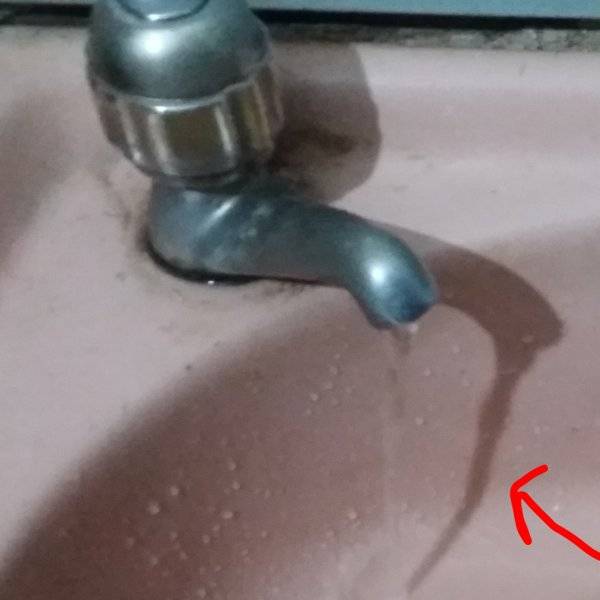
20181111_031136.jpg


If you see through the water flowing from the tap, you can see that the pink colour of the wash basin is visible almost clearly.

What is the cause of the flowing water casting a shadow? Is it because the turbulence prevents any light from getting refracted through the stream, thereby casting a shadow?

N.B.: Maybe this question has been asked before. If so, moderators may delete the thread.
 

Attachments

  • 20181111_031136.jpg
    20181111_031136.jpg
    24.6 KB · Views: 2,315
Physics news on Phys.org
Hi Wrichik Basu:

The movement of the water is irrelevant. Imagine a transparent glass tube. If it is properly made, when it is empty it will not cast a noticeable shadow. When it is full of water, then it will.

ADDED
I added "noticeable" after the original post
Buzz
 
Last edited by a moderator:
Part is down to refractive index...

Analogy with a rainbow, where part of the sky just off the bow is slightly darker, some light having been diverted...

And consider the patterns on the bottom of a swimming pool caused by sun-lit ripples...
 
A thin, flat sheet of glass would cast only a faint shadow, but a hollow glass tube would cast more of a shadow and a solid cylindrical glass rod would cast even more of a shadow. You might like to think why the shape of the glass makes a difference. And you could try a practical experiment with a drinking glass or a clear glass bottle.
 
If you turn off the room light and shine a light beam (eg. laser pointer) at the water you will see that most of the light is refracted away from the geometrical shadow area.
 
  • Like
Likes   Reactions: anorlunda, sophiecentaur and mfb
Buzz Bloom said:
but sometimes when a window with an ordinary pane of glass is partially open, the wood frame of the window casts a shadow, but I am unable to distinguish any difference between the sunlight on the floor which passed through the open part the window and the sunlight which passed through the pain of glass in the window.
But this is not an equivalent scenario at all.
The glass tube is round, not flat, so the tangential edges of the glass tube will be quite visible in the shadow, and
the glass tube has no "wood pane" to mask the side-by-side difference.

A glass tube will most definitely cast a shadow.
 
  • Like
Likes   Reactions: Buzz Bloom
The simplest answer to the OP's question (as has been stated by others) is that the column of water is a cylindrical prism (with a higher index of refraction than the surrounding air). It refracts the light passing through it. This means the rays from a specific light source will be directed obliquely (to parallel rays), and not fall directly behind the column.

glassrefraction.gif
 

Attachments

  • glassrefraction.gif
    glassrefraction.gif
    4.3 KB · Views: 1,588
  • Like
Likes   Reactions: sophiecentaur and Keith_McClary
DaveC426913 said:
The simplest answer to the OP's question (as has been stated by others) is that the column of water is a cylindrical prism (with a higher index of refraction than the surrounding air). It refracts the light passing through it. This means the rays from a specific light source will be directed obliquely (to parallel rays), and not fall directly behind the column.

View attachment 233792
However, when we look at an object through the falling water, it's also necessary to explain why our eye is not equivalent to the ceramic of the sink. The effects require particular circumstances to make them particularly noticeable - water from a tap is a very common example but there are others where it doesn't happen as described.
The shadow is not particularly deep, in that picture but it is easily discriminated by our eye so it is subjectively significant. The scattered light lands on either side of it, increasing the illumination but that is not perceived because it is diffuse. Objects on either side of the water have images 'in' the stream - you can see the fuzzy images of the actual shadow and the tap on the ceramic, through the water. I think they are, in fact, images very near to the water stream (Virtual or real, depending on the details), which our eyes can perceive but which will not form identifiable 'shadows'.
There will be instances where the view through a water-filled tube will be definitely darker than the scene behind it. If the tube is in front of a light coloured stripe on a black background, the view through the water will be darker than the stripe because the image contains parts of the black background as well as the stripe.
Sorry but I don't have time to do a picture. Anyone can verify this with a glass of water if they choose a suitable place in their house. Squinting with the eyes can blur the image and make the effect more obvious.
 
  • Like
Likes   Reactions: Buzz Bloom
This thread is (unnecessarily) becoming a bit of a mess, with people editing messages to say different things and the mentors deleting correct explanations.

Only invisible objects cast no shadows. A column of water is not invisible (for reasons mentioned above by some), therefore it will cast a shadow.

DaveC426913 said:
A glass tube will most definitely cast a shadow.

Be careful! That may cause your message to be removed!
 
  • #10
Vanadium 50 said:
Be careful! That may cause your message to be removed!
I can't even see it. :biggrin:
 
  • #11
Even a removed message casts a shadow in the thread and so I think it’s time to close this thread.

Thank you all for contributing here.

Jedi
 
  • Like
Likes   Reactions: russ_watters and berkeman

Similar threads

  • · Replies 2 ·
Replies
2
Views
2K
  • · Replies 13 ·
Replies
13
Views
7K
  • · Replies 40 ·
2
Replies
40
Views
14K
  • · Replies 3 ·
Replies
3
Views
3K
  • · Replies 5 ·
Replies
5
Views
3K
  • · Replies 1 ·
Replies
1
Views
3K
  • · Replies 2 ·
Replies
2
Views
3K
  • · Replies 13 ·
Replies
13
Views
3K
  • · Replies 16 ·
Replies
16
Views
4K
Replies
3
Views
3K