Why Does Friction Provide Centripetal Acceleration in Circular Motion?

Click For Summary
SUMMARY

The discussion centers on the role of friction in providing centripetal acceleration for a particle moving in circular motion. Participants clarify that static friction acts towards the center of the circular path, countering the inertia of the particle that seeks to maintain linear motion. They emphasize that static friction adjusts its direction and magnitude to prevent relative motion between surfaces, which is crucial for maintaining circular motion. Misunderstandings about static versus kinetic friction and their respective roles in motion are also addressed, highlighting the importance of understanding the forces at play in real-world scenarios like cars negotiating turns.

PREREQUISITES
  • Understanding of Newton's Laws of Motion
  • Familiarity with static and kinetic friction concepts
  • Basic knowledge of circular motion dynamics
  • Ability to analyze free body diagrams (FBD)
NEXT STEPS
  • Study the mechanics of circular motion in depth, focusing on centripetal force.
  • Learn about the differences between static and kinetic friction in various contexts.
  • Explore real-world applications of friction in vehicle dynamics and road safety.
  • Practice drawing and analyzing free body diagrams for objects in circular motion.
USEFUL FOR

Physics students, mechanical engineers, automotive engineers, and anyone interested in the principles of motion and forces in circular dynamics.

  • #31
Vigorous said:
When I turn the wheels, ...
How the particle moving around a circular track described in post #1 ended up having wheels and a steering mechanism? :smile:

Please, see:
https://en.m.wikipedia.org/wiki/Camber_thrust
 
  • Like
  • Haha
Likes   Reactions: Nugatory and russ_watters
Physics news on Phys.org
  • #32
Vigorous said:
I can't grasp how from this friction will act radially inwards?
What static friction opposes is the relative motion at contact that would occur if there was no friction (marked red in the diagram).

wheel_relative_motion_hs.png
 
  • #33
Lnewqban said:
How the particle moving around a circular track described in post #1 ended up having wheels and a steering mechanism? :smile:

See post #3:
Vigorous said:
but why and how does friction cause a car to turn?
 
  • Like
Likes   Reactions: Lnewqban
  • #34
Vigorous said:
Picture a runner in the right direction, let the runner plant his left foot on the floor, he is exerting a force down and backward on the floor, the left leg stays in contact with the floor for a few milliseconds, and the right leg is in mid air, after those milliseconds, the force exerted exceeds the maximum limit of static friction and slippage occurs. By Newtons third law, the ground exerts an equal and opposite force on the runner but do we identify this force as static or kinetic friction
You seem to be confused that friction is a reaction force to the force you apply to move any object. In fact it is not. It is a force that occurs due to electromagnetic interaction between the 2 surfaces in relative motion. In fact if you were to take an object to outer space and push it, it is not friction that is reacting to your push (because action reaction pair always act on different bodies) it the push of the object on you. You can see that you will be pushed backwards when you try to push the object forward in space. This can be recreated by standing on a roller skate and trying to push the wall, you seem to go backward even though you push the wall forward, this is the reaction force that the wall exerts on you when you exert a force on the wall.
 
  • Like
Likes   Reactions: Vigorous
  • #35
As I turn the wheels to the left the wheels are pushing to the right against the floor. Friction allows the floor to push back against the wheels allowing them to turn left. If there was no friction then the object would fly off the circular trajectory and continue in the direction of the tangential velocity.
 
  • #36
Vigorous said:
If there was no friction then the object would fly off the circular trajectory and continue in the direction of the tangential velocity.
Yes. the car would move tangentially. But the relative motion between road and the bottom of the rotating wheel would radial (red arrow below). If present, static friction opposes that motion, and acts radially, thus providing a centripetal force to the car.

wheel_relative_motion_hs-png.png
 
  • #37
Vigorous said:
As I turn the wheels to the left the wheels are pushing to the right against the floor. Friction allows the floor to push back against the wheels allowing them to turn left. If there was no friction then the object would fly off the circular trajectory and continue in the direction of the tangential velocity.
Yes you got it right
 
  • #38
Vigorous said:
... If there was no friction then the object center of mass of the object would fly off the circular trajectory and continue in the direction of the tangential velocity.

... the center of mass of the object.

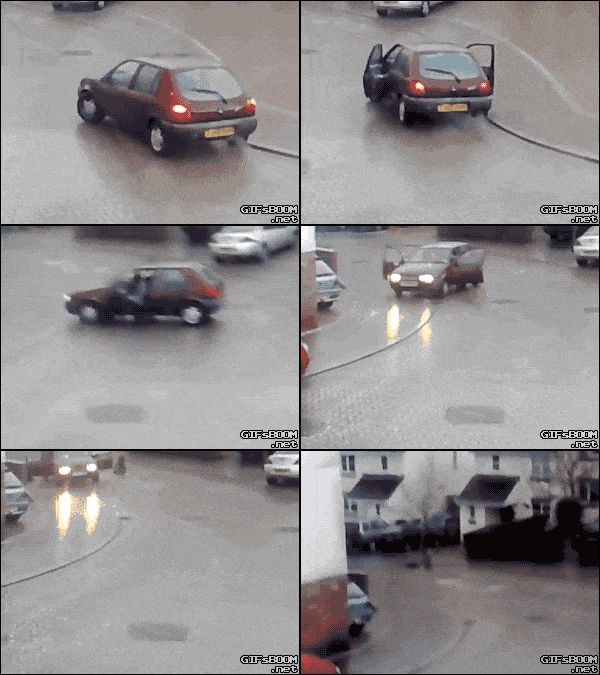
giphy%2B%252816%2529.gif
 

Similar threads

  • · Replies 16 ·
Replies
16
Views
2K
  • · Replies 15 ·
Replies
15
Views
4K
  • · Replies 8 ·
Replies
8
Views
3K
  • · Replies 20 ·
Replies
20
Views
2K
  • · Replies 18 ·
Replies
18
Views
2K
  • · Replies 6 ·
Replies
6
Views
2K
  • · Replies 4 ·
Replies
4
Views
588
  • · Replies 14 ·
Replies
14
Views
2K
Replies
2
Views
1K
  • · Replies 24 ·
Replies
24
Views
4K