Why does Larmor precession appear to go against the right hand rule?

Click For Summary
SUMMARY

The discussion centers on the confusion surrounding Larmor precession and its relationship to the right-hand rule. Participants clarify that the torque for Larmor precession is defined as \(\mathbf{\Gamma} = \mathbf{\mu} \times \mathbf{B}\), leading to counterclockwise precession, contrary to the clockwise expectation based on the right-hand rule. The discrepancy arises from the consideration of charge, as the magnetic moment for electrons is negative, which flips the torque direction. Textual references, such as Haacke et al. (1999), confirm the counterclockwise precession observed in protons, which are the focus in MRI contexts.

PREREQUISITES
  • Understanding of angular momentum and torque in physics
  • Familiarity with the right-hand rule for vector cross products
  • Knowledge of magnetic moments and their relation to charge
  • Basic principles of magnetic resonance imaging (MRI)
NEXT STEPS
  • Study the mathematical derivation of Larmor precession
  • Learn about the role of magnetic moments in particle physics
  • Explore the differences between electron and proton magnetic moments
  • Review the principles of torque in rotational dynamics
USEFUL FOR

Physics students, researchers in magnetic resonance imaging, and anyone interested in the principles of angular momentum and torque in electromagnetic contexts.

kmm
Messages
188
Reaction score
15
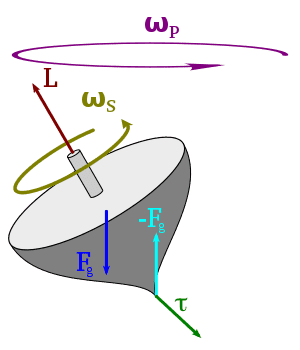
For some reason, I don't understand the direction of larmor precession. Torque is: \mathbf{\Gamma} = \frac{d \mathbf{L}}{d t} = \mathbf{r} \times \mathbf{F} As an example, I understand with a gyroscope, using the right hand rule and with angular momentum in the direction as shown in this picture, it will precess counterclockwise looking down on it.
300px-PrecessionOfATop.svg.png


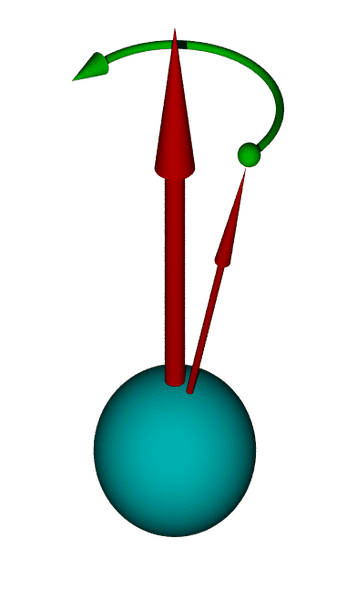
Now, with larmor precession, the torque is: \mathbf{\Gamma} = \frac{d \mathbf{L}}{dt} = \mathbf{\mu} \times \mathbf{B} From the right hand rule, the torque is in the opposite direction as that of the gyroscope so the change in angular momentum should give a precession clockwise. But in the image below, and every other image I've seen, it still goes counter clockwise in the opposite direction of the change in angular momentum. Well, I have found on other sites that the change of angular momentum is in the opposite direction I get from the right hand rule. I'm not sure what I'm doing wrong. Thanks!
Pr%C3%A4zession2.png
 
Physics news on Phys.org
Could it be a matter of charge?
 
Pythagorean said:
Could it be a matter of charge?
Except the charge is taken into account in the direction of the magnetic moment.
 
Interesting. I looked at my MRI textbook (Haacke, et al. 1999. Magnetic Resonance Imaging: Physical Principles and Sequence Design). On p 29 it has a drawing with the correct direction of precession. It looks very similar to the plot you are showing, but precessing CW. I don't know what source you are using or why it gets the sense backwards, but it seems to be a mistake in your source rather than a consistently different convention.
 
DaleSpam said:
It looks very similar to the plot you are showing, but precessing CCW. I don't know what source you are using or why it gets the sense backwards, but it seems to be a mistake in your source rather than a consistently different convention.

My expectation by the right hand rule is that it should precess clockwise. But yes, all the sources I've seen showing larmor precession show counter clockwise precession, agreeing with your textbook. Did you mean yours shows clockwise precession?
 
Yes, I meant CW. I edited it, but not before you caught the mistake.

My textbook shows the correct direction which is opposite the direction of your picture.
 
Pythagorean said:
Could it be a matter of charge?

Actually, I think Pythagorean was right. The sources I was looking at are referring to electrons or negative charges so the magnetic moment vectors I was looking at are actually negative so the magnetic moment \mathbf{\mu} had a negative value, flipping the direction of the torque.
 
That could be. My text is a MRI text, so the spins of interest are protons rather than electrons.
 

Similar threads

  • · Replies 1 ·
Replies
1
Views
1K
  • · Replies 1 ·
Replies
1
Views
1K
  • · Replies 9 ·
Replies
9
Views
924
  • · Replies 39 ·
2
Replies
39
Views
3K
  • · Replies 10 ·
Replies
10
Views
4K
  • · Replies 7 ·
Replies
7
Views
2K
  • · Replies 3 ·
Replies
3
Views
453
  • · Replies 2 ·
Replies
2
Views
1K
  • · Replies 5 ·
Replies
5
Views
2K
  • · Replies 23 ·
Replies
23
Views
3K