Why does less dense air rise and more dense air come down?

Click For Summary

Homework Help Overview

The discussion revolves around the behavior of air density and buoyancy, specifically why less dense air rises while more dense air descends. Participants explore the principles of pressure and temperature in relation to air movement in a closed environment.

Discussion Character

  • Exploratory, Conceptual clarification, Assumption checking

Approaches and Questions Raised

  • Participants examine the relationship between air density, pressure, and buoyancy, questioning how pressure differences lead to upward and downward forces on air cubes. Various explanations are proposed, including references to Archimedes' Principle and the effects of temperature on pressure.

Discussion Status

The discussion is active with multiple interpretations being explored. Some participants provide guidance on pressure dynamics, while others express confusion about the application of Newton's laws and the stability of the equilibrium state in stratified fluids.

Contextual Notes

There are mentions of specific conditions such as the presence of heat sources or sinks affecting air movement, and discussions about the implications of temperature gradients on pressure and density in the atmosphere.

vcsharp2003
Messages
913
Reaction score
179
Homework Statement
I am trying to explain a common phenomenon in nature. The phenomenon is that warm air in room rises in a room and colder air at the top of the room settles down closer to the floor of the room.
Relevant Equations
##\rho = \frac {m} {v}##, where ##\rho## is density of material and ##m## , ##v## are mass and volume of a certain amount of the material
My answer given below seems incomplete.

Since warm air causes the air to expand in volume, so its density becomes less as compared to the colder air at the top of the room. After this, I generally find all books saying the less dense air rises and more dense air from top comes down and therefore this phenomenon occurs in nature.

But, how would I explain why less dense air rises and more dense air falls. I have tried to explain it using the diagram below which shows two cubes of air at the top and bottom of the room. The arrows for each cube indicate the pressure acting on the cube from all directions. Wouldn't the force due to pressure on each face of the cube be balanced by the force due to pressure on the opposite face of the cube? If yes, then I cannot explain why the cube of air at the bottom would rise since it needs to have a net upward force acting on it in order for it to rise. If the upward pressure is greater than the downward pressure on the bottom cube, then I could say that the less dense cube of air will rise since it would end up having a net upward force.

Or perhaps, there is another explanation for this.

CamScanner 12-13-2022 13.07.jpg
 
Last edited:
Physics news on Phys.org
vcsharp2003 said:
Wouldn't the force due to pressure on each face of the cube be balanced by the force due to pressure on the opposite face of the cube?
For the sides, yes. For the top and bottom, no. Remember that the fluid (air or liquid) near the bottom of the box is holding up more stuff against gravity than the fluid near the top of the box. This means there is a greater pressure on that part of the fluid, which is exerted against the bottom of the box, lifting it up.

In other words, the pressure at the bottom of the box is greater than at the top, leading to a net upward force against the box.
 
  • Like
Likes   Reactions: vcsharp2003
Drakkith said:
the pressure at the bottom of the box is greater than at the top, leading to a net upward force against the box.
Quite so, and that underpins Archimedes' Principle.
 
  • Like
Likes   Reactions: vcsharp2003
Drakkith said:
Remember that the fluid (air or liquid) near the bottom of the box is holding up more stuff against gravity than the fluid near the top of the box. This means there is a greater pressure on that part of the fluid, which is exerted against the bottom of the box, lifting it up.
Can we say the following?

The pressure on the top face of bottom cube is greater than pressure at the bottom face of the same cube because the temperature decreases as we go up and for a gas ##P \propto T## (at constant volume), so we can say that top face has a lower temperature and therefore lower pressure.
 
haruspex said:
Quite so, and that underpins Archimedes' Principle.
So, can we apply Archimedes' Principle to each of air cubes in the diagram in OP? Normally, we apply this principle only when a solid is partially or fully submerged in a fluid.
 
Last edited:
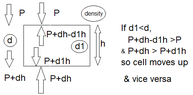
Not sure I understand what is being said, so I drew a diagram (as always for me!)
airRising.png

Now, I'm as troubled as you (or whoever) that when there is no solid box, there can't be two different pressures in the same place. So I guess that as soon as there is the smallest difference in density, something starts moving and we can add terms like F=ma to bring the pressures at the interface back in line.
If the packet of air ascends at a steady speed, I'm still struggling with that one.
 

Attachments

  • airRising.png
    airRising.png
    4.2 KB · Views: 138
Does having cold fluid on top and warm fluid below violate any of Newton's 3 laws of motion for static equilibrium? Is this condition of static equilibrium stable?
 
Chestermiller said:
Does having cold fluid on top and warm fluid below violate any of Newton's 3 laws of motion for static equilibrium? Is this condition of static equilibrium stable?
Warm air at bottom would expand and this would mean that the force of normal reaction on bottom cube from the cube just above it would have decreased so the cube at bottom would expand upwards till its pressure on top fave equals the pressure on its top face from cube just above it.
 
vcsharp2003 said:
... Wouldn't the force due to pressure on each face of the cube be balanced by the force due to pressure on the opposite face of the cube? If yes, then I cannot explain why the cube of air at the bottom would rise since it needs to have a net upward force acting on it in order for it to rise. If the upward pressure is greater than the downward pressure on the bottom cube, then I could say that the less dense cube of air will rise since it would end up having a net upward force.

Or perhaps, there is another explanation for this.
For that to happen in a closed room or system, there must be a heat source or heat sink that keeps a flow of energy.
The result will be a draft circulation in the room, within which air is heated or cooled at an area or point, being displaced or forced to move by air that has not been yet heated or cooled.

If that source or sink equals its temperature with the air’s, a stratification process begins, when circulation or draft stops (there is no more energy for that), and an equilibrium of temperatures and densities slowly happens, in which top layers of warmer air transfer thermal energy to the lower layers of cooler air.
 
  • #10
vcsharp2003 said:
Warm air at bottom would expand and this would mean that the force of normal reaction on bottom cube from the cube just above it would have decreased so the cube at bottom would expand upwards till its pressure on top fave equals the pressure on its top face from cube just above it.
This is incorrect. If it is warmer, it had already expanded.
 
  • #11
Chestermiller said:
This is incorrect. If it is warmer, it had already expanded.
Sorry, I don't get how a Newton's Law could be applied in this scenario, except in the way I explained in my OP.
 
  • #12
vcsharp2003 said:
Sorry, I don't get how a Newton's Law could be applied in this scenario, except in the way I explained in my OP.
I said it doesn't violate any of Newton's laws of motion for equilibrium to be established. What I'm saying is that a fluid stratified from warm below to cold on top is an allowable equilibrium state, although it is unstable, and will result in an inversion flow with the slightest perturbation.
 
Last edited:
  • #13
vcsharp2003 said:
Can we say the following?

The pressure on the top face of bottom cube is greater than pressure at the bottom face of the same cube because the temperature decreases as we go up and for a gas ##P \propto T## (at constant volume), so we can say that top face has a lower temperature and therefore lower pressure.
The pressure difference is not primarily caused by temperature. Note that there are parts of the atmosphere where temperature rises with altitude instead of falling, and yet buoyancy works just fine there. There are also temperature inversions in the oceans, and yet submarines work just fine there too. Also, water isn't very compressible, so its change in density vs temperature is extremely small.
 
  • Like
Likes   Reactions: vcsharp2003
  • #14
vcsharp2003 said:
Normally, we apply this principle only when a solid is partially or fully submerged in a fluid.
You are treating the parcel of air as a body, and the surrounding air is a fluid.
 
  • Like
Likes   Reactions: vcsharp2003
  • #15
Lnewqban said:
For that to happen in a closed room or system, there must be a heat source or heat sink that keeps a flow of energy.
I donot see the connection between this and the question being asked.
 
  • #16
Merlin3189 said:
Not sure I understand what is being said, so I drew a diagram (as always for me!)
View attachment 318718
Now, I'm as troubled as you (or whoever) that when there is no solid box, there can't be two different pressures in the same place. So I guess that as soon as there is the smallest difference in density, something starts moving and we can add terms like F=ma to bring the pressures at the interface back in line.
If the packet of air ascends at a steady speed, I'm still struggling with that one.
I do not understand your diagram. The pressures inside the box differ by 2d1h-dh. Shouldn’t that be just d1h?
 
  • Like
Likes   Reactions: Merlin3189 and vcsharp2003
  • #17
vcsharp2003 said:
because the temperature decreases as we go up
Whoa! That’s a whole other topic (see "6. the lapse rate" at https://www.physicsforums.com/insights/frequently-made-errors-climate-science-greenhouse-effect/) and plays no part in the question you asked in post #1.

The pressure difference with altitude is to do with the weight of air, in exactly the same way that pressure increases with depth in water.

I admit there is a conundrum in your post #1 scenario, though. If we put a flimsy box around the parcel of warm air, we are saying it rises because the density is less inside the box. But in that case the internal pressure difference between top and bottom should be less than the external pressure difference between top and bottom; on the other hand, the internal pressure should be the same as the external pressure everywhere on the box boundary, or the box would deform accordingly.
To resolve this we need to consider the dynamics. If we warm a parcel of air the first thing that happens is its pressure increases. As soon as that starts to happen, its excess pressure over the surroundings causes it to expand. Now Archimedes' Principle kicks in and causes it to rise bodily. So the mistake was treating it as though internal and external pressures have to balance everywhere exactly all the time.
 
Last edited:
  • Like
Likes   Reactions: vcsharp2003 and member 731016
  • #18
haruspex said:
I donot see the connection between this and the question being asked.
What is the question being asked?

My answer reflects what I understood (incorrectly perhaps) after reading the “Homework statement”:

“I am trying to explain a common phenomenon in nature. The phenomenon is that warm air in room rises in a room and colder air at the top of the room settles down closer to the floor of the room.”

Maybe @vcsharp2003 could clarify how the warm air was originally (and unnaturally) at the bottom of the room and the colder air at the top.
 
  • #19
Lnewqban said:
My answer reflects what I understood (incorrectly perhaps) after reading the “Homework statement”:
Sadly, that is quite common on this forum. The question @vcsharp2003 is asking us is more specific and is further down in post #1.
 

Similar threads

  • · Replies 11 ·
Replies
11
Views
3K
  • · Replies 11 ·
Replies
11
Views
2K
  • · Replies 11 ·
Replies
11
Views
3K
Replies
17
Views
3K
  • · Replies 21 ·
Replies
21
Views
3K
  • · Replies 5 ·
Replies
5
Views
1K
  • · Replies 18 ·
Replies
18
Views
7K
  • · Replies 4 ·
Replies
4
Views
2K
Replies
7
Views
2K
Replies
3
Views
2K