Why does Planck's BB emissive power increase with n?

Click For Summary

Discussion Overview

The discussion revolves around the dependence of Planck's law for black-body radiation intensity on the index of refraction (n) of the medium through which the radiation travels. Participants explore the implications of this relationship, particularly why a black body in a medium with n>1 emits higher power per area compared to one in a vacuum (n=1). The conversation includes both theoretical and conceptual considerations.

Discussion Character

  • Exploratory
  • Conceptual clarification
  • Debate/contested

Main Points Raised

  • One participant questions the counterintuitive nature of increased emissive power in a medium with higher n, suggesting that while photons may be closer together spatially, their slower speed could imply longer travel times to the irradiated object.
  • Another participant proposes that in a mixed medium of vacuum and a medium with n>1, light from the vacuum can enter the medium, which may lead to some light being reflected back, effectively increasing the solid angle for emission.
  • A different viewpoint emphasizes that reflection should not influence Planck's law, which focuses on the power intensity radiating from a black body, and suggests that any secondary effects should not alter the fundamental understanding of the law.
  • One participant suggests that the increase in emissive radiation could be due to radiation emitted from the black body being reflected at the medium interface, which could lead to increased absorption and temperature, thus enhancing further radiation emission.
  • Another participant argues that the scenario described does not align with the thermal equilibrium case initially considered, indicating that the power does not necessarily increase in that specific context.
  • A participant introduces an analogy involving antennas in a medium with lower light speed, suggesting that black bodies may radiate better at low frequencies due to their microscopic antenna-like structure.
  • One participant speculates that the critical angle for total internal reflections might play a role in the integrated results of emissive power, although they express a desire for more details on the geometric conditions of the formulas discussed.
  • Another participant describes a scenario involving a closed box with graphite walls and a high refractive index material, suggesting that the material could affect the propagation of radiation and lead to an increase in detected photons.

Areas of Agreement / Disagreement

Participants express various viewpoints and hypotheses regarding the relationship between the index of refraction and emissive power, with no consensus reached on the underlying reasons or mechanisms. Multiple competing explanations are presented, indicating an unresolved discussion.

Contextual Notes

Some participants note the importance of geometric conditions and thermal equilibrium in understanding the implications of Planck's law in different media, suggesting that these factors may not have been fully addressed in the discussion.

kayan
Messages
36
Reaction score
0
This question is regarding the dependence of Planck's law for black-body (BB) radiation intensity (or integrating over a hemisphere, the emissive power, E = pi * I).
Physically speaking, why is it that a BB emitting in a medium with n>1 (n being index of refraction) emits a higher power/area than the same BB (same T, same everything) in a vacuum (n=1)?

Obviously, I can just plug greater values of n into Planck's law to see this mathematically, and I have done that in the plot attached below for n values 1 (red, bottom), 1.25 (blue, mid), 1.50 (green, top). However, how can I make sense of this trend? It seems counter intuitive that if radiation has to travel through a medium with a higher n (slower speed), then the power increases? I've tried over and over to rationalize this trend using both photon and wave behavior, but cannot come to a rationale that makes sense. For example, in the photon perspective, higher n means each photon travels slower in the medium, which means that the spatial photon intensity increases, however, since the photons are traveling slower, this also means that whatever object they are irradiating, they would take longer to reach that object (even though they are closer together spacially), hence, there wouldn't be a change.
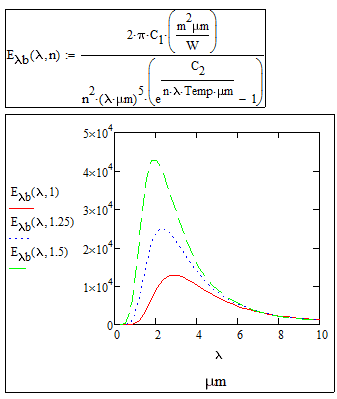
upload_2016-10-10_10-57-50.png
 
Physics news on Phys.org
You can get an intuition from an equilibrium in a volume partially filled with a medium with n>1 and vacuum, for example. All light from the vacuum will enter the medium (and get a bit collimated), but in the medium some light will get reflected back at the surface and only light under some angle can go to the vacuum. The medium has conditions that act like a larger than 4 pi solid angle.
 
Not sure if that makes sense to me. First of all, can you describe the geometry a little better (spherical, a wall, etc)? Second of all, you mentioned "reflection", however, Planck's law doesn't say anything about reflection. It is only describing the power intensity radiating from a BB. If there is reflection or other modes of transmission going on, those are independent and secondary effects, and effects that should not have any bearing on how the value of n affects Planck's law.
 
kayan said:
First of all, can you describe the geometry a little better (spherical, a wall, etc)?
It does not matter, as long as there is a surface between the materials of different refractive index.
kayan said:
however, Planck's law doesn't say anything about reflection.
Planck's law says something about an equilibrium condition. It is possible to analyze the same thermal equilibrium conditions elsewhere.
 
Let's talk about specifics. Say there is a BB sphere in a vacuum, and then there is a medium with n>1 after light passes through the vacuum. So you're saying that the reason the emissive radiation increases is because the radiation emits from the BB, travels through the vacuum, then some of it gets reflected at the medium interface, goes back to the BB, and gets absorbed more which increases its temperature and hence the radiation it then emits?
 
kayan said:
Let's talk about specifics. Say there is a BB sphere in a vacuum, and then there is a medium with n>1 after light passes through the vacuum.
In this case the power does not increase, but this is neither the thermal equilibrium case I was considering nor the direct emission into a medium as in your initial question.
 
Does anybody else have an explanation? Still haven't heard an answer that makes sense to me.
 
An antenna might be too short to radiate long waves efficiently. But if we immerse that antenna in a liquid where speed of light is low, the antenna works better, at low frequencies. Then we might say: "radiation resistance increased".

A black body consists of antennas that are mostly microscopic, that's why its radiation power at low frequencies is low.

Why do cold black bodies radiate best at low frequencies?
 
kayan said:
Does anybody else have an explanation? Still haven't heard an answer that makes sense to me.
I have one possibility that could explain the formulas that you have. I would normally like to see the geometric conditions upon which these formulas were derived to try to validate/verify them, but taking them as likely to be accurate, perhaps one explanation for a higher emission rate is the critical angle that exists for total internal reflections that may affect the total integrated result. The specifics for which your formulas might apply have not been detailed, but I'm just giving one possibility that might account for some differences.
 
  • #10
If we consider a closed box of graphite walls at a constant temperature with a small hole on one side and some material with high refractive index covering the hole, we can see that the quantum-waves, or waves of probability of detecting a radiation photon, propagate slowly in the material, which causes the wave-crests near the hole to turn towards the hole.

And that causes some 'extra' photons to be detected in the material, and some photons 'missing' in the box.

In other words the material with high refractive index sucks radiation from the box.
 

Similar threads

  • · Replies 7 ·
Replies
7
Views
2K
  • · Replies 2 ·
Replies
2
Views
9K
  • · Replies 29 ·
Replies
29
Views
5K
Replies
5
Views
1K
  • · Replies 23 ·
Replies
23
Views
3K
  • · Replies 47 ·
2
Replies
47
Views
4K
  • · Replies 4 ·
Replies
4
Views
2K
  • · Replies 14 ·
Replies
14
Views
2K
Replies
3
Views
2K
  • · Replies 21 ·
Replies
21
Views
2K