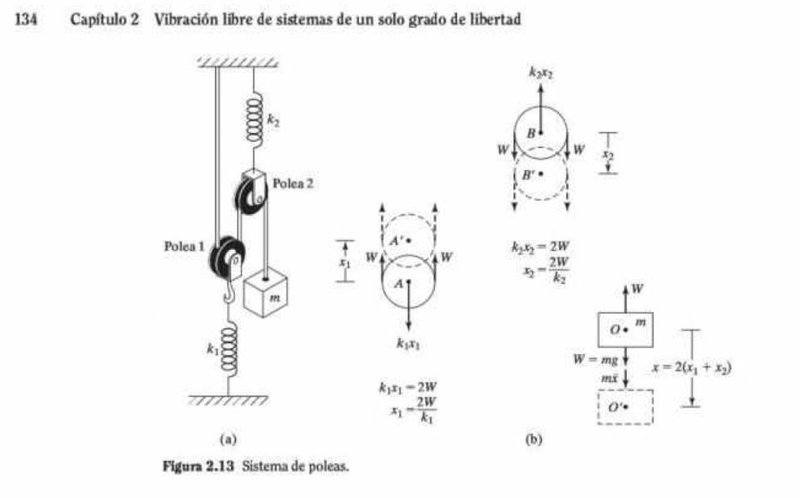
Why Does Pulley and Spring Setup Result in 2(x1+x2) Displacement?

Click For Summary
SUMMARY

The displacement of the mass in a pulley and spring setup is calculated as 2(x1 + x2), where x1 is the upward movement of pulley 1 and x2 is the downward movement of pulley 2. The key to understanding this lies in the constant length of the rope and the relationship between the movements of the pulleys and the mass. When pulley 1 moves up by x1, it decreases the length of the rope on the left, while pulley 2 moving down by x2 affects the middle section of the rope. The total displacement of the mass is thus a result of both pulleys' movements, leading to the conclusion that the mass moves down by double the total displacement of the pulleys.

PREREQUISITES
  • Understanding of basic pulley mechanics
  • Knowledge of kinematics in physics
  • Familiarity with the concept of rope length conservation
  • Ability to analyze forces in mechanical systems
NEXT STEPS
  • Study the principles of mechanical advantage in pulley systems
  • Learn about the conservation of energy in mechanical systems
  • Explore advanced kinematics involving multiple pulleys
  • Investigate real-world applications of pulley systems in engineering
USEFUL FOR

Students of physics, mechanical engineers, and anyone interested in understanding the dynamics of pulley systems and their applications in real-world scenarios.

Guidestone
Messages
93
Reaction score
5
Homework posted in wrong forum, so no template
Hey guys, I'm wondering why the displacement of the mass mounted in this setup is 2(x1+x2)?. I'm assuming that when the pulley rotates(when the mass is pulled downwards) the distance between the initial point and the end point of its center and the distance traveled by the mass are equal, meaning that both the mass and the pulley moved the same distance. However, I don't know what other phenomenon is adding displacement to the mass To make it double. I would be really grateful if you clarify on this matter.
IMG_1126.JPG
 
Physics news on Phys.org
In pulley problems, before doing any force balances, the first step must be to consider the kinematics of the motion. In particular, you need to determine the displacements, under the constraint that the total length of rope is constant. If pulley 1 moves up x1 and pulley 2 moves down x2, what is the change in length of the section of rope between pulley 2 and mass m? How much does m2 move downward?
 
My guess is that the change in length is x1+x2 and to me that's the same distance that m2 has moved downwards.
 
Thank you for your answer Mr.Chestermiller
 
I'm still stuck in this, I do understand that the rope's length remains constant but I'm still not getting why the distance traveled by m2 is the double do the distance traveled by the pulleys. I'm begging to think that both the rotation and translation of each pulley adds the same amount of displacement to m2 which would explain why the displacement is doubled but I may be getting more confused.
 
Guidestone said:
My guess is that the change in length is x1+x2 and to me that's the same distance that m2 has moved downwards.
That's not correct. If pulley 1 moves up x1, then the part of the rope on the left decreases in length by x1. If pulley 1 moves up x1 and pulley 2 moves down x2, then the part of the rope in the middle decreases in length by (x1+x2). So, in order for the total length of rope to remain unchanged, the part of the rope on the right must increase in length by 2x2+x1. This is how much the mass moves down relative to pulley 2. But pulley 2 has moved down by x2. So the total amount that the mass m moves down is x2+2x1+x2=2(x1+2x2)
 
Ok, so pulley 1 goes up and makes the left side of the rope decrease X1 units but it also makes the middle part of the rope decrease x1 units and pulley 2 makes the middle part of the rope decrease in x2 units but it still adds x2 units to the position of the mass? Why is that?
 
Guidestone said:
Ok, so pulley 1 goes up and makes the left side of the rope decrease X1 units but it also makes the middle part of the rope decrease x1 units and pulley 2 makes the middle part of the rope decrease in x2 units but it still adds x2 units to the position of the mass? Why is that?
Imagine pulley 2 moving down by some distance x2, but the other pulley and the mass remaining fixed. How much slack is introduced on each side of the pulley? How far down will the mass have to move to take up all that slack?
 
Guidestone said:
Ok, so pulley 1 goes up and makes the left side of the rope decrease X1 units but it also makes the middle part of the rope decrease x1 units and pulley 2 makes the middle part of the rope decrease in x2 units but it still adds x2 units to the position of the mass? Why is that?
Read the last two lines of my post #6.
 

Similar threads

Replies
6
Views
982
  • · Replies 40 ·
2
Replies
40
Views
5K
Replies
13
Views
4K
  • · Replies 13 ·
Replies
13
Views
3K
  • · Replies 16 ·
Replies
16
Views
2K
  • · Replies 4 ·
Replies
4
Views
4K
Replies
8
Views
14K
  • · Replies 15 ·
Replies
15
Views
3K
  • · Replies 19 ·
Replies
19
Views
12K
  • · Replies 13 ·
Replies
13
Views
7K