Why does scattered light appear polarized only at 90 degrees to the sun?

Join the discussion
Registration is free. Start your own thread to ask a follow-up.
7 replies · 3K views
annamal
Messages
393
Reaction score
33
My book says:
Screen Shot 2022-06-01 at 3.40.15 PM.png


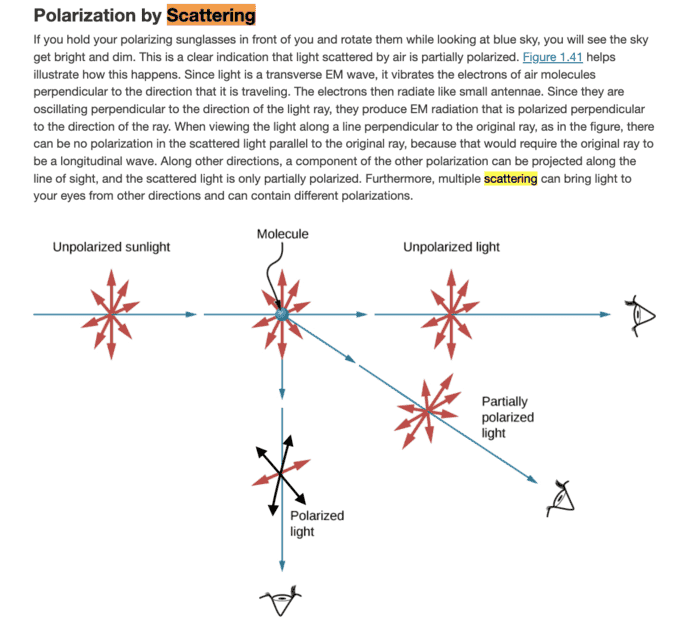
I don't understand why the bottom eye only sees the horizontal red arrow and not the other angles (black arrows)
 
  • Like
Likes   Reactions: Delta2
Physics news on Phys.org
The diagram is very confusing. Let's call the direction of propagation z, x is the plane of the paper and y is normal to the paper.
A component of the unpolarised source lying in the y direction will cause an electron in the scatterer to vibrate also in the y direction. It will then radiate all round in the x plane, and you will see it from the bottom location.

However, if the unpolarised source radiates a wave polarised in the x direction, it will cause an electron in the scatterer to vibrate in the x direction also. The electron is then end-on to the bottom observer and does not radiate in that direction.
So the bottom observer sees only those waves from the source having components in the y direction, and which are therefore polarised.
 
  • Informative
Likes   Reactions: Delta2
Tested experimentally now with polarization filter on a blue sky. Effect is real - visible as fuzzy blackening in the arc roughly perpendicular to the direction to Sun.
 
  • Like
Likes   Reactions: Delta2 and berkeman
Remember the plane of polarisation aligns with the circumference of the arc, so rotates as you go around this halo.
 
tech99 said:
The diagram is very confusing. Let's call the direction of propagation z, x is the plane of the paper and y is normal to the paper.
A component of the unpolarised source lying in the y direction will cause an electron in the scatterer to vibrate also in the y direction. It will then radiate all round in the x plane, and you will see it from the bottom location.
What is the scatterer?
tech99 said:
However, if the unpolarised source radiates a wave polarised in the x direction, it will cause an electron in the scatterer to vibrate in the x direction also. The electron is then end-on to the bottom observer and does not radiate in that direction.
How do you radiate a wave polarized in the x direction?
tech99 said:
So the bottom observer sees only those waves from the source having components in the y direction, and which are therefore polarised.
 
In reply to post #5, the scatterers in the atmosphere are particles of dust and gas molecules.
Waves polarised in the x direction will be present in "unpolarised" sunlight - it is when the electrons vibrate in the plane of the paper.
 
tech99 said:
The diagram is very confusing. Let's call the direction of propagation z, x is the plane of the paper and y is normal to the paper.
A component of the unpolarised source lying in the y direction will cause an electron in the scatterer to vibrate also in the y direction. It will then radiate all round in the x plane, and you will see it from the bottom location.
What do you mean by "It will then radiate all round in the x plane"
 
If electrons in the scatterer vibrate normal to the paper, they will radiate in all directions in the plane of the paper. It is similar to the radiation from a vertical antenna.