Why does the magnetic flux change if the loop area stays the same?

Join the discussion
Registration is free. Start your own thread to ask a follow-up.
12 replies · 2K views
ZARATHUSTRA
Messages
42
Reaction score
0
Member warned about lack of template
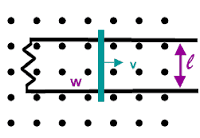
consider the graph below, the bar of length ζ moving to the right with speed v in a uniform magnetic field B going out the page.
2ed001a8-0915-4e5d-a0c0-cbb8fc0d8ca8.gif


i don't understand why does the textbook say that there is a change in the magnetic fluxΦ? i think the area doesn't change, although it's moving. the original saying is that: During a time interval dt, the area of the loop increases by a differential rectangular strip of area dA=ldt this change in area causes a differential change in flux given by dΦ=B⋅dA ....
 
Physics news on Phys.org
ZARATHUSTRA said:
i think the area doesn't change, although it's moving.
Only the blue bar is moving. The resistor is at rest. A is the area between the resistor and the bar.
 
Last edited:
TSny said:
Only the blue bar is moving. The resistor is at rest. A is the area between the resistor and the bar.
right, so... what does that mean?
 
is it true that the moving object in motional emf has to be a conductor?
 
and the emf created is from the separation of charges, therefore creating a potiential difference?
 
i feel sorry to ask those stupid questions. i don't have a teacher currently teaching me AP Physics.
 
ZARATHUSTRA said:
right, so... what does that mean?
As shown in the figure below, as the rod travels to the right the shaded area A increases. So, the amount of magnetic flux through the circuit also increases.
 

Attachments

  • Induction.png
    Induction.png
    5 KB · Views: 444
interesting! let me think hard about it, and thank you for your help:smile:
TSny said:
As shown in the figure below, as the rod travels to the right the shaded area A increases. So, the amount of magnetic flux through the circuit also increases.
 
You can also look at his from a different perspective. Starting with the Lorentz force F = qv x B you can determine that the emf across the moving bar is Blv. This view is "flux cutting" of a B field (uniform or not) by a bar of length l moving with veloc ity v.

In some cases, using Faraday's law, as you did with emf = -dφ/dt, in moving media does not work. So the "Blv" law is preferred whenever media (like your bar) is moving.
ZARATHUSTRA said:
is it true that the moving object in motional emf has to be a conductor?
Yes, but not a perfect conductor. In fact, anything other than a perfect insulator.
 
Last edited:
rude man said:
You can also look at his from a different perspective. Starting with the Lorentz force F = qv x B you can determine that the emf across the moving bar is Blv. This view is "flux cutting" of a B field (uniform or not) by a bar of length l moving with veloc ity v.

In some cases, using Faraday's law, as you did with emf = -dφ/dt, in moving media does not work. So the "Blv" law is preferred whenever media (like your bar) is moving.

Yes, but not a perfect conductor. In fact, anything other than a perfect insulator.
right, i found out that there are many ways to analyse motional emf, for example, relativity, parallel capacitor, potential difference or magnetic flux, etc
 
but the results is the same,this Blv expression occurred in a lot of the results, am i right?
 
ZARATHUSTRA said:
and the emf created is from the separation of charges, therefore creating a potential difference?
Right.
ZARATHUSTRA said:
but the results is the same,this Blv expression occurred in a lot of the results, am i right?
Truth to tell, I'm not sure what to make of your comment. Bit of a jumble, seems like.
I restricted my comment to the generation and determination of emf by magnetic means.
 
thanks for the reply, i found it hard to understand the magnetic field and therefore don't like to use magnetic means, too.