Undergrad Why Does the Partial Derivative of a Sum Cancel Out?

Click For Summary
The discussion centers on understanding why the partial derivative of a sum cancels out when differentiating with respect to a specific variable, x_i. The key point is that when differentiating the sum of squares of independent variables, only the term corresponding to x_i contributes to the derivative, while all other terms yield zero. This results in the derivative being equal to 2x_i, as the differentiation applies only to the specific term in the sum. Participants emphasize the importance of distinguishing between the summation index and the variable of differentiation. Overall, the clarification helps solidify the understanding of how partial derivatives work in the context of summation.
Ryan187
Messages
5
Reaction score
1
Why the summation of the following function will be canceled out when we take the partial derivative with respect to the x_i?
Notice that x_i is the sub of (i), which is the same lower limit of the summation! Can someone, please explain in details?
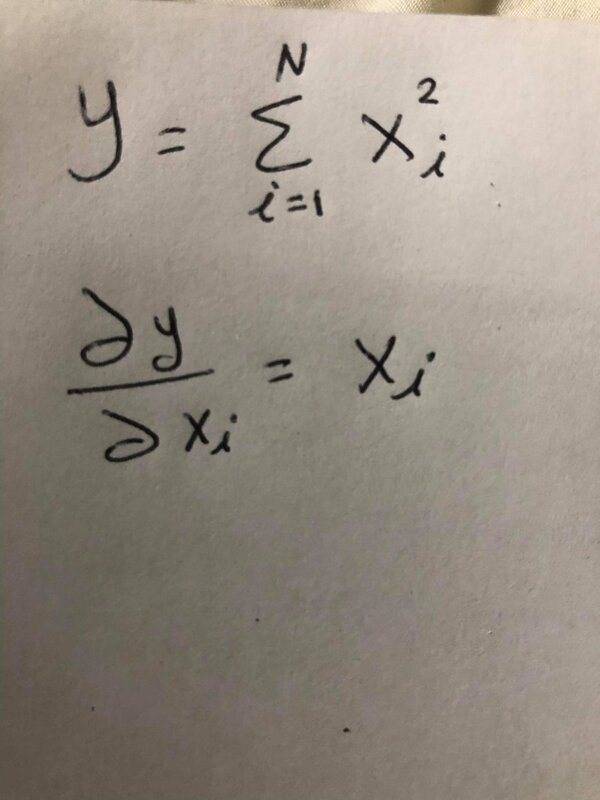
118541109_630427871231244_6999212244547890627_n.jpg
 
Physics news on Phys.org
The ##x_i## are, I assume, independent variables. If ##i \ne j## then ##\frac{\partial x_j}{\partial x_i} = 0##.

Note that the answer should be ##2x_i##.
 
Thank you PeroK! Even if x_i is an independent variable. why the summation is canceled out? can you explain the derivative in detail, please? and you're right the answer is 2x_i not x_i
 
Ryan187 said:
Thank you PeroK! Even if x_i is an independent variable. why the summation is canceled out? can you explain the derivative in detail, please? and you're right the answer is 2x_i not x_i
The summation is not needed because most terms in the sum are zero.
 
  • Like
Likes Ryan187 and etotheipi
PS it might help is you use a different dummy variable for the definition of ##y##. Use ##j = 1## to ##n## instead of ##i##, for example.
 
@Ryan187 if you replace the free index ##i## with a concrete number, can you for instance evaluate$$\frac{\partial}{\partial x_3} \sum_{k=1}^5 ({x_k}^2)= \frac{\partial}{\partial x_3} ({x_1}^2 + {x_2}^2 + {x_3}^2 + {x_4}^2 + {x_5}^2)$$assuming the ##x_i## are independent variables?
 
  • Like
Likes Ryan187 and Mark44
Ryan187 said:
explain
Differentiation is a linear function: ##\dfrac{\partial}{\partial x_j}(\alpha \cdot f(x)+\beta\cdot g(x))=\alpha\cdot \dfrac{\partial}{\partial x_j}f(x)+\beta\cdot \dfrac{\partial}{\partial x_j} g(x)##.

Here we only have a longer sum: ##x_1^2+x_2^2+\ldots+x_N^2##
 
  • Like
Likes Ryan187 and etotheipi
etotheipi said:
@Ryan187 if you replace the free index ##i## with a concrete number, can you for instance evaluate$$\frac{\partial}{\partial x_3} \sum_{k=1}^5 ({x_k}^2)= \frac{\partial}{\partial x_3} ({x_1}^2 + {x_2}^2 + {x_3}^2 + {x_4}^2 + {x_5}^2)$$assuming the ##x_i## are independent variables?
This is the key -- expanding the sum, and then differentiating with respect to one of the terms in the sum.
 
  • Like
Likes Ryan187 and etotheipi
So, in this case, I am kind of differentiating over one term that's why the sum will be canceled out?
 
  • #10
Ryan187 said:
So, in this case, I am kind of dif\displaystyle{}ferentiating over one term that's why the sum will be canceled out?
No. You differentiate all terms. ##\displaystyle{\dfrac{\partial}{\partial x_i}\left(\sum_{j=1}^N x_j^2\right) = \sum_{j=1}^N \dfrac{\partial}{\partial x_i} (x_j^2)}##
 
  • Like
Likes Ryan187 and etotheipi
  • #11
I'll use my example again$$\begin{align*}\frac{\partial}{\partial x_3} \sum_{k=1}^5 ({x_k}^2)&= \frac{\partial}{\partial x_3} ({x_1}^2 + {x_2}^2 + {x_3}^2 + {x_4}^2 + {x_5}^2)\\ \\&= \frac{\partial}{\partial x_3}({x_1}^2) + \frac{\partial}{\partial x_3}({x_2}^2) + \frac{\partial}{\partial x_3}({x_3}^2)+ \frac{\partial}{\partial x_3}({x_4}^2)+\frac{\partial}{\partial x_3}({x_5}^2) \\ \\

&= 0 + 0 + \frac{\partial}{\partial x_3}({x_3}^2) + 0 + 0\end{align*}$$I see I've been beaten to it by @fresh_42 :wink:
 
  • Like
Likes Ryan187
  • #12
etotheipi said:
I see I've been beaten to it by @fresh_42 :wink:
I have these shortcuts on the keyboard:

\displaystyle{}
\dfrac{}{}
\left(\right)
\partial

:smile:
 
  • Like
  • Wow
Likes jim mcnamara and etotheipi
  • #13
but in this case, we derive with respect to x3 (i=3) which is one term, but the original derivative is with respect to (x_i) which is the whole i's values?!
 
  • #14
Ryan187 said:
but in this case, we derive with respect to x3 (i=3) which is one term, but the original derivative is with respect to (x_i) which is the whole i's values?!
No. ## i ## is just one specific index, an arbitrary one, but a specific one. That's why we have to distinguish this index from the summation index which runs over all. One of them matches ##j=i## whereas all others do not: ##j\neq i##. The former yields ##2x_i##, the latter yields the zeros.
 
  • Like
Likes Ryan187
  • #15
Got it now! Thanks, guys, you're amazing! It is my first thread to this community!
 
Last edited:
  • Like
Likes etotheipi

Similar threads

  • · Replies 1 ·
Replies
1
Views
3K
  • · Replies 2 ·
Replies
2
Views
3K
  • · Replies 3 ·
Replies
3
Views
3K
  • · Replies 4 ·
Replies
4
Views
3K
  • · Replies 9 ·
Replies
9
Views
2K
  • · Replies 16 ·
Replies
16
Views
3K
  • · Replies 1 ·
Replies
1
Views
2K
  • · Replies 12 ·
Replies
12
Views
3K
  • · Replies 1 ·
Replies
1
Views
1K
Replies
11
Views
2K