Why does the point experience NEGATIVE field strength?

Click For Summary
The discussion centers on understanding why a point experiences negative electric field strength when approaching a positive charge. The key point is that the resultant electric field strength at a specific point is zero due to the influence of two charges, A and B. The sign of the electric field strength indicates direction, which changes depending on the point's location relative to the charges. As one moves closer to a charge, its influence dominates, but the direction of the field can vary, leading to a negative value. Clarifying these concepts helps in grasping the behavior of electric fields in relation to charge positions.
1832vin
Messages
58
Reaction score
1
Hi, i'm looking for an explanation to this answer of a past paper that I'm doing, it's from OCR (A level) G485, question 1 b ii)

the question on top, and answer on bottom
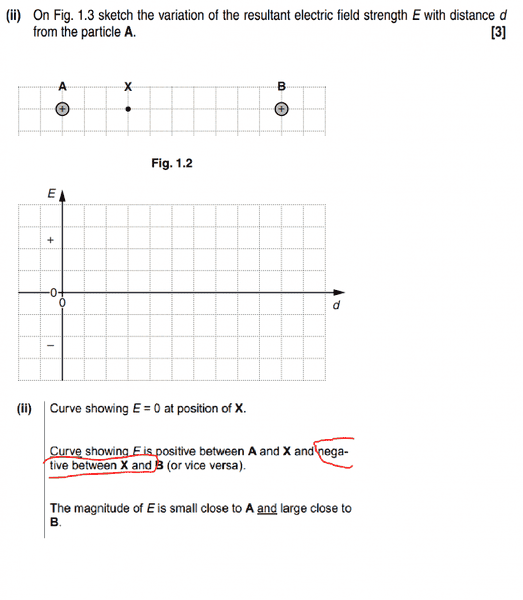
upload_2016-5-28_22-46-32.png


i don't understand why would the point experience a negative electric field strength when it's getting closer to a positive source or vice versa (positive field strength) , this is the first question of the paper, and not much other relevant information is presented... what am i not understanding?

http://www.ocr.org.uk/Images/243747-question-paper-unit-g485-01-fields-particles-and-frontiers-of-physics.pdf

thankyou
 
Last edited by a moderator:
Physics news on Phys.org
At point X , the magnitude of the resultant electric field strength due to the particles A and B is zero
That is an important part of the question.

The sign gives the direction. If you are close to one of the charges, the influence of this charge dominates, but to the left of X you are on the right side of the charge A, to the right of X you are on the left side of charge B. The direction towards the charge is different, and a different direction means a different sign.
 
i didn't notice! thanks

i even drew out the diagrams and i still didn't caught that, thanks
 
The book claims the answer is that all the magnitudes are the same because "the gravitational force on the penguin is the same". I'm having trouble understanding this. I thought the buoyant force was equal to the weight of the fluid displaced. Weight depends on mass which depends on density. Therefore, due to the differing densities the buoyant force will be different in each case? Is this incorrect?

Similar threads

Replies
4
Views
3K
  • · Replies 3 ·
Replies
3
Views
2K
Replies
6
Views
2K
  • · Replies 4 ·
Replies
4
Views
2K
Replies
4
Views
2K
Replies
10
Views
2K
Replies
6
Views
2K
Replies
9
Views
2K
  • · Replies 1 ·
Replies
1
Views
2K
  • · Replies 7 ·
Replies
7
Views
3K