Why Does the PREM Model Predict Increasing Acceleration Towards Earth's Core?

  • Context: Graduate 
  • Thread starter Thread starter mangoplant
  • Start date Start date
  • Tags Tags
    Acceleration Earth
Click For Summary

Discussion Overview

The discussion revolves around the behavior of an object dropped through a hypothetical hole to the center of the Earth, specifically examining the predictions made by the PREM (Preliminary Reference Earth Model) regarding gravitational acceleration. Participants explore the implications of varying density within the Earth and how this affects gravitational forces, contrasting these predictions with those derived from Newton's law of gravitation.

Discussion Character

  • Debate/contested
  • Technical explanation
  • Conceptual clarification

Main Points Raised

  • One participant notes that according to the PREM model, acceleration increases as an object approaches the outer core, which contradicts Newton's law of gravitation that suggests acceleration should decrease due to less mass below the object.
  • Another participant argues that the PREM model incorporates variations in density, implying that the assumption of constant density in Newton's law is a simplification that leads to incorrect predictions.
  • A different participant questions how acceleration could increase as one approaches the core, asserting that the mass contained within a smaller radius must be less than that within a larger radius, regardless of density distribution.
  • One participant proposes that if the outer layers of the Earth are less dense than the inner layers, then acceleration could indeed increase as one nears the core, using a hypothetical scenario of a planet with a significant density gradient to illustrate this point.
  • Another participant reiterates the previous point about the outer layers being less dense and suggests that Newton's shell theorem would indicate minimal effect on net acceleration as the object falls through less dense material.

Areas of Agreement / Disagreement

Participants express differing views on the implications of density variations within the Earth and how they relate to gravitational acceleration. There is no consensus on whether the PREM model's predictions are valid or how they reconcile with Newton's law of gravitation.

Contextual Notes

Participants highlight the importance of density distribution in the Earth when discussing gravitational acceleration, indicating that assumptions about uniform density may lead to misunderstandings of the PREM model's predictions.

mangoplant
Messages
5
Reaction score
0
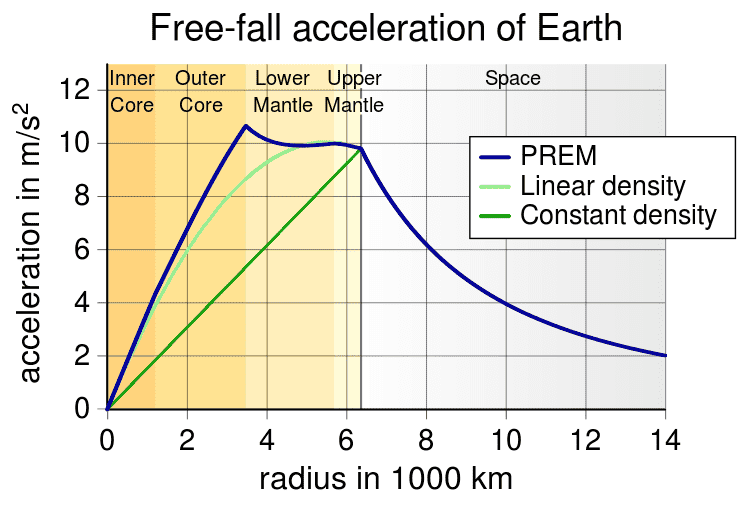
Here is an interesting phenomenon: If one were to drill a hole that went all the way to the center of the Earth and drop an object through the hole, according to a model called PREM (Preliminary Reference Earth Model), the acceleration of the object would initially increase as it approached the outer core of the Earth and then decrease as the gravitational pull from the mass above the object started canceling the gravitational pull from the mass below (see pic below).
8743453a90cde1918630a1c58a8d37b99cc8b826.png

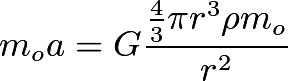
Now Newton's law of gravitation predicts that the acceleration should decrease as an object moves down the hole because there is less mass below the object and more above, pulling in the other direction. Anyone know why this widely accepted PREM model predicts otherwise?Here is Newton's law of gravitation prediction where
b297e5dd04aaa172eb7de68e20328516747e2691.png
is the mass of the object,
b55ca7a0aa88ab7d58f4fc035317fdac39b17861.png
is the distance from the core,
0027034d8a10372a06deaf4f4084c01956587479.png
is the density of the Earth (assuming it is constant),
6e28ce12d49d39f160d5a0ef54077fc98e4b9d2b.png
is the gravitational constant, and
c7d457e388298246adb06c587bccd419ea67f7e8.png
is the acceleration of the object.

e4b716351056e7c410ad32685c80f373cc8dbb6b.png

93f6384db22ec0397be241d8c9f60d0ffbe4a1f1.png

Clearly, Newton's law predicts something very different from the PREM model.

How could acceleration possibly increase according to the PREM model when there is less mass below the object as it is moving toward the core?
 
Physics news on Phys.org
mangoplant said:
Clearly, Newton's law predicts something very different from the PREM model.
Presumably the PREM model also uses Newton's law of gravity. What you are calling "Newton's law" is just the calculation done with the simplifying (but incorrect) assumption of uniform density. See the green line in the diagram.
 
  • Like
Likes   Reactions: mangoplant
mangoplant said:
is the density of the Earth (assuming it is constant)

There's your mistake. It's not constant, and PREM takes that into account.
 
  • Like
Likes   Reactions: mangoplant
Even if density were not constant and varied as a function of r, how could acceleration increase as one got closer to the core? The mass of the sphere contained by a radius ##r_1## must be smaller than the mass of a sphere contained by radius ##r_2## where ##r_2 > r_1## regardless of the density distribution of the Earth right?
 
If the outer layer are less dense than the inner layers then acceleration should increase as one nears the core.

Consider a hypothetical extreme: a planet of 5000 miles radius where its outer 1000 miles are so rarified one could almost call it vacuum. As something falls through this first thousand miles, one could apply Newton's shell theorem, but what do you expect its acceleration will do? It is essentially still falling toward a massive body. Taking into account Newtons shell theorem, it will have little effect on net acceleration.
 
  • Like
Likes   Reactions: olgerm and mangoplant
DaveC426913 said:
If the outer layer are less dense than the inner layers then acceleration should increase as one nears the core.

Consider a hypothetical extreme: a planet of 5000 miles radius where its outer 1000 miles are so rarified one could almost call it vacuum. As something falls through this first thousand miles, one could apply Newton's shell theorem, but what do you expect its acceleration will do? It is essentially still falling toward a massive body. Taking into account Newtons shell theorem, it will have little effect on net acceleration.

I understand now. Thanks!
 

Similar threads

  • · Replies 51 ·
2
Replies
51
Views
5K
  • · Replies 46 ·
2
Replies
46
Views
4K
  • · Replies 3 ·
Replies
3
Views
2K
  • · Replies 22 ·
Replies
22
Views
2K
  • · Replies 5 ·
Replies
5
Views
1K
  • · Replies 9 ·
Replies
9
Views
2K
  • · Replies 5 ·
Replies
5
Views
3K
  • · Replies 12 ·
Replies
12
Views
2K
  • · Replies 0 ·
Replies
0
Views
2K
  • · Replies 4 ·
Replies
4
Views
2K