Why Does the Tension Calculation for Charged Hanging Balls Show Incorrect?

  • Thread starter Thread starter IllTry
  • Start date Start date
Click For Summary

Homework Help Overview

The discussion revolves around the calculation of tension in massless threads supporting charged balls. The original poster describes a scenario involving two insulated balls with a total charge, questioning their tension calculation before the charge is applied.

Discussion Character

  • Mathematical reasoning, Assumption checking

Approaches and Questions Raised

  • The original poster attempts to calculate tension using the formula T = -m*g, expressing confusion over the correctness of their result. Some participants question the sign convention used in the calculations, while others suggest considering additional forces, such as the Coulombic force, that may affect the tension.

Discussion Status

The discussion is ongoing, with participants exploring different interpretations of the tension calculation and the forces involved. There is no explicit consensus, but various perspectives on the problem are being shared.

Contextual Notes

Participants note the mass of the balls as 0.1 g, which may be a source of confusion in the calculations. The original poster's frustration with the course site feedback indicates potential misunderstandings in the problem setup or calculations.

IllTry
Messages
2
Reaction score
0
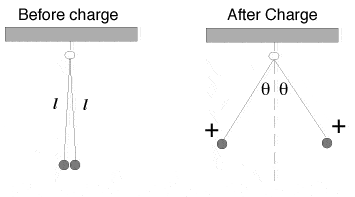
Two insulated balls of mass 0.1 g hang from the same support point by massless insulating threads of length l (as shown in the diagram below.) A total positive charge of 5.70 x 10-07 C is added to the system. Half this charge is taken up by each ball, distributed uniformly, and the balls spread apart to a new equilibrium position.
prob14a.gif

Assuming that the balls hang essentially vertical before the charge is added, what is the tension in each thread before the charge is added?


T=-m*g


I believe that since the strings are mass less and said to be essentially vertical, then the only equation i should need is Tension=-mass*gravity to get the force of tension on each string. so I have T=-(.1 g)(-9.8 m/s2)=.98 g*m/s2=.98 N but when I enter it onto my course site it tells me I am incorrect. Am i being oblivious to something?
 
Physics news on Phys.org
I notice that you multiply 2 negatives in the last line, should not one of these be +ve?
 
What is the total force acting per metre of wall when the applied pressure is as sho

What is the total force acting per metre of wall when the applied pressure is as shown in the diagram? The maximum pressure is 65 kN/m2
 

Attachments

  • 4.JPG
    4.JPG
    17.6 KB · Views: 551
arithmetix said:
I notice that you multiply 2 negatives in the last line, should not one of these be +ve?

In my problem i am orienting the gravity to go in a negative direction, thus force on the ball is F=(.1 g)(-9,8 m/s2)=-.98 N, however, the tension in the rope acting on the ball is in the opposite direction (if i am wrong, please explain), so the Tension will be a positive value.

btw. I tried putting in -.98 N as well on the site and it told me i was incorrect. This is driving me crazy, it seems so simple!
 
Are you including the Coulombic force?
 
IllTry said:
btw. I tried putting in -.98 N as well on the site and it told me i was incorrect. This is driving me crazy, it seems so simple!

The balls are 0.1 g, not 0.1 kg
 

Similar threads

  • · Replies 2 ·
Replies
2
Views
4K
  • · Replies 12 ·
Replies
12
Views
2K
  • · Replies 3 ·
Replies
3
Views
4K
  • · Replies 10 ·
Replies
10
Views
3K
Replies
3
Views
4K
Replies
10
Views
2K
  • · Replies 1 ·
Replies
1
Views
2K
  • · Replies 13 ·
Replies
13
Views
2K
Replies
2
Views
3K
  • · Replies 25 ·
Replies
25
Views
6K