LauwranceGilbert
Why Does This Higher Order Derivative Equation Hold?
- Level: Undergrad
- Thread starter LauwranceGilbert
- Start date
-
- Tags
- Derivatives Higher order Rules
Join the discussion
Registration is free. Start your own thread to ask a follow-up.
2 replies · 3K views

Physics news on Phys.org
Discussion
Mentor
- 15,828
- 10,716
Can you provide some context of where you found this equation and what you were investigating?
It looks like ordinary power rules applied to derivatives ie derivative chain rule.
https://en.wikipedia.org/wiki/Chain_rule
There's a section further into the article talking about generalizations of the rule:
Here's a presentation where they use something like this for trig derivatives:
https://www.cs.drexel.edu/classes/Calculus/MATH121_Fall02/lecture14.pdf
It looks like ordinary power rules applied to derivatives ie derivative chain rule.
https://en.wikipedia.org/wiki/Chain_rule
There's a section further into the article talking about generalizations of the rule:
Higher derivatives[edit]
Faà di Bruno's formula generalizes the chain rule to higher derivatives. Assuming that y = f(u) and u = g(x), then the first few derivatives are:
\begin{aligned}{\frac {dy}{dx}}&={\frac {dy}{du}}{\frac {du}{dx}}\\[4pt]{\frac {d^{2}y}{dx^{2}}}&={\frac {d^{2}y}{du^{2}}}\left({\frac {du}{dx}}\right)^{2}+{\frac {dy}{du}}{\frac {d^{2}u}{dx^{2}}}\\[4pt]{\frac {d^{3}y}{dx^{3}}}&={\frac {d^{3}y}{du^{3}}}\left({\frac {du}{dx}}\right)^{3}+3\,{\frac {d^{2}y}{du^{2}}}{\frac {du}{dx}}{\frac {d^{2}u}{dx^{2}}}+{\frac {dy}{du}}{\frac {d^{3}u}{dx^{3}}}\\[4pt]{\frac {d^{4}y}{dx^{4}}}&={\frac {d^{4}y}{du^{4}}}\left({\frac {du}{dx}}\right)^{4}+6\,{\frac {d^{3}y}{du^{3}}}\left({\frac {du}{dx}}\right)^{2}{\frac {d^{2}u}{dx^{2}}}+{\frac {d^{2}y}{du^{2}}}\left(4\,{\frac {du}{dx}}{\frac {d^{3}u}{dx^{3}}}+3\,\left({\frac {d^{2}u}{dx^{2}}}\right)^{2}\right)+{\frac {dy}{du}}{\frac {d^{4}u}{dx^{4}}}.\end{aligned}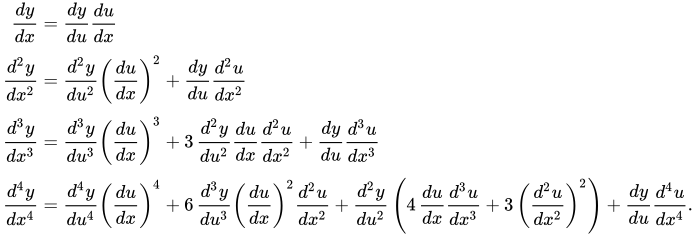
Here's a presentation where they use something like this for trig derivatives:
https://www.cs.drexel.edu/classes/Calculus/MATH121_Fall02/lecture14.pdf
Last edited:
Science Advisor
Homework Helper
Dearly Missed
- 10,704
- 1,723
The first equality is easy: the ##(4M+4)##th derivative of ##F## is just the 4th derivative of the ##(4M)##th derivative. The second equality is false, in general, because there are many counterexamples. The ##(4M+4)##th derivative is usually not a constant (##= (-4)^M## ) times the 4th derivative.LauwranceGilbert said:mod: moved from homework
Does anyone know why and when this equation holds? I have searched online but cannot find the reason or the rules for the higher order derivatives.
View attachment 213801
Similar threads
- TheCanadian
- · Replies 1 ·
- Differential Equations
- Replies
- 1
- bagasme
- · Replies 5 ·
- Calculus
- Replies
- 5
- lugita15
- · Replies 5 ·
- Topology and Analysis
- Replies
- 5
- shiromani
- · Replies 4 ·
- Other Physics Topics
- Replies
- 4
- Danielk010
- · Replies 2 ·
- Quantum Physics
- Replies
- 2
Undergrad
Higher Order derivative representation
- pari777
- · Replies 9 ·
- Calculus
- Replies
- 9
- tmlrlz
- · Replies 9 ·
- Calculus and Beyond Homework Help
- Replies
- 9
- lasm2000
- · Replies 3 ·
- High Energy, Nuclear, Particle Physics
- Replies
- 3
- lichen1983312
- · Replies 4 ·
- Differential Geometry
- Replies
- 4
- physixguru
- · Replies 4 ·
- Calculus
- Replies
- 4