Why does w(t+T)=wt+2π imply wT=2π?

  • Level: Undergrad 
  • Thread starter xtrubambinoxpr
  • Start date
  • Tags Tags
    Oscillation Shm
2 replies · 2K views · last reply
xtrubambinoxpr
Messages
86
Reaction score
0
I have a quick question about simple harmonic motion. My text states this in the picture attached, and I'm confused as to why:

w(t+T) = wt+2pi
wT=2pi

I assumed w would distribute out into the first expression. I know this may be a dumb question but please help because it is bothering me.
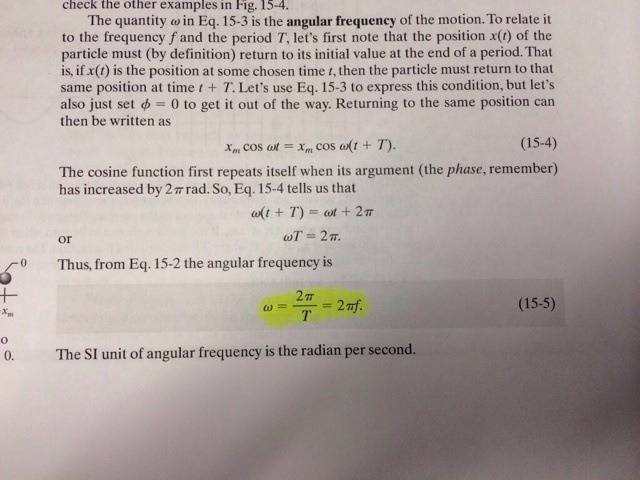
Textbook page on simple harmonic motion showing Eq. 15-4, xm cos ωt = xm cos ω(t + T), the derivation of ω(t + T) = ωt + 2π and ωT = 2π, and Eq. 15-5, ω = 2π/T = 2πf, highlighted in green.


Thank you!
 
hi xtrubambinoxpr! :smile:
xtrubambinoxpr said:
w(t+T) = wt+2pi
wT=2pi

I assumed w would distribute out into the first expression.

T is defined as being the time difference after which everything is the same.

So cos(ω(t+T)) = cos(ωt).

So ω(t+T) - ωt = 2π, ie ωT = 2π. :wink:
 
  • Like
Likes   Reactions: 1 person
tiny-tim said:
hi xtrubambinoxpr! :smile:


T is defined as being the time difference after which everything is the same.

So cos(ω(t+T)) = cos(ωt).

So ω(t+T) - ωt = 2π, ie ωT = 2π. :wink:


i see my mistake! thanks!