Why doesn't the released mass m2 on pulley have higher acceleration?

Join the discussion
Ask a follow-up here, or get your own question answered by working scientists, mathematicians and engineers — people, not an autocomplete.
Real named experts · corrections over time · the nuance an AI answer skips
14 replies · 1K views
annamal
Messages
393
Reaction score
33
TL;DR
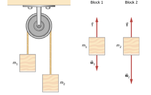
Why doesn't the released mass m2 on pulley have higher acceleration since it is no longer subject to the upward force of tension?
Consider the pulley in the attached image to be frictionless. (a) If m2 is released, what will its acceleration be?

My question is why wouldn't m2's acceleration be greater if released rather than attached to the string because m2 released is no longer subject to the string's upward force tension?
 

Attachments
  • Screen Shot 2022-03-23 at 6.49.32 PM.png
    Screen Shot 2022-03-23 at 6.49.32 PM.png
    15.8 KB · Views: 181
Physics news on Phys.org
annamal said:
Summary:: Why doesn't the released mass m2 on pulley have higher acceleration since it is no longer subject to the upward force of tension?

Consider the pulley in the attached image to be frictionless. (a) If m2 is released, what will its acceleration be?

My question is why wouldn't m2's acceleration be greater if released rather than attached to the string because m2 released is no longer subject to the string's upward force tension?
Is there an actual full problem statement associated with this image? Of course if you cut the string, M2 will free fall. But are they actually asking about when the 2 masses are still connected to the string? Then the acceleration will depend on the difference between the 2 masses, no?
 
berkeman said:
Is there an actual full problem statement associated with this image? Of course if you cut the string, M2 will free fall. But are they actually asking about when the 2 masses are still connected to the string? Then the acceleration will depend on the difference between the 2 masses, no?
That's how the problem is worded. I think it just means at that instant the mass 2 is released.
 
annamal said:
That's how the problem is worded. I think it just means at that instant the mass 2 is released.
Usually "released" means let go out of your hand. If they were cutting the string, the verb "cut" would likely be used. I suppose you could submit both answers for extra credit to your teacher... :wink:
 
"Consider the pulley in the attached image to be frictionless. (a) If m2 is released, what will its acceleration be?"

If the problem would mean to cut the string, how important the friction in the pulley would be?
As @berkeman stated above, somebody has been holding mass 2, preventing the system from moving under its own forces.

Please, see:
http://hyperphysics.phy-astr.gsu.edu/hbase/atwd.html

:cool:
 
Lnewqban said:
"Consider the pulley in the attached image to be frictionless. (a) If m2 is released, what will its acceleration be?"

If the problem would mean to cut the string, how important the friction in the pulley would be?
As @berkeman stated above, somebody has been holding mass 2, preventing the system from moving under its own forces.

Please, see:
http://hyperphysics.phy-astr.gsu.edu/hbase/atwd.html

:cool:
a) If m2 were cut, initially a2 = a (acceleration of mass on string) - g but then a2 grows to equal -g
Is that correct?
 
annamal said:
a) If m2 were cut, initially a2 = a (acceleration of mass on string) - g but then a2 grows to equal -g
Is that correct?
As I understand this new question, you previously have released mass ##m_2## from your hand. It is accelerating at some rate ##a## while mass ##m_1## is accelerating at the same rate in the opposite direction.

You ask about how the acceleration changes from ##a## to ##-g##.

If you snip the [ideal, inextensible] cord above mass ##m_2## instantly then the acceleration of ##m_2## will change instantly. It will not slowly "grow".
 
annamal said:
a) If m2 were cut, initially a2 = a (acceleration of mass on string) - g but then a2 grows to equal -g
Is that correct?
No. Use ##F=ma##. What forces are on ##m_2## after the string is cut? That's what determines the acceleration.
 
vela said:
No. Use ##F=ma##. What forces are on ##m_2## after the string is cut? That's what determines the acceleration.
but isn't the acceleration of the cut mass going to be influenced by the acceleration the mass is going with the string
 
jbriggs444 said:
As I understand this new question, you previously have released mass ##m_2## from your hand. It is accelerating at some rate ##a## while mass ##m_1## is accelerating at the same rate in the opposite direction.

You ask about how the acceleration changes from ##a## to ##-g##.

If you snip the [ideal, inextensible] cord above mass ##m_2## instantly then the acceleration of ##m_2## will change instantly. It will not slowly "grow".
can this instant change be measured in time of milliseconds or even less?
 
annamal said:
can this instant change be measured in time of milliseconds or even less?
that confuses me because doesn't it take time to change acceleration?
 
annamal said:
a) If m2 were cut, initially a2 = a (acceleration of mass on string) - g but then a2 grows to equal -g
Is that correct?
Sorry, I don't understand.
My previous post only tried to reason about the release of mass 2 (from a repose condition), rather than being allowed to free fall (detached from the string and the effect of mass 1).

If mass 2 is released, tension in the string increases to a maximum value, which reaches mass 1.
After that instant, mass 1-string-mass 2 become a system that moves (or not) at same rate of acceleration.
Such a system is also known as an Atwood machine.

Being frictionless, the pulley only job here is to change the direction of the string and its internal tension.
 
annamal said:
that confuses me because doesn't it take time to change acceleration?
If the force changes discontinuously then so does the acceleration.

Edit: Yes, there are always (almost always?) limits on how rapidly forces can be changed. But they can be changed pretty rapidly.
 
jbriggs444 said:
If the force changes discontinuously then so does the acceleration.

Edit: Yes, there are always (almost always?) limits on how rapidly forces can be changed. But they can be changed pretty rapidly.
So therefore if the mass is accelerating at a1 attached to the string, if the string were cut, it would first accelerate at a1 - g and then -g. correct?
 
annamal said:
So therefore if the mass is accelerating at a1 attached to the string, if the string were cut, it would first accelerate at a1 - g and then -g. correct?
Sorry, egg all over my face. Forgot which thread I am on.