Why don't we use the antiderivative factor for Average Voltage

Join the discussion
Ask a follow-up here, or get your own question answered by working scientists, mathematicians and engineers — people, not an autocomplete.
Real named experts · corrections over time · the nuance an AI answer skips
9 replies · 1K views
rtareen
Messages
162
Reaction score
32
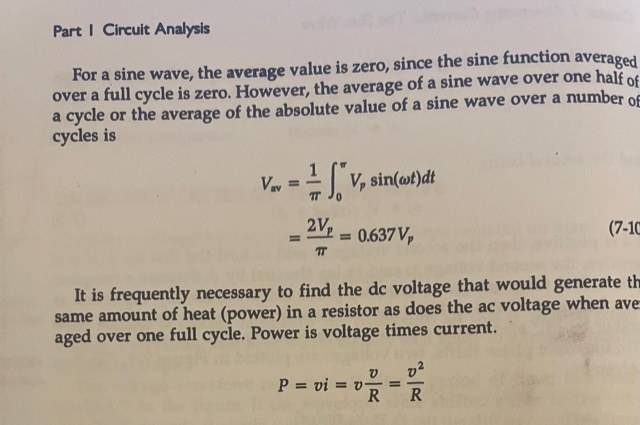
Below is the really quick derivation for average voltage. However when we do the anti-derivative a factor of ##1/\omega## should come out and the full answer should be ##\frac{2V_p}{\pi \omega}##. So why don't we include that? What's going on?
AVG_VOLTAGE.jpg
 
Physics news on Phys.org
I think there's a typo. The range from ##0## to ##\pi## is not one half a cycle of ##\sin(\omega \pi)##. It's probably supposed to be the integral from ##0## to ##\pi/\omega##?
 
  • Like
Likes   Reactions: DaveE, mfb and rtareen
Office_Shredder said:
I think there's a typo. The range from ##0## to ##\pi## is not one half a cycle of ##\sin(\omega \pi)##. It's probably supposed to be the integral from ##0## to ##\pi/\omega##?
I wouldn't doubt it. I already found something wrong previously in this book. It doesn't help that there's only one edition. However that doesn't solve the problem of the factor ##1/\omega## not being included?
 
It's a time average, so the factor in front of the integral gets a factor ##\omega##, too (we average over a time of ##\frac \pi \omega##).
 
rtareen said:
Below is the really quick derivation for average voltage. However when we do the anti-derivative a factor of ##1/\omega## should come out and the full answer should be ##\frac{2V_p}{\pi \omega}##. So why don't we include that? What's going on?
Do the integral (anti-derivative). The average of the voltage over half a cycle when time is the variable is the average over half a period T:$$\langle V \rangle = \frac{\int_0^{T/2}V_P\sin(\omega t)~dt}{\int_0^{T/2}dt}=\frac{ V_P\left[1-\cos\left(\frac{\omega T}{2}\right)\right]}{\omega}\times \frac{1}{\frac{T}{2}}.$$ Now substitute ##\omega T=2\pi.## What do you get?
 
  • Like
Likes   Reactions: alan123hk
mfb said:
It's a time average, so the factor in front of the integral gets a factor ##\omega##, too (we average over a time of ##\frac \pi \omega##).
That makes it work out. Thanks!
 
  • Like
Likes   Reactions: mfb
kuruman said:
Do the integral (anti-derivative). The average of the voltage over half a cycle when time is the variable is the average over half a period T:$$\langle V \rangle = \frac{\int_0^{T/2}V_P\sin(\omega t)~dt}{\int_0^{T/2}dt}=\frac{ V_P\left[1-\cos\left(\frac{\omega T}{2}\right)\right]}{\omega}\times \frac{1}{\frac{T}{2}}.$$ Now substitute ##\omega T=2\pi.## What do you get?
I get the answer they got. After a search I realized that was the right answer. But the integral(s) they say would evaluate to that is wrong.
 
kuruman said:
What integral(s) is (are) that (these) and who are they who say that?
If you look at OP you will see they got the answer right but did not set up the integral properly.
 
  • Like
Likes   Reactions: kuruman