Why is 2/3 required in the calculation for the equilibrium of rigid bodies?

Click For Summary

Homework Help Overview

The discussion revolves around understanding the significance of the factor 2/3 in calculations related to the equilibrium of rigid bodies under distributed loads, particularly triangular loads. Participants are exploring the implications of centroids and how they relate to the distribution of forces along a beam.

Discussion Character

  • Exploratory, Conceptual clarification, Assumption checking

Approaches and Questions Raised

  • Participants are questioning the relevance of the 2/3 factor in the context of centroids of triangular loads and how it affects calculations of total load and its distribution. There are inquiries about the nature of distributed loads and how they differ from concentrated loads.

Discussion Status

The conversation is ongoing, with participants actively seeking clarification on the concepts of centroids and distributed loads. Some have provided insights into the nature of triangular loads and their centroids, while others are still grappling with the underlying principles and mathematical proofs related to these concepts.

Contextual Notes

There are indications of confusion regarding the representation of distributed loads and the calculations involved, particularly concerning the total load and its center of gravity. Participants are also referencing basic principles of equilibrium and moments in their discussions.

goldfish9776
Messages
310
Reaction score
1

Homework Statement


why 2/3 is required in this calculation as circled ? I have no idea.
I know that 4.5/2 is the distance of the centroid of the bar from point A .

Homework Equations

The Attempt at a Solution


Attachments

  • IMG_20150925_094053[1].jpg
    IMG_20150925_094053[1].jpg
    29.2 KB · Views: 489
Physics news on Phys.org
Because it is not a constant load, the load increases as you move to the right. Do you know how to draw Shear/Moment diagrams?
 
goldfish9776 said:

Homework Statement


why 2/3 is required in this calculation as circled ? I have no idea.
I know that 4.5/2 is the distance of the centroid of the bar from point A .

Homework Equations

The Attempt at a Solution

The calculation shown is not about the centroid of the bar is located; it's about where the centroid of the triangular load is located from the left support.
 
SteamKing said:
The calculation shown is not about the centroid of the bar is located; it's about where the centroid of the triangular load is located from the left support.
well , can you explain what the 2/3 means here?
 
goldfish9776 said:
2 x 4.5 is the force ... then why 1/2 appear in the calculations?
Is 2 kN/m x 4.5 m total the force? Wouldn't that be true only if the 2 kN/m distributed load was applied evenly over the entire length of the beam?
 
SteamKing said:
Is 2 kN/m x 4.5 m total the force? Wouldn't that be true only if the 2 kN/m distributed load was applied evenly over the entire length of the beam?
you mean the different points at entire length of rod have different forces? if so, why shouldn't the force = 2x4.5x2/3 ?
since the force involved only from point A to centroid ...
 
goldfish9776 said:
you mean the different points at entire length of rod have different forces? if so, why shouldn't the force = 2x4.5x2/3 ?
since the force involved only from point A to centroid ...

You've apparently missed some basic instruction in how distributed loads are represented. Here are two commonly encountered types of distributed loadings:

distributed-loading.jpg

Unlike with a concentrated load, the individual arrows in the figures on the left do not represent individual loads; they are merely diagrammatic. The equivalent concentrated load and its location are given in the corresponding figures to the right.
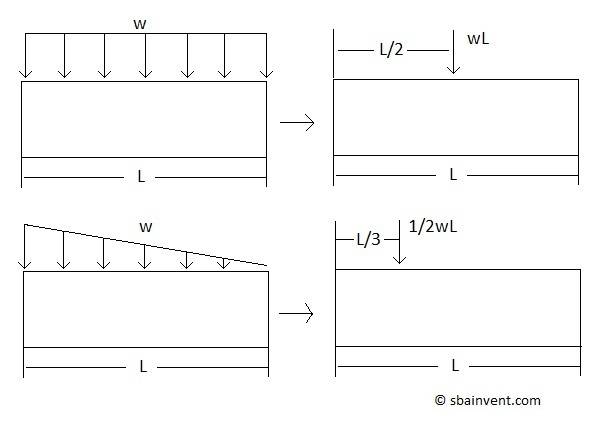
The first type is the uniformly distributed load. This is a loading which has a constant amount of force applied per unit length along the beam. In the diagram, this load is w kN/m, for example.
The Total Load = w * L and its center is located at L/2 from one end of the beam.

The second type is the uniformly varying load. This is a loading which has a zero amount of force applied per unit length at the right end of the beam, and this loading increases in a linearly increasing fashion until it reaches say w kN/m at the left end of the beam.
The Total Load = (1/2)*w*L and its center is located at (2/3) of the length of the beam from the end where w = 0.
 
  • #10
SteamKing said:
You've apparently missed some basic instruction in how distributed loads are represented. Here are two commonly encountered types of distributed loadings:

distributed-loading.jpg

Unlike with a concentrated load, the individual arrows in the figures on the left do not represent individual loads; they are merely diagrammatic. The equivalent concentrated load and its location are given in the corresponding figures to the right.

The first type is the uniformly distributed load. This is a loading which has a constant amount of force applied per unit length along the beam. In the diagram, this load is w kN/m, for example.
The Total Load = w * L and its center is located at L/2 from one end of the beam.

The second type is the uniformly varying load. This is a loading which has a zero amount of force applied per unit length at the right end of the beam, and this loading increases in a linearly increasing fashion until it reaches say w kN/m at the left end of the beam.
The Total Load = (1/2)*w*L and its center is located at (2/3) of the length of the beam from the end where w = 0.
ok , why The Total Load = (1/2)*w*L is located at (2/3) of the length of the beam from the end where w = 0.
why not w*L as in the first case ?
 
  • #11
goldfish9776 said:
ok , why The Total Load = (1/2)*w*L is located at (2/3) of the length of the beam from the end where w = 0.
why not w*L as in the first case ?

Because most of the total load is located toward the end opposite of the end of the beam where w = 0.

If you took each beam as loaded in the diagrams, and placed a fulcrum under the location of the center of the total load, the beam would be balanced, which indicates that the moments of the load on either side of the fulcrum produce equal and opposite rotation of the beam. The moments cancel out, the rotations cancel out, and the beam is balanced around the point.

It's like playing on a see-saw: as long as the load on each end of the seesaw is the same and is located the same distance away from the middle, the see-saw is balanced. Add some more load to one side, and the see-saw wants to sink on that side.

I can't believe you've never tried to balance anything, a ruler, a stick, a bat, a baton.
 
  • #12
SteamKing said:
Because most of the total load is located toward the end opposite of the end of the beam where w = 0.

If you took each beam as loaded in the diagrams, and placed a fulcrum under the location of the center of the total load, the beam would be balanced, which indicates that the moments of the load on either side of the fulcrum produce equal and opposite rotation of the beam. The moments cancel out, the rotations cancel out, and the beam is balanced around the point.

It's like playing on a see-saw: as long as the load on each end of the seesaw is the same and is located the same distance away from the middle, the see-saw is balanced. Add some more load to one side, and the see-saw wants to sink on that side.

I can't believe you've never tried to balance anything, a ruler, a stick, a bat, a baton.
so , at the distance 2L/3 from the position where w= 0 , the force only become wL/2 ?
Is there any mathematical proof for this ? it's hard for me to fully understand it
 
  • #13
goldfish9776 said:
so , at the distance 2L/3 from the position where w= 0 , the force only become wL/2 ?
Is there any mathematical proof for this ? it's hard for me to fully understand it

No, the total load over the entire length of the beam = wL/2.

The total load is the area under the distributed load diagram, which in this case is a triangle. What's the area of a right triangle where the base is L units long and the height is w units?

When the loading has a uniform distribution, the distributed load diagram is a rectangle of length L and height of w. What's the area of this rectangle?

Those are your mathematical proofs.
 
  • Like
Likes   Reactions: goldfish9776

Similar threads

  • · Replies 10 ·
Replies
10
Views
2K
  • · Replies 3 ·
Replies
3
Views
2K
  • · Replies 4 ·
Replies
4
Views
2K
  • · Replies 11 ·
Replies
11
Views
2K
  • · Replies 3 ·
Replies
3
Views
2K
Replies
4
Views
2K
  • · Replies 12 ·
Replies
12
Views
2K
  • · Replies 9 ·
Replies
9
Views
2K
  • · Replies 31 ·
2
Replies
31
Views
4K
  • · Replies 6 ·
Replies
6
Views
3K