Why is a 12-foot wire needed for the electric brake on a 24 Vdc lawnmower motor?

Click For Summary

Discussion Overview

The discussion centers around the function and necessity of a 12-foot wire used as an electric brake in a 24 Vdc lawnmower motor. Participants explore the implications of this wire's length, resistance, and potential inductance in the context of motor braking mechanisms, including the effects of induced currents and back-emf.

Discussion Character

  • Exploratory
  • Technical explanation
  • Debate/contested
  • Mathematical reasoning

Main Points Raised

  • Some participants explain that the wire allows induced current to flow when the motor is shorted, creating a magnetic force that opposes the motor's rotation.
  • Others suggest that the length of the wire may be a cost-effective alternative to using high-powered resistors, which can be expensive.
  • There is a question regarding whether the wire is indeed standard AWG 18 or if it has a different resistivity, with some participants planning to verify its specifications.
  • One participant discusses the relationship between supply voltage, back-emf, and the current flowing through the motor, noting that the current can exceed the motor's ratings during a stall condition.
  • Another participant introduces the concept of "rheostatic braking," suggesting that the kinetic energy of the rotor must be dissipated quickly, ideally through an external resistor rather than the motor windings.
  • Some participants speculate about the implications of the wire's resistance on braking time and the potential for oscillations if resistance is too low.
  • There is a mention of the wire's coiling possibly serving as a cheap inductor, which could help manage current changes during braking.

Areas of Agreement / Disagreement

Participants express various hypotheses regarding the wire's purpose and function, with no clear consensus reached. Multiple competing views remain about the wire's characteristics and the implications for motor performance during braking.

Contextual Notes

Participants note uncertainties regarding the wire's specifications and the motor's behavior under different conditions, such as stall versus controlled braking. There are also discussions about the potential effects of the wire's resistance on braking dynamics.

Redbelly98
Staff Emeritus
Science Advisor
Homework Helper
Insights Author
Messages
12,178
Reaction score
186
I'm trying to understand just how the electric brake on my 24 Vdc lawnmower works.

First, here is the circuit schematic:
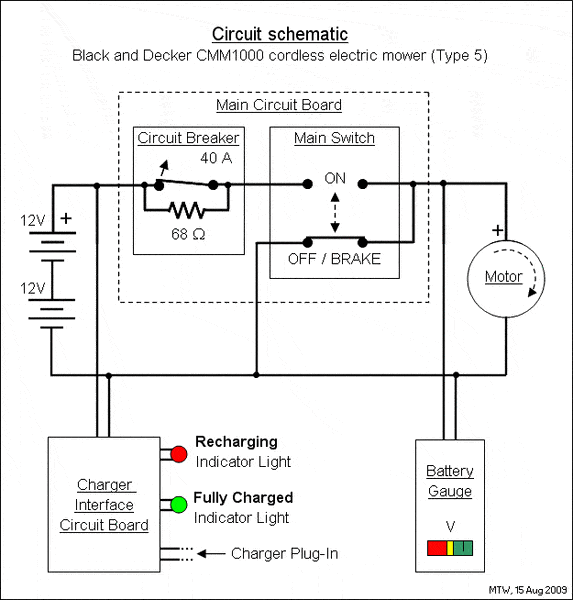
MowerCMM1000_circuit_2009-08-15.gif


For the purposes of this discussion just note that, when the motor is shut off, the motor gets "shorted" when the main switch moves to the OFF/BRAKE position.

Now, I understand that:

1. The short allows an induced current to flow in the motor coils as they spin past the magnets, and
2. The magnetic force on the current-carrying wires will oppose the direction of spin, bringing the motor to a stop.

However ... the construction of this thing isn't really a simple short. Instead, it is a 12-foot long, AWG 18 wire coiled in a loop. It is the wire labeled "Brake Wire" in this photo:
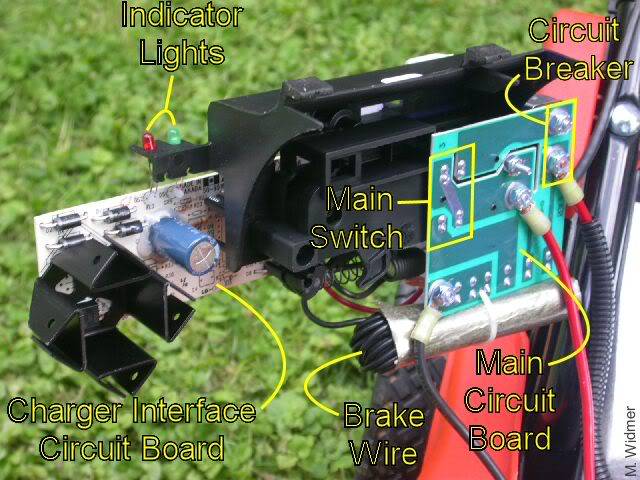
MowerCMM1000_5177.jpg


So my question is, why is a 12 foot wire needed for this? I estimate it's resistance to be about 0.07 Ω. (12 feet of AWG 18 wire). I assume it's coiled just to fit it into a small space, but of course this would mean a small amount of inductance which may or may not be relevant.

Other details: the motor runs on 24 V DC. [STRIKE]I don't know the current, but there is a 40A circuit breaker, so somewhere between 10 A and 30 A?[/STRIKE] (EDIT 2/26/10: I have measured 12A current on a fully charged battery.)

Also, I'm just assuming it's a permanent magnet motor, but am not 100% on that. It could be a universal motor I suppose.

Thanks in advance!
 
Last edited:
Engineering news on Phys.org
Large currents can be generated if you short the motor - more current than the motor can handle. To prevent going over its max ratings, the motor can be shorted by a resistor capable of handling a lot of current. However, high powered resistors are expensive, so I would guess they just used a 12 foot wire because it's cheaper.
 
  • Like
Likes   Reactions: 1 person
Redbelly98 said:
However ... the construction of this thing isn't really a simple short. Instead, it is a 12-foot long, AWG 18 wire coiled in a loop. It is the wire labeled "Brake Wire" in this photo:

Are you certain that it is standard 18 AWG wire and not something having a relatively high resistivity?
 
what said:
Large currents can be generated if you short the motor - more current than the motor can handle. To prevent going over its max ratings, the motor can be shorted by a resistor capable of handling a lot of current. However, high powered resistors are expensive, so I would guess they just used a 12 foot wire because it's cheaper.
Hmm, it didn't occur to me that the generated current would be more than the operating current. In that case yes, you'd need some resistance there.

Ivan Seeking said:
Are you certain that it is standard 18 AWG wire and not something having a relatively high resistivity?
No, not absolutely sure. It has "AWG 18" printed on the insulation, and I just assumed the rest. I can (and should) double check this with an ohmmeter.

Thanks for the responses.
 
I think waht nailed it. Again.
 
DC motors operate on the principle that the supply voltage has to counter the back-emf generated by the motor to cause rotation. So in a sense much less current is flowing through the motor coil than there is. I_{motor} = \frac{V_{supply} - V_{emf}}{R_{motor}}Under reasonable load/torque, V_supply is just little greater than the V_emf

V_{supply} > V_{emf}

hence, in your case, the difference can be small enough to cause maybe 30 amps to flow (40 amp breaker)

However, if you were to jam the mower on a rock, then Vemf could not be generated, then the whole current from the battery is dumped directly to the coils - that are not designed to handle so much current.

I_{motor} = \frac{V_{supply}}{R_{motor}}

On the other hand, if you short the motor, then V_supply is zero, then the whole current is momentarily dumped to the coils

I_{motor} = \frac{ - V_{emf}}{R_{motor}}hopefully I got this right, got to go to sleep.
 
Last edited:
what said:
On the other hand, if you short the motor, then V_supply is zero, then the whole current is momentarily dumped to the coils

I_{motor} = \frac{ - V_{emf}}{R_{motor}}


hopefully I got this right, got to go to sleep.

Makes sense to me. Of course, in the limit Rmotor→0, Vemf would go to zero as well. Imotor would be whatever current is necessary to cancel the change in magnetic flux, resulting in Vemf=0.

I finally hit on the proper term for googling, "rheostatic braking", and found another explanation in terms of energy conservation. The kinetic energy of the spinning rotor has to go somewhere quickly during braking ... better to heat up an external resistor and not the motor windings.

Thanks again.
 
Ivan Seeking said:
Are you certain that it is standard 18 AWG wire and not something having a relatively high resistivity?

Redbelly98 said:
No, not absolutely sure. It has "AWG 18" printed on the insulation, and I just assumed the rest. I can (and should) double check this with an ohmmeter.

It's standard wire. I disconnected it from the circuit, and measured 0.0 ohms.
 
what's explanation must be the correct one, but they are running that suprisingly tight. Assuming that you are using a Currie motor [nameplate ratings of 36V, 30 A, 2600 RPM], the winding resistance should be about 0.2 ohms. And I think the ESR of the batteries may be greater than the resistance of the [edit: brake] wire, but I don't know that number offhand.

I just happen to have a Currie motor sitting on my bench and I think this is what is used in most devices as such.

I wonder if it was a balancing act between the wire [winding] rating and the required braking time.
 
Last edited:
  • #10
Ivan Seeking said:
what's explanation must be the correct one, but they are running that suprisingly tight. Assuming that you are using a Currie motor [nameplate ratings of 36V, 30 A, 2600 RPM], the winding resistance should be about 0.2 ohms. And I think the ESR of the batteries may be greater than the resistance of the wire, but I don't know that number offhand.
Interesting, I should try to measure the winding resistance. I was thinking I had done that last spring, but now realize I was actually measuring the parallel combination of brake wire + motor. (This was before I was aware of the existence of the brake wire.)

The battery is disconnected during braking (see schematic in OP), so wouldn't it's esr be irrelevant?

Edit: I wonder if it was a balancing act between the wire [winding] rating and the required braking time.
Edit: That's a thought. Perhaps with zero (or approaching zero) resistance, the "braking" motor would simply oscillate. The presence of resistance either makes the oscillations decay, or if large enough makes the motor come to a stop a la a damped harmonic oscillator. Just an educated guess here, I haven't actually set up equations of motion for the motor.
 
Last edited:
  • #11
Redbelly98 said:
The battery is disconnected during braking (see schematic in OP), so wouldn't it's esr be irrelevant?

I was thinking of the sudden stall condition in addition to a controlled stop.
 
  • #12
Redbelly98 said:
Edit: That's a thought. Perhaps with zero (or approaching zero) resistance, the "braking" motor would simply osciallate. The presence of resistance either makes the oscillations decay, or if large enough makes the motor come to a stop a la a damped harmonic oscillator. Just an educated guess here, I haven't actually set up equations of motion for the motor.

My thought was that the braking time was chosen according to operator safety concerns, and this drove the braking resistor value as low as possible without causing damage to the motor windings. Otherwise, why not use a larger value and save the extra stress on the windings?
 
  • #13
That came in handy, Redbelly. Thanks!
 
  • #14
That wire looks like it's wrapped into coils. Maybe it's supposed to be a cheap inductor. It's inductance wouldn't be especially high but, because it's made of regular wire, it can handle a large current.

Inductors oppose changes in current. The 12 foot wire will basically create a little back voltage in itself to oppose Vemf. When you short the motor with the coiled up wire, the inductor slows down the growth of the current so that the energy has a little more time to dissipate through the motor + wire resistance. It keeps the current from getting up to an astronomical value.
 
  • #15
Does the lawn mower just stop or does it undergo braking (retardation) when you push the switch. I don't really know much about lawn mowers. I am wondering if that switch is used to implement electrical braking or if it just shuts off the motor.
 
  • #16
The motor will stop no matter what. The question is, will it throw sparks when you open its terminals?

Motors have some inductance. When you disconnect a motor, it may have a big voltage spike at it's terminals. It's just like disconnecting an induction coil from a power source and instantly connecting it to a to a spark plug. The coil will generate just about any voltage it needs to drive a current that jumps the air gap.
 
Last edited:
  • #17
Ivan Seeking said:
That came in handy, Redbelly. Thanks!
How so? Do you own one of these too? You're welcome!

Okefenokee said:
That wire looks like it's wrapped into coils. Maybe it's supposed to be a cheap inductor. It's inductance wouldn't be especially high but, because it's made of regular wire, it can handle a large current.
That was my initial thought, but surely its inductance is way smaller than the motor windings? I'm with what's explanation that it's the wire's resistance that matters here, and coiling it is just a convenient way to store 12 feet of wire.

New info/mystery: since starting this thread, I discovered (because it broke) a short, maybe 4", length of AWG 24 solid wire in series with the 12 foot coiled-up wire. Calculated resistance is 0.009 ohms, an order of magnitude less than the 12 foot wire, so what is it's purpose?

Oh, and in case their location is not clear, if you look at the circuit in the OP, they lie along the path running between the word "OFF" and the bottom part of the circuit. (I should really update that diagram now that I know more about it.)

chaoseverlasting said:
Does the lawn mower just stop or does it undergo braking (retardation) when you push the switch. I don't really know much about lawn mowers. I am wondering if that switch is used to implement electrical braking or if it just shuts off the motor.
When the motor is on and you release the switch into the OFF/BRAKE position, the motor comes to a stop in about 1 second, if I remember correctly -- at this point it has been a few months since I last used it. Anyway, it stops fairly quickly, but not "instantaneously" by human reaction-time standards. Without the break, it takes 5 or 10 seconds for the motor to come to a stop.

Okefenokee said:
The motor will stop no matter what. The question is, will it throw sparks when you open its terminals?

Motors have some inductance. When you disconnect a motor, it may have a big voltage spike at it's terminals. It's just like disconnecting an induction coil from a power source and instantly connecting it to a to a spark plug. The coil will generate just about any voltage it needs to drive a current that jumps the air gap.
The motor sparks at the brushes while it is running, but I haven't paid attention to whether it sparks while it is braking. I would also expect some arcing at the switch terminals when it is released.
 
  • #18
Redbelly98 said:
How so? Do you own one of these too?

No, I used this style of motor for a new industrial design. That is why I had been bench testing for brake horsepower, temp stability, max load over time, etc. No hard data was available from China. The extreme low cost and relatively high torque for the package size makes them very appealing for certain applications.

The brake works like a champ. Just copy and paste. :biggrin: Normally I would have gone for a much more expensive resistor.

And get this! I also needed clutches. Quotes ranging from $800 to $4000 each, were received. By making a simple modification, I was able to use an 18hp clutch that was designed for a lawnmower. Unit cost ~ $150.
 
Last edited:

Similar threads

  • · Replies 9 ·
Replies
9
Views
3K
  • · Replies 13 ·
Replies
13
Views
3K
  • · Replies 23 ·
Replies
23
Views
8K
  • · Replies 8 ·
Replies
8
Views
2K
  • · Replies 29 ·
Replies
29
Views
3K
  • · Replies 6 ·
Replies
6
Views
4K
  • · Replies 6 ·
Replies
6
Views
7K
  • · Replies 10 ·
Replies
10
Views
5K
  • · Replies 6 ·
Replies
6
Views
7K
Replies
6
Views
5K