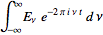
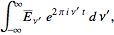
Why is E(t) multiplied by e^(-ix) in Plancherel's Theorem proof?

  • Context: Undergrad 
  • Thread starter Thread starter QuantumDuality
  • Start date Start date
  • Tags Tags
    Proof Theorem
Click For Summary
SUMMARY

The discussion centers on the application of the Fourier Transform in the proof of Plancherel's Theorem, specifically addressing why E(t) is multiplied by e^(-ix). The participants clarify that this multiplication relates to the complex conjugate of e^(ix) and is essential for maintaining the integrity of the Fourier Transform pairs. The conversation also touches on the importance of variable substitution in integrals, emphasizing the need for accurate limits when changing variables.

PREREQUISITES
  • Understanding of Fourier Transform pairs
  • Familiarity with complex conjugates in mathematical expressions
  • Knowledge of variable substitution in integrals
  • Basic principles of Plancherel's Theorem
NEXT STEPS
  • Study the derivation of Plancherel's Theorem in detail
  • Learn about the properties of Fourier Transform pairs
  • Explore complex analysis, focusing on complex conjugates
  • Practice variable substitution techniques in calculus
USEFUL FOR

Mathematicians, physics students, and anyone interested in advanced calculus and Fourier analysis will benefit from this discussion.

QuantumDuality
Messages
10
Reaction score
0
the first step of the Plancherel's Theorem proof found in: http://mathworld.wolfram.com/PlancherelsTheorem.html, says:
let
Inline1.gif
be a function that is sufficiently smooth and that decays sufficiently quickly near infinity so that its integrals exist. Further, let
Inline2.gif
and
Inline3.gif
be FT pairs so that:
Inline4.gif
Inline5.gif
Inline6.gif

Inline7.gif
Inline8.gif
Inline9.gif


assuming x = 2*pi*v*t, why is E(t) multiplied by e^(-ix)?, i guess it has to do with the fact that it is the conjugate of e^(ix), but i can't figure it out
 
Physics news on Phys.org
The first equation follows from the definition of Fourier Transform pairs (to be more precise from a theorem that the inverse Fourier transform of the Fourier transform of a function, is the function itself).

The second equation follows from first by taking the complex conjugate at each side of the first equation. And of course changing the name of the variable but I guess you know that ##\int f(x)dx=\int f(y)dy## no matter what x and y are.
 
but if we have for example:
f(x) = x³
y = x²
then
f(y) = (x²)³ = x⁶
dy/dx = 2x
dy = 2x dx

using the equation you suggest:
∫f(x)dx=∫f(y)dy
∫x³ dx=∫2x⁷ dx

i'm missing something?
 
Well the equation I wrote is for definite integrals (ok I admit I didn't write it in an accurate way) , so i should ve write ##\int\limits_{a}^{b}f(x)dx=\int\limits_{a}^{b}f(y)dy##

What you doing is a change of variable ##y=x^2## in the integral ##\int\limits_{a}^{b}f(y)dy## so the interval of integration changes from ##(a,b)## to ## (\sqrt{a},\sqrt{b})##. So the last line of your post should be actually ##\int\limits_{a}^{b}x^3dx=\int\limits_{\sqrt{a}}^{\sqrt{b}}2x^7dx##.
 
  • Like
Likes   Reactions: QuantumDuality

Similar threads

  • · Replies 1 ·
Replies
1
Views
4K
  • · Replies 54 ·
2
Replies
54
Views
11K
  • · Replies 2 ·
Replies
2
Views
2K
Replies
18
Views
2K
  • · Replies 1 ·
Replies
1
Views
9K
  • · Replies 2 ·
Replies
2
Views
2K
  • · Replies 1 ·
Replies
1
Views
6K
  • · Replies 4 ·
Replies
4
Views
2K
Replies
3
Views
5K
  • · Replies 16 ·
Replies
16
Views
7K