Why is φ Assumed to Be 90 in the Undamped Forced Oscillator Solution?

  • Thread starter Thread starter member 731016
  • Start date Start date
  • Tags Tags
    Oscillator
Click For Summary
SUMMARY

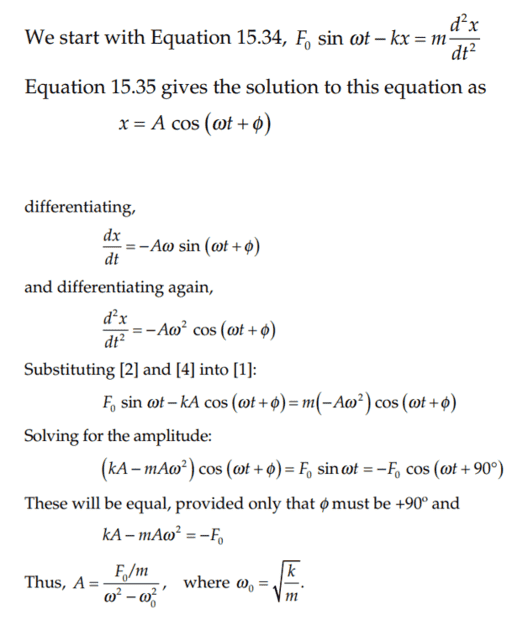
The discussion centers on the assumption that φ (phi) equals 90 degrees in the context of the undamped forced oscillator solution, specifically relating to equations 15.34 and 15.35. It is established that equation 15.35 can satisfy equation 15.34 under the condition φ = π/2 + 2nπ and A = F₀/(mω² - k). The participants clarify that φ and A were not initially defined, and their values were derived to ensure the equations hold true. This understanding is crucial for solving forced oscillation problems in physics.

PREREQUISITES
  • Understanding of forced oscillation concepts
  • Familiarity with harmonic motion equations
  • Knowledge of trigonometric functions and their applications in physics
  • Basic grasp of differential equations related to motion
NEXT STEPS
  • Study the derivation of the undamped forced oscillator equations
  • Learn about the implications of phase angle φ in oscillatory systems
  • Examine the role of initial conditions in solving differential equations
  • Explore the relationship between force, mass, and acceleration in oscillatory motion
USEFUL FOR

Students and professionals in physics, particularly those focusing on mechanics and oscillatory systems, will benefit from this discussion. It is also valuable for educators teaching concepts related to forced oscillations and differential equations.

member 731016
Homework Statement
Please see below
Relevant Equations
Please see below
For this problem,
1675720881858.png

The solution is,
1675720909212.png

However, can someone please explain how this is showing equation 15.35 as a solution of equation 15.34? I though both sides should be equal without assuming that ##\phi = 90##

Also why are they allowed to assume ##\phi = 90##?

Many thanks!
 
Physics news on Phys.org
Given 15.34, we want to see whether an equation of the form 15.35 can be a solution if we plug in suitable values for ##A, \omega, \phi##.
To check this, we use 15.35 to substitute for x in 15.34.
It turns out that 15.34 is satisfied by 15.35 provided ##\phi=\pi/2+2n\pi## and ##A=\frac{F_0}{m\omega^2-k}##.
 
  • Like
Likes   Reactions: member 731016
haruspex said:
Given 15.34, we want to see whether an equation of the form 15.35 can be a solution if we plug in suitable values for ##A, \omega, \phi##.
To check this, we use 15.35 to substitute for x in 15.34.
It turns out that 15.34 is satisfied by 15.35 provided ##\phi=\pi/2+2n\pi## and ##A=\frac{F_0}{m\omega^2-k}##.
Thank you for your reply @haruspex !
 
and any solution to the unforced (or homogeneous or ##F_0=0##) system can be added to produce another solution as dictated by initial conditions.
 
  • Like
Likes   Reactions: member 731016
hutchphd said:
and any solution to the unforced (or homogeneous or ##F_0=0##) system can be added to produce another solution as dictated by initial conditions.
Thank you @hutchphd , that is good to know!
 
  • Like
Likes   Reactions: hutchphd
Callumnc1 said:
I though both sides should be equal without assuming that ϕ=90

Also why are they allowed to assume ϕ=90?
Φ and A were not defined initially. They were testing a function to see what would be required for it it satisfy the original equation. Then they derived what Φ and A had to be for that form to be correct.
 
  • Like
Likes   Reactions: member 731016
DaveE said:
Φ and A were not defined initially. They were testing a function to see what would be required for it it satisfy the original equation. Then they derived what Φ and A had to be for that form to be correct.
Oh ok thank you @DaveE that makes more sense now!
 

Similar threads

Replies
9
Views
2K
  • · Replies 2 ·
Replies
2
Views
1K
Replies
1
Views
1K
Replies
17
Views
3K
Replies
5
Views
2K
Replies
7
Views
2K
  • · Replies 12 ·
Replies
12
Views
2K
Replies
4
Views
2K
  • · Replies 9 ·
Replies
9
Views
7K
Replies
8
Views
4K