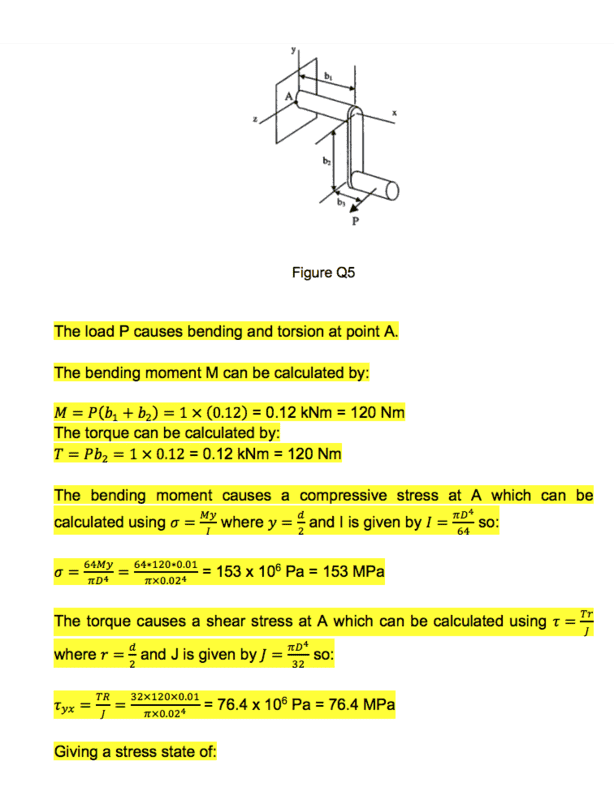
Discussion Overview
The discussion revolves around understanding why point A in a simplified crankshaft is considered to be in compression when subjected to a load P. Participants explore the mechanics of bending moments and stress distribution in beams, particularly focusing on the implications of point A's position relative to the beam's curvature.
Discussion Character
- Technical explanation
- Conceptual clarification
- Debate/contested
- Mathematical reasoning
Main Points Raised
- One participant expresses confusion about the classification of stress at point A, noting that both their calculations and the solutions indicate positive stress values, which they associate with tension.
- Another participant explains that in bending, the concave portion of a beam is in compression while the convex portion is in tension, suggesting that point A is in the concave portion.
- A different participant proposes visualizing the forces acting on point A by eliminating a section of the crankshaft to clarify the bending effects.
- One participant questions how to determine if point A is in compression when it is located on the side of the beam, indicating a lack of clarity regarding the influence of load P on stress classification.
- Another participant confirms that in a modified scenario where the load P acts downwards, point A would be in tension, emphasizing the importance of concave versus convex positioning rather than absolute top or bottom placement.
- One participant acknowledges a previous misunderstanding and seeks clarification on the stress state of point A in different configurations of the beam.
- A later reply points out that point A in the first diagram is not positioned the same as in the second diagram, suggesting that the context of the diagrams is crucial for understanding the stress state.
Areas of Agreement / Disagreement
Participants exhibit a mix of understanding and confusion regarding the stress state at point A, with some agreeing on the principles of bending while others remain uncertain about the implications of different load orientations and beam configurations. The discussion does not reach a consensus on the classification of stress at point A in all scenarios presented.
Contextual Notes
Participants express uncertainty about the definitions of tension and compression in relation to the position of point A and the effects of load P. There are unresolved questions regarding the application of bending theory to different configurations of the crankshaft.