Why is the area under a curve the integral?

Click For Summary
SUMMARY

The discussion clarifies that the integral of a function is defined as the area under its graph, a concept rooted in the fundamental theorem of calculus. The area is initially defined for rectangles, and the extension to more complex shapes is a choice of terminology rather than a provable fact. The conversation highlights the distinction between treating the integral as a definition versus a theorem, emphasizing that understanding the concept of measure is crucial for deeper comprehension.

PREREQUISITES
  • Fundamental theorem of calculus
  • Understanding of Riemann sums
  • Basic knowledge of geometric proofs
  • Familiarity with the concept of measure in mathematics
NEXT STEPS
  • Study the fundamental theorem of calculus in detail
  • Explore Riemann sums and their application in defining integrals
  • Investigate the concept of measure theory in mathematics
  • Review geometric proofs related to integration and area
USEFUL FOR

Students of calculus, mathematics educators, and anyone seeking to understand the relationship between integrals and areas under curves.

dgamma3
Messages
12
Reaction score
0
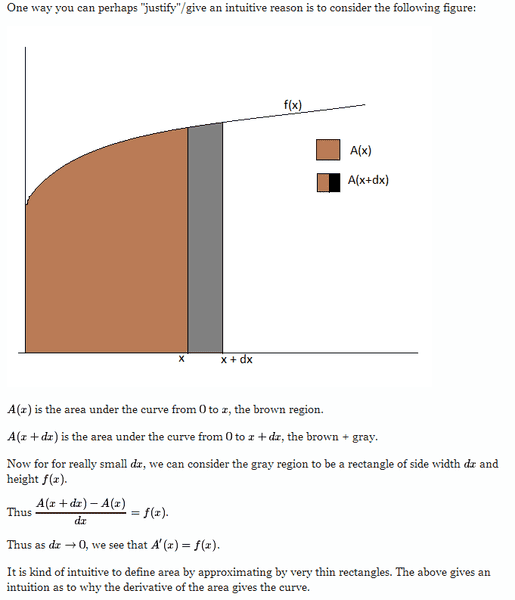
here is a geometric proof, similar to the one in my textbook (copied from Aryabhata, from http://math.stackexchange.com/questions/15294/why-is-the-area-under-a-curve-the-integral) :
RCskose.png


Is this saying: that the A' equals the function. Which is implying, that the integration of A equals F (where F is the integral of f)?

thanks
 
Physics news on Phys.org
You don't prove that the integral of a function is the area under its graph. What you do is to extend the definition of the "area" (which is initially only defined for rectangles) to regions of shapes like this, by saying that the area of such a region is the integral of the function. This is just a choice to use the word "area" in these situations, nothing more. So it can't be proved.

What you can do is to explain why the word "area" was chosen for this concept.

The argument you posted says that A'=f. By the fundamental theorem of calculus, this implies that for all real numbers a,b,
$$\int_a^b f(x)dx =\int_a^b A'(x)dx =A(b)-A(a).$$
 
Last edited:
@Fredrik
Perhaps I am being pedantic, but the fact that the integral equals area is a theorem rather than just a definition.

See the following links:
http://en.wikipedia.org/wiki/Jordan_measure
http://terrytao.files.wordpress.com/2011/01/measure-book1.pdf

In calculus, it is often treated as a definition, but the justification is basically there using lower/upper Riemann sums.

@OP
The above is just a quibble that does not have much to do with your question.
 
Vargo said:
@Fredrik
Perhaps I am being pedantic, but the fact that the integral equals area is a theorem rather than just a definition.
If we have already defined "area" using a measure, then yes. But the OP clearly hadn't. People who ask why the integral is the area under the graph don't know what a measure is. So it makes sense to take the integral as the definition at this point.
 
Relativistic Momentum, Mass, and Energy Momentum and mass (...), the classic equations for conserving momentum and energy are not adequate for the analysis of high-speed collisions. (...) The momentum of a particle moving with velocity ##v## is given by $$p=\cfrac{mv}{\sqrt{1-(v^2/c^2)}}\qquad{R-10}$$ ENERGY In relativistic mechanics, as in classic mechanics, the net force on a particle is equal to the time rate of change of the momentum of the particle. Considering one-dimensional...

Similar threads

  • · Replies 2 ·
Replies
2
Views
3K
  • · Replies 2 ·
Replies
2
Views
3K
  • · Replies 20 ·
Replies
20
Views
4K
  • · Replies 3 ·
Replies
3
Views
2K
  • · Replies 4 ·
Replies
4
Views
3K
  • · Replies 2 ·
Replies
2
Views
2K
  • · Replies 5 ·
Replies
5
Views
2K
  • · Replies 11 ·
Replies
11
Views
3K
  • · Replies 3 ·
Replies
3
Views
3K