Why is the couple moment negative in this example?

2 replies · 4K views · last reply
unknown_2
Messages
28
Reaction score
0
Hey, I'm having some difficulty calculating couple moment. i understand that [tex]\sum[/tex]M = [tex]\sum[/tex]Fd. here's an example:
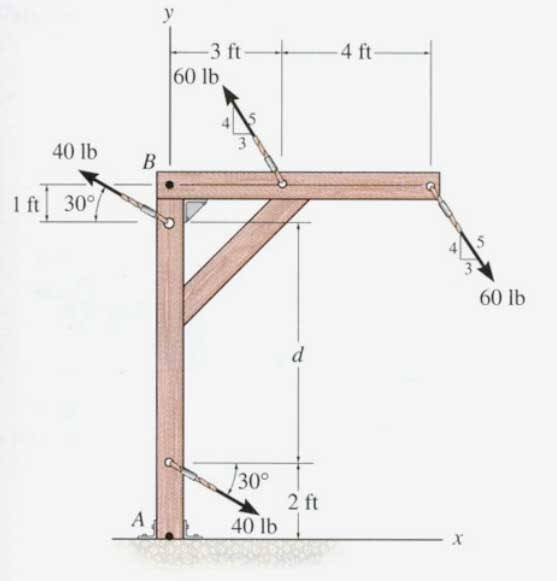
Frame diagram with a vertical member A-B and horizontal member at top; forces of 60 lb (3 ft and 4 ft from the vertical member), 40 lb at 30 degrees left, 40 lb at 30 degrees near bottom, dimensions 1 ft, 2 ft and d, and x-y axes.

it asks to resolve the couple forces.

the answer is:
(4/5)(60lb) = 48lb
and
(40lb)(cos30)

[tex]\sum[/tex]M = -(48lb)(4ft) + (40lb)(cos30)(8ft)

Now, i don't understand why "-(48lb)(4ft)" is negative. I'm not sure when to use a negative value. Can someone explain this to me?

Cheers
 
unknown_2 said:
Hey, I'm having some difficulty calculating couple moment. i understand that [tex]\sum[/tex]M = [tex]\sum[/tex]Fd. here's an example:
Free-body diagram of a bent timber frame with a vertical post fixed at A and a horizontal beam at top, labelled B, with 40 lb, 60 lb and 60 lb forces at angles, dimensions 3 ft, 4 ft, 1 ft and 2 ft, and an x-y axis.

it asks to resolve the couple forces.

the answer is:
(4/5)(60lb) = 48lb
and
(40lb)(cos30)

[tex]\sum[/tex]M = -(48lb)(4ft) + (40lb)(cos30)(8ft)

Now, i don't understand why "-(48lb)(4ft)" is negative. I'm not sure when to use a negative value. Can someone explain this to me?

Cheers

It's a matter of convention. Typically, the clockwise direction is negative and counter-clockwise is positive. So if the applied force causes rotation in the clockwise direction, the moment is negative and vice-versa.

CS