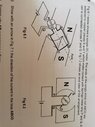
Why is the direction in which the D.C. motor turns reversed here?

  • Thread starter Thread starter ellieee
  • Start date Start date
  • Tags Tags
    Direction Motor
Click For Summary
The discussion centers on a discrepancy between the direction of rotation of a D.C. motor in a worksheet and a textbook. The worksheet indicates that the motor turns clockwise, while the textbook states it turns anti-clockwise. Participants question the interpretation of the figures, particularly Figure 6.2, which shows movement but lacks clarity on the direction of rotation. There is confusion regarding the upward and downward movements of components A and D and how they relate to the overall rotation direction. Clarification on these points is needed to resolve the conflicting information.
ellieee
Messages
78
Reaction score
6
Homework Statement
I tried Fleming left hand rule and no matter what doesn't AB move downwards?
Relevant Equations
nil
?hash=6d346eced0b2fc4bd71f50774e41825c.jpg

CamScanner 06-08-2021 13.56.jpg


in my worksheet, AB turns in clockwise direction , while in my textbook, it turns in the anti clockwise direction.
so may I know why is this the case?
 

Attachments

  • 16238118805705338160021237279143.jpg
    16238118805705338160021237279143.jpg
    35.9 KB · Views: 132
Physics news on Phys.org
Where does it say it turns clockwise?
 
vela said:
Where does it say it turns clockwise?
in fig 6.2, A moves upwards while D moves downwards so doesn't it mean clockwise?
 
I don't see anything in the figure which suggests A is moving upward and D is moving downward.
 
Thread 'Correct statement about size of wire to produce larger extension'
The answer is (B) but I don't really understand why. Based on formula of Young Modulus: $$x=\frac{FL}{AE}$$ The second wire made of the same material so it means they have same Young Modulus. Larger extension means larger value of ##x## so to get larger value of ##x## we can increase ##F## and ##L## and decrease ##A## I am not sure whether there is change in ##F## for first and second wire so I will just assume ##F## does not change. It leaves (B) and (C) as possible options so why is (C)...

Similar threads

  • · Replies 2 ·
Replies
2
Views
871
  • · Replies 6 ·
Replies
6
Views
1K
Replies
12
Views
2K
  • · Replies 2 ·
Replies
2
Views
2K
  • · Replies 2 ·
Replies
2
Views
2K
  • · Replies 40 ·
2
Replies
40
Views
4K
  • · Replies 11 ·
Replies
11
Views
2K
  • · Replies 7 ·
Replies
7
Views
1K
  • · Replies 8 ·
Replies
8
Views
2K
  • · Replies 6 ·
Replies
6
Views
2K