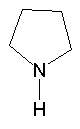
Why is the N in pyrrolidine sp2 hybridized?

  • Thread starter Thread starter jackjack
  • Start date Start date
Click For Summary

Discussion Overview

The discussion revolves around the hybridization of nitrogen in pyrrolidine and its comparison to related compounds like pyrrole. Participants explore the implications of molecular geometry, bonding, and hybridization in the context of organic chemistry.

Discussion Character

  • Exploratory
  • Technical explanation
  • Debate/contested

Main Points Raised

  • One participant expresses confusion about the hybridization of nitrogen in C4H9N, noting its resemblance to ammonia, which is sp3 hybridized.
  • Another participant suggests that the 3D geometry of nitrogen in pyrrolidine may differ from ammonia, proposing that the nitrogen could be trigonal planar due to ring strain, potentially allowing for sp2 character.
  • A different participant questions the validity of associating hybridization with planar structures, suggesting that bonding can be described independently of geometry.
  • There is a clarification regarding the distinction between pyrrole and pyrrolidine, with pyrrole being described as an aromatic compound where all ring members are sp2 hybridized.
  • One participant posits that the nitrogen's sp2 hybridization may result from its adjacency to sp2 hybridized carbons, allowing for overlap of p-orbitals and participation in resonance structures.
  • Another participant explains that nitrogen in pyrrole adopts sp2 hybridization due to its involvement in an aromatic pi system, which contributes to the stability of the molecule.
  • A participant provides an orbital energy level diagram to illustrate the energy considerations related to hybridization in pyrrole.

Areas of Agreement / Disagreement

Participants express differing views on the hybridization of nitrogen in pyrrolidine versus pyrrole, with some asserting sp2 hybridization due to geometric and bonding considerations, while others remain uncertain or confused about the distinctions and implications.

Contextual Notes

There are unresolved questions regarding the specific hybridization states of nitrogen in different contexts, and the discussion highlights potential dependencies on molecular geometry and resonance without reaching a consensus.

jackjack
Messages
3
Reaction score
0
I'm just starting an Organic Chemistry course, and I'm completely confused by this problem. It says that the hybridization of nitrogen in C4H9N is sp2, but it has 3 single bonds + 1 lone pair and has a Lewis structure that looks similar to ammonia which is sp3 hybridized. What about pyrrolidine makes the nitrogen sp2?

Just for reference, it looks like this, except there is a double bond between carbons 1 and 2 and carbons 3 and 4 (I think I'm numbering them right :redface:):

pyrrolidine-s-o.gif
 
Last edited:
Chemistry news on Phys.org
The only reason I can think of why this would be the case is the 3D geometry of the nitrogen in this molecule. It probably is not as similar to Ammonia, which is trigonal pyramidal, as you'd think: 5 membered rings are pretty strained. Comparing this with sugar molecules like ribose, I would expect the C-N-C bond to be at about 120 degrees and planar (i.e., the N is trigonal planar), while the remaining two carbons would be puckered out of the plane of the molecule.

What this means is that the lone electron pair may be participating in bonding more than is apparent, giving it some sp2 character.
 
It's not a sign of a good book if they identify a planar structure with a specific hybridization. you can always describe the bonding in some compound with either hybridized or unhybridized orbitals independently of the geometry.
 
Thinking about it now, I might have misidentified it as pyrrolidine. Still, the book shows a compound with that structure (except for the double bonds that are not represented in that picture), and says that the N has sp2 hybridization.

With the double bonds, the formula is C4H5N... sorry. I still don't know how that affects the question, though.
 
It sounds like you are confused about the difference between pyrrole and pyrrolidine. Pyrrole is an heterocyclic aromatic compound. All members of that ring are validly described as being sp2 hybridized.
 
DDTea said:
It sounds like you are confused about the difference between pyrrole and pyrrolidine. Pyrrole is an heterocyclic aromatic compound. All members of that ring are validly described as being sp2 hybridized.

I'm still a little unclear why it is sp2 hybridized. It has 3 single bonds and 1 lone pair. Is it sp2 because it has sp2 hybridized atoms on either side of it?
 
jackjack said:
Is it sp2 because it has sp2 hybridized atoms on either side of it?

Yes. By adopting sp2 hydribization, the nitrogen can place its lone pair into a p-orbital. This p-orbital can overlap with the p-orbitals from the neighboring sp2 hybridized carbons in order to join into a larger molecular orbital. You can see this by drawing out the resonance structures for pyrrole. When you draw the resonance structures, you'll see that the C-N bonds have a partial double-bond character. If a nitrogen is adjacent to an sp2 hybridized atom, it is very likely that it will also adopt sp2 hybridization in order to share its electron pair with the neighboring atom (you can draw out resonance structures to see whether the lone pair would be shared between the atoms).

I don't know if you have covered this yet in your organic chemistry course, but pyrrole exhibits something called aromaticity. This occurs when electrons are shared throughout all of the atoms in a cyclic system (like pyrrole). This type of electron sharing is very energetically favorable as it forms a very stable molecular orbital where the electrons are spread out throughout the molecule.
 
If you're talking about pyrrole, then the nitrogen would be sp2 hybridized because it is part of an aromatic pi system. An aromatic ring gives enormous stability because it creates (in the case of pyrrole) 3 bonding orbitals, all of which are of lower energy than the p orbitals. This is favorable enough (by a LOT) to make the nitrogen not sp3.

Heres an orbital energy level diagram I drew.

http://i.imgur.com/igAQv.jpg
 

Similar threads

  • · Replies 18 ·
Replies
18
Views
4K
  • · Replies 5 ·
Replies
5
Views
3K
  • · Replies 5 ·
Replies
5
Views
2K
  • · Replies 4 ·
Replies
4
Views
6K
  • · Replies 9 ·
Replies
9
Views
3K
  • · Replies 6 ·
Replies
6
Views
5K
Replies
8
Views
3K
Replies
3
Views
7K
  • · Replies 4 ·
Replies
4
Views
3K
  • · Replies 1 ·
Replies
1
Views
4K