Discussion Overview
The discussion centers on the refractive index of water for different colors of light, specifically why the refractive index is lower for red light compared to blue. Participants explore theoretical models, particularly the Drude dispersion model, and its implications for understanding light propagation in various media.
Discussion Character
- Exploratory
- Technical explanation
- Debate/contested
- Mathematical reasoning
Main Points Raised
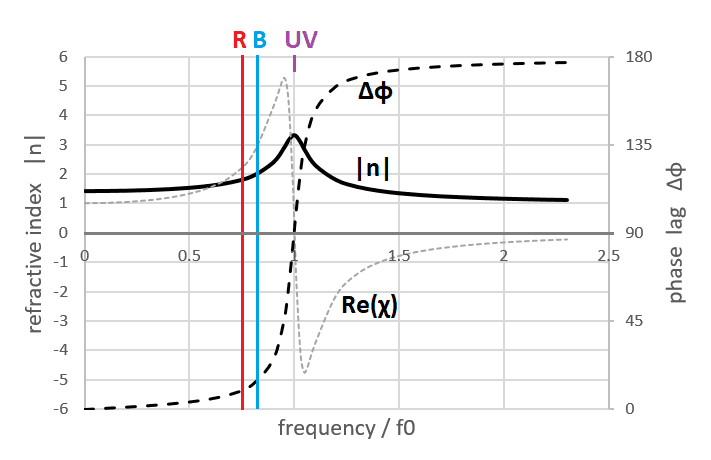
- Some participants suggest that the lower refractive index for red light can be explained by the Drude dispersion model, which relates electric susceptibility to frequency, but express confusion about how this relates to the speed of light.
- There is a recurring question about the relationship between the speed of light and electric susceptibility, with participants seeking a visual understanding of wave propagation delays rather than relying solely on equations.
- One participant notes that when considering light propagation in attenuating media, a complex refractive index should be used, which is tied to the complex dielectric function.
- Another participant references an old post that discusses how the Drude model explains the increase of refractive index with frequency, but expresses uncertainty about the details, particularly regarding phase delays and amplitude effects.
- There is a discussion about phase shifts at resonance, with some participants clarifying that a 90° phase shift occurs at resonance and that above resonance, the phase shift approaches 180°.
- One participant questions the assertion that the phase velocity of light would be higher than in a vacuum, particularly in the context of increasing frequency and decreasing amplitude.
- A later reply discusses high-frequency behavior where the refractive index can drop below one, explaining the interaction of incoming light with oscillating electrons and the resulting phase lag.
Areas of Agreement / Disagreement
Participants express various viewpoints and uncertainties regarding the application of the Drude model and the implications of phase shifts. There is no consensus on the explanations provided, and multiple competing interpretations remain present throughout the discussion.
Contextual Notes
Participants highlight limitations in their understanding of the Drude model's application to light propagation, particularly regarding phase delays and the relationship between amplitude and speed. The discussion also touches on the complexities introduced by using a complex refractive index in certain contexts.