Schwarzschild metric in terms of refractive index

Click For Summary

Discussion Overview

The discussion revolves around the interpretation of the Schwarzschild metric in terms of a refractive index, exploring the implications of this model for light propagation in a gravitational field. Participants examine theoretical aspects, mathematical formulations, and potential discrepancies between the optical model and general relativity.

Discussion Character

  • Exploratory
  • Technical explanation
  • Conceptual clarification
  • Debate/contested
  • Mathematical reasoning

Main Points Raised

  • Some participants propose that the gravitational field can be modeled as a medium with a refractive index, leading to effects such as light bending and time delays, specifically referencing the Shapiro time-delay.
  • Concerns are raised about the frequency dependence of the refractive index, as all known materials exhibit this property, which may challenge the validity of the model.
  • It is noted that the refractive index must be anisotropic in different directions, with specific formulations provided for radial and horizontal components.
  • Mathpages' use of an isotropic refractive index to approximate the Schwarzschild metric is discussed, with some differences highlighted, such as the photon orbit location.
  • A simplified model involving parallel layers is introduced, suggesting that additional curvature effects may arise when adapting the model to concentric spherical shells.
  • One participant questions the feasibility of finding a coordinate system where spatial slices are flat, indicating potential limitations in the approach.
  • Further investigation into the Euclidean versus non-Euclidean aspects of the model is suggested, emphasizing the theoretical concerns regarding the resemblance between the optical model and general relativity.

Areas of Agreement / Disagreement

Participants express multiple competing views regarding the interpretation of the refractive index model and its implications for the Schwarzschild metric. The discussion remains unresolved, with no consensus reached on the validity of the model or its limitations.

Contextual Notes

Limitations include the dependence on the assumptions of isotropy and frequency independence of the refractive index, as well as unresolved mathematical steps in adapting the model to different geometries.

yuiop
Messages
3,962
Reaction score
20
This is a spin off from another thread:

TrickyDicky said:
... To do this, we shall change the independent variable in Eq. (4.67) from the affine parameter λ to the coordinate time t by using the relation 0=dt2 +gαβ/g00dxα dxβ. (4.75) ...The Fermat principle is now equivalent to the statement that such a gravitational field acts like a medium with a refractive index n(x)=f(x)/ |g00(x)|. In addition to the bending of light, such an effective refractive index will also lead to a time delay in the propagation of light rays. This delay, called Shapiro time-delay has been observationally verified."
First there are a couple of mathpages http://mathpages.com/rr/s8-04/8-04.htm and http://mathpages.com/rr/s8-03/8-03.htm that discuss the refractive index model and highlights the differences.

The first obvious objection is that the 'medium' must have a refractive index that is independent of frequency, because there is no rainbow effect. In nature all known refractive materials are frequency dependent so the metric can't be interpreted in terms of any normal material. Then again, a vacuum can't be treated as a normal material as it does not cause any friction on objects passing through it.

The second objection is that the refractive index cannot be isotropic. In the radial direction, the refractive index has to be ##N_r = 1/(1=2m/r)## and in the horizontal direction the refractive index has to be ##N_x = 1/\sqrt{1-2m/r}##. This objection is not as strong as the previous one as many materials have non isotropic refractive index. See http://en.wikipedia.org/wiki/Double_refraction. Some artificial composite materials called meta-materials have refractive properties never seen in nature, such as negative refractive indexes.

Mathpages uses an isotropic refractive index of ##N = 1/(1=2m/r)## to approximate the Schwarzschild metric and finds some differences, mainly that the deflection is not quite right and that the photon orbit is at r=4m rather than the usual 3m.

Mathpages does not explore the non isotropic model in any detail and I was curious what that would look like, starting with this simplified model with parallel thin layers:
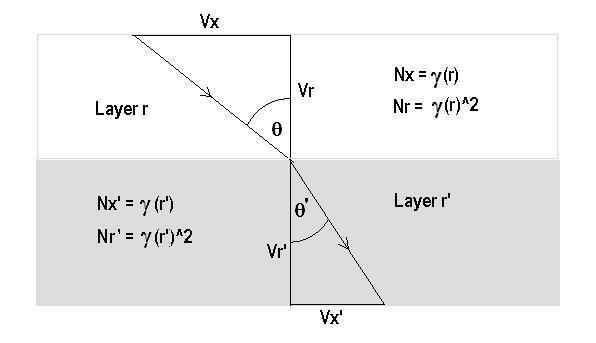
attachment.php?attachmentid=63323&stc=1&d=1382842103.jpg


The incident ray passes from layer r to layer r' with the refractive index and velocity of the ray broken down into orthogonal components. Here ##\gamma(r)## and ##\gamma(r')## mean ##1/\sqrt{1-2m/r}## and ##1/\sqrt{1-2m/r'}## respectively. Everything is measured in the coordinates of the observer at infinity. Layer r' is lower in the gravitational field than layer r and has a higher refractive index. By simple trigonometry it is easy to determine that:

\frac{\tan(\theta)}{\tan(\theta')} = \frac{V_x/V_r}{V_x'/V_r'} = \frac{\gamma(r)}{\gamma(r')} = \frac{N_x}{N_x'}

This is an interesting, yet still surprisingly simple version of Snell's law.

Mathpages mentions that the optical model does not take account of the additional curvature due to the curvature of spacetime. If we take the above simplified model with flat parallel layers and adapt it to the form of concentric spherical shells, it seems almost certain that their will be additional curvature of the incident ray due to the curvature of the refractive index shells, over and above the the parallel model, but whether that is enough to duplicate what is actually observed remains to be analysed.

P.S. The point of this exercise is to try and produce a mathematical model that may simplify some calculations or provide insight.
 

Attachments

  • SnellSch.jpg
    SnellSch.jpg
    10.8 KB · Views: 648
Last edited:
Physics news on Phys.org
yuiop said:
This is a spin off from another thread:


First there are a couple of mathpages http://mathpages.com/rr/s8-04/8-04.htm and http://mathpages.com/rr/s8-03/8-03.htm that discuss the refractive index model and highlights the differences.

The first obvious objection is that the 'medium' must have a refractive index that is independent of frequency, because there is no rainbow effect. In nature all known refractive materials are frequency dependent so the metric can't be interpreted in terms of any normal material. Then again, a vacuum can't be treated as a normal material as it does not cause any friction on objects passing through it.

The second objection is that the refractive index cannot be isotropic. In the radial direction, the refractive index has to be ##N_r = 1/(1=2m/r)## and in the horizontal direction the refractive index has to be ##N_x = 1/\sqrt{1-2m/r}##. This objection is not as strong as the previous one as many materials have non isotropic refractive index. See http://en.wikipedia.org/wiki/Double_refraction. Some artificial composite materials called meta-materials have refractive properties never seen in nature, such as negative refractive indexes.

Mathpages uses an isotropic refractive index of ##N = 1/(1=2m/r)## to approximate the Schwarzschild metric and finds some differences, mainly that the deflection is not quite right and that the photon orbit is at r=4m rather than the usual 3m.

Mathpages does not explore the non isotropic model in any detail and I was curious what that would look like, starting with this simplified model with parallel thin layers:

attachment.php?attachmentid=63323&stc=1&d=1382842103.jpg


The incident ray passes from layer r to layer r' with the refractive index and velocity of the ray broken down into orthogonal components. Here ##\gamma(r)## and ##\gamma(r')## mean ##1/\sqrt{1-2m/r}## and ##1/\sqrt{1-2m/r'}## respectively. Everything is measured in the coordinates of the observer at infinity. Layer r' is lower in the gravitational field than layer r and has a higher refractive index. By simple trigonometry it is easy to determine that:

\frac{\tan(\theta)}{\tan(\theta')} = \frac{V_x/V_r}{V_x'/V_r'} = \frac{\gamma(r)}{\gamma(r')} = \frac{N_x}{N_x'}

This is an interesting, yet still surprisingly simple version of Snell's law.

Mathpages mentions that the optical model does not take account of the additional curvature due to the curvature of spacetime. If we take the above simplified model with flat parallel layers and adapt it to the form of concentric spherical shells, it seems almost certain that their will be additional curvature of the incident ray due to the curvature of the refractive index shells, over and above the the parallel model, but whether that is enough to duplicate what is actually observed remains to be analysed.

P.S. The point of this exercise is to try and produce a mathematical model that may simplify some calculations or provide insight.

Good reference as it is usually the case from mathpages.
They conclude in the first reference that even though using isotropic coordinates of the Schwarzschild metric (with the radial coordinate defined as provided in the other thread) gives formally the same equations of motion for light paths that Fermat's optical model as shown in the Padmanabhan book and as confirmed in the form of the Shapiro delay by the Cassini probe, that resemblance is purely formal for many theoretical reasons(one of them independence from frequency as you point out, another that Fermat's optical model is Euclidean while GR's is obviously non-euclidean) (see the last 3 paragraphs of the first reference).
 
Last edited:
I haven't gotten into the mathematics yet, but is the basic idea that you want to find a coordinate system where the spatial slices are flat, so that all the curvature is thrown into the time component? That isn't always possible, is it?
 
TrickyDicky said:
... that resemblance is purely formal for many theoretical reasons(one of them independence from frequency as you point out, another that Fermat's optical model is Euclidean while GR's is obviously non-euclidean) (see the last 3 paragraphs of the first reference).
The Euclidean/non Euclidean aspect is a valid concern and I would like to investigate this further as below. (P.S. I don't think it is necessary or desirable to quote the entire OP in the first reply.)

stevendaryl said:
I haven't gotten into the mathematics yet, but is the basic idea that you want to find a coordinate system where the spatial slices are flat, so that all the curvature is thrown into the time component? That isn't always possible, is it?

I was considering things purely from the point of view of the effects on light such as deflection of light grazing the sun or the Shapiro delay. Mathpages does seem to concede that by using isotropic coordinates or a non-isotropic refractive index, that those effects can be exactly duplicated. I would like as a mathematical exercise try to do that with a non isotropic refractive index as mathpages did not actually attempt that.

The trouble is that when it comes to local measurements using natural rulers and clocks, things do not work so well. The isotropic version of the Schwarzschild metric uses 'unnatural' rulers where a vertical ruler will not match a horizontal ruler when rotated to the horizontal. I agree with stevendaryl that we cannot exactly duplicate the Schwarzschild metric locally with a model that depends only on the time component. Basically, the optical model can explain light paths in coordinate terms, but has to invoke gravitational time dilation and gravitational length contraction to explain local measurements and then becomes redundant. Nevertheless an optical model might be a useful mathematical tool for motion in a gravitational field. To handle timelike motion, presumably the equations will require a velocity dependent component.
 
yuiop said:
The isotropic version of the Schwarzschild metric uses 'unnatural' rulers where a vertical ruler will not match a horizontal ruler when rotated to the horizontal.

How do you figure that?
 
PeterDonis said:
How do you figure that?
Looks like I was getting coordinate and local measurements mixed up. I withdraw that bit.
 

Similar threads

  • · Replies 6 ·
Replies
6
Views
3K
  • · Replies 11 ·
Replies
11
Views
3K
  • · Replies 13 ·
Replies
13
Views
6K
  • · Replies 14 ·
Replies
14
Views
8K
  • · Replies 3 ·
Replies
3
Views
2K
  • · Replies 12 ·
Replies
12
Views
3K
  • · Replies 1 ·
Replies
1
Views
3K
  • · Replies 2 ·
Replies
2
Views
2K
  • · Replies 6 ·
Replies
6
Views
2K
  • · Replies 3 ·
Replies
3
Views
2K