Why is this equation about adding pure substances correct?

  • Thread starter Thread starter HAF
  • Start date Start date
  • Tags Tags
    Pure
Join the discussion
Ask a follow-up here, or get your own question answered by working scientists, mathematicians and engineers — people, not an autocomplete.
Real named experts · corrections over time · the nuance an AI answer skips
5 replies · 2K views
HAF
Messages
58
Reaction score
6
Hello,
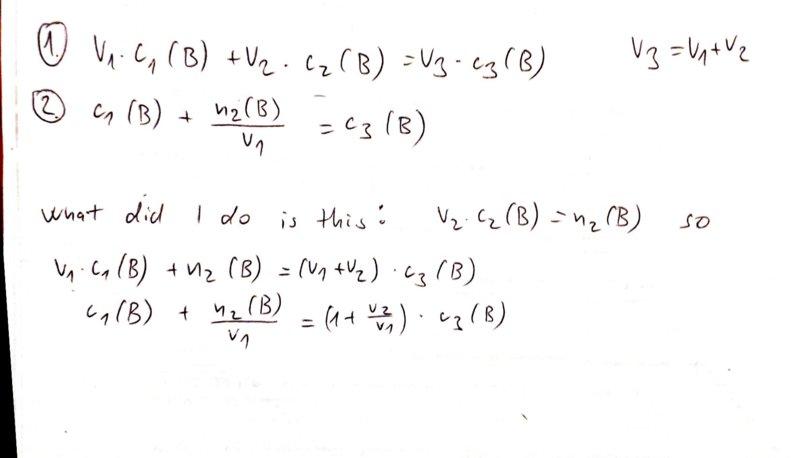
I have a little problem. I try to find out why the second equation in the picture is correct. How can I get it? Down on the paper is what I did.

Where did the (1+V2/V1) disappear from the right side of equation?

Thank You for every help.
Document 13_4.jpg
 

Attachments

  • Document 13_4.jpg
    Document 13_4.jpg
    22.8 KB · Views: 786
Last edited:
Chemistry news on Phys.org
In general you are right, something is wrong. Perhaps V2 is much lower than V1, then 1+V2/V1 is approximately 1.
 
Borek said:
In general you are right, something is wrong. Perhaps V2 is much lower than V1, then 1+V2/V1 is approximately 1.
Thank You sir. I really appreciate your help.
 
The clue is in the title of the post. Equation 1 is about mixing two solutions; Equation 2 is about adding pure B to a solution. There is no V2 and c2; n2 moles of pure B are added to solution 1. The assumption is that this does not result in any change to the volume V1 of the solution, which is a good approximation if c1 and c3 are both dilute.
 
  • Like
Likes   Reactions: Borek
mjc123 said:
The clue is in the title of the post. Equation 1 is about mixing two solutions; Equation 2 is about adding pure B to a solution. There is no V2 and c2; n2 moles of pure B are added to solution 1. The assumption is that this does not result in any change to the volume V1 of the solution, which is a good approximation if c1 and c3 are both dilute.
I understand what you want to tell me but can I ask something?

Why by adding pure B the volume does not change?
 
It does change, but not by very much if the solutions are dilute. If the volume of solute is much smaller than the volume of solvent, it can often be practically ignored, and we can say with minimal error that concentration = moles of solute/volume of solvent. For highly accurate work we need to take volume changes into account, and of course the assumption breaks down for concentrated solutions.