Why parts of the laser ray seem brighter than other parts

  • Context: High School 
  • Thread starter Thread starter titansarus
  • Start date Start date
  • Tags Tags
    Laser Light parts Ray
Click For Summary

Discussion Overview

The discussion centers on the visual perception of laser rays, specifically why certain parts of the laser appear brighter and exhibit a vibrating effect. Participants explore the implications of environmental factors, such as dust and smoke, on the visibility of laser beams, as well as the conditions under which laser beams can be observed.

Discussion Character

  • Exploratory
  • Technical explanation
  • Debate/contested

Main Points Raised

  • One participant suggests that the varying brightness of the laser ray could be due to differing amounts of dust in the air.
  • Another participant notes that the visibility of the laser beams is contingent upon a colloidal dispersion, such as smoke or fog, which allows the beams to be seen.
  • There is a discussion about whether a laser beam would be visible in a vacuum, with some participants asserting that it would not be seen unless it interacts with an object or hits the eye.
  • A participant proposes testing the visibility of a laser beam in a vacuum using a vacuum airtight glass tube, claiming that no beam is visible inside the tube.
  • One participant emphasizes that light travels in straight lines and requires something to scatter off, like dust or moisture, to be visible from the side.
  • Another participant mentions the use of smoke machines in film production to enhance the visibility of laser beams.

Areas of Agreement / Disagreement

Participants express differing views on the visibility of laser beams in a vacuum and the factors contributing to the perception of brightness in laser rays. There is no consensus on the primary reason for the observed effects.

Contextual Notes

Some assumptions about the conditions under which laser beams are visible remain unresolved, particularly regarding the interaction of light with different mediums and the implications of vacuum conditions.

titansarus
Messages
62
Reaction score
0
Hi.

When we see a laser ray, it seems that part of the ray are brighter than the other parts and they seem like they’re vibrating and moving. It also seems there are fractures in its path. I want to know why do we see like this?

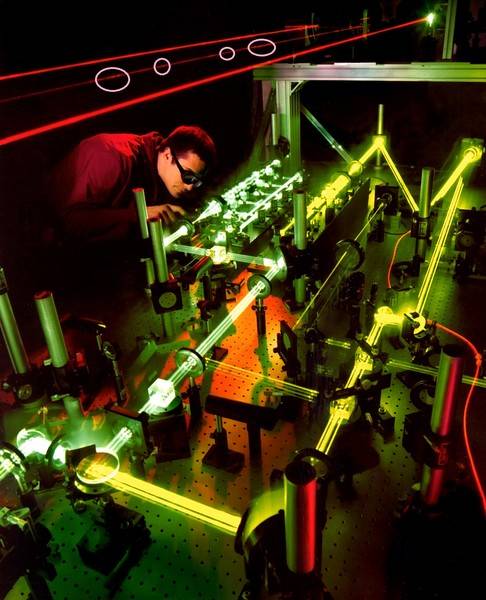
For example see this picture (it is from wikipedia). I circled some parts with pink. Why some of these parts are brighter than the others? And it seems there are fractures in its path (the rightmost circled one). Is it because of the procedure of making laser (stimulating) and that it is not a completely constant procedure in atomic scale?
Sorry for my English and thanks in advance.
6EEU8Xy.jpg
 

Attachments

  • 6EEU8Xy.jpg
    6EEU8Xy.jpg
    48.6 KB · Views: 735
Science news on Phys.org
probably differing amounts of dust in the air
 
The only reason you are seeing the beams at all is that a colloidal dispersion (smoke, vapor (fog), or dust) is being used.
In the photo above, most beams are saturating the image - so variations in their intensity will not be rendered.
For the weaker beams, there are variations in the density of the fog.
 
titansarus said:
When we see a laser ray,...
... there must something in its way.

 
.Scott said:
The only reason you are seeing the beams at all is that a colloidal dispersion (smoke, vapor (fog), or dust) is being used.
You mean in vacuum you won't see the polarized beam at all. How can we test that here on earth?

P.S. (restatement of the first part): that means in vacuum you won't see the polarized beam at all.
 
Last edited:
Stavros Kiri said:
You mean in vacuum you won't see the polarized beam at all.
You would see it, if it hits your eye.
 
A.T. said:
You would see it, if it hits your eye.
Or see the dot when it hits an object. (My original statement (the first part) was not a question.)
 
Stavros Kiri said:
You mean in vacuum you won't see the polarized beam at all. How can we test that here on earth?

P.S. (restatement of the first part): that means in vacuum you won't see the polarized beam at all.
About the 2nd part: we can use a vacuum airtight glass tube and let the laser cross it. I just tried and it works. No beam inside.

[Or we can observe the beam changes for dimmer and dimmer air ... . That kind of explains (/is related to) also the original question:]
titansarus said:
When we see a laser ray, it seems that part of the ray are brighter than the other parts and they seem like they’re vibrating and moving. It also seems there are fractures in its path. I want to know why do we see like this?
 
Last edited:
Stavros Kiri said:
You mean in vacuum you won't see the polarized beam at all. How can we test that here on earth?
You've heard, maybe, of vacuum chambers?
 
  • #10
phinds said:
You've heard, maybe, of vacuum chambers?
You're late!
Stavros Kiri said:
About the 2nd part: we can use a vacuum airtight glass tube and let the laser cross it. I just tried and it works. No beam inside.
 
  • #11
Stavros Kiri said:
You're late!
Yeah, not paying enough attention.
 
  • #12
phinds said:
Yeah, not paying enough attention.
Don't we all ... sometimes
 
  • #13
phinds said:
probably differing amounts of dust in the air

This. Light always* travels in completely straight lines. For you to see the laser "beam" from the side, the light has to bounce off of something, like moisture or a speck of dust.
In film production, or at concerts, they will often use lasers in combination with dry-ice smoke machines and/or smoke from pyrotechnics to create the affect of a beam going through the air.

*(I don't know what happens to light when near black holes or other cosmic disturbances)
 

Similar threads

  • · Replies 12 ·
Replies
12
Views
2K
  • · Replies 2 ·
Replies
2
Views
11K
Replies
8
Views
5K
  • · Replies 11 ·
Replies
11
Views
3K
  • · Replies 7 ·
Replies
7
Views
4K
  • · Replies 6 ·
Replies
6
Views
3K
  • · Replies 25 ·
Replies
25
Views
3K
  • · Replies 28 ·
Replies
28
Views
5K
  • · Replies 5 ·
Replies
5
Views
2K
  • · Replies 4 ·
Replies
4
Views
2K