High School Why to write numbers in square roots and not in decimals?

Click For Summary
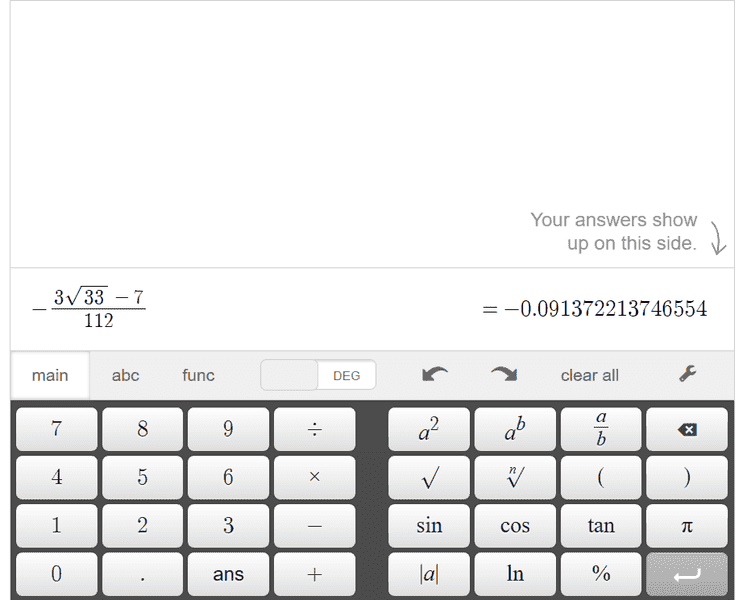
Writing numbers in square roots provides exact values, while decimal representations are merely approximations and always carry some error. For instance, the coefficient of x² can be expressed as -0.091372213746554, but this is not exact; it can only be approximated with more digits. In contrast, expressions like -\frac{3\sqrt{33}-4}{112} offer an exact representation. The discussion highlights the distinction between rational approximations and irrational numbers, such as \sqrt{2}, which cannot be precisely expressed in decimal form. Understanding this difference is crucial for accurate mathematical representation.
pairofstrings
Messages
411
Reaction score
7
Hi. I have coefficient of x2 as
Screenshot-2018-6-27%20Desmos%20Scientific%20Calculator_zpspvlymbzx.png


in an expression that looks like this
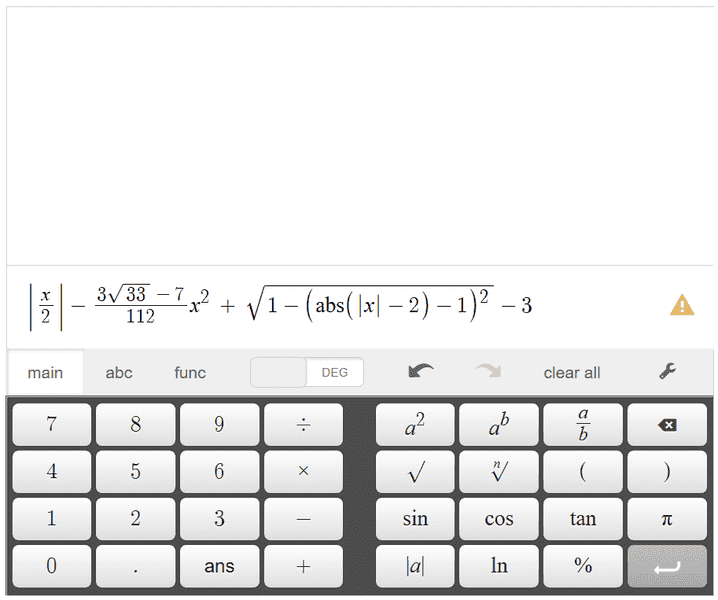
Screenshot-2018-6-27%20Desmos%20Scientific%20Calculator1_zps61nrorgw.png


* calculator shows little yellow triangle because 'x' is not defined.

If I can write the coefficient of x2 as - 0.091372213746554 then why did the author write coefficient of x2 like this shown below?
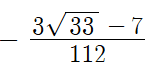
Screenshot-2018-6-27%20Desmos%20Scientific%20Calculator2_zpsji2vfmgf.png


Thanks.
 

Attachments

  • Screenshot-2018-6-27%20Desmos%20Scientific%20Calculator_zpspvlymbzx.png
    Screenshot-2018-6-27%20Desmos%20Scientific%20Calculator_zpspvlymbzx.png
    22.2 KB · Views: 898
  • Screenshot-2018-6-27%20Desmos%20Scientific%20Calculator1_zps61nrorgw.png
    Screenshot-2018-6-27%20Desmos%20Scientific%20Calculator1_zps61nrorgw.png
    19.4 KB · Views: 881
  • Screenshot-2018-6-27%20Desmos%20Scientific%20Calculator2_zpsji2vfmgf.png
    Screenshot-2018-6-27%20Desmos%20Scientific%20Calculator2_zpsji2vfmgf.png
    1 KB · Views: 555
Last edited:
Mathematics news on Phys.org
pairofstrings said:
the author
Of what?
 
-0.091372213746554 is not exact. It is only an approximation, where the number of digits is determined by the the calculator. A better approximation is:
-0.091372213746554339103141378613 - but that is again not exact, it just has a smaller error. No matter how many digits you add you always have an error.

##\displaystyle -\frac{3\sqrt{33}-4}{112}## is exact.
 
  • Like
Likes symbolipoint and jedishrfu
@pairofstrings, you seem to have a fundamental misunderstanding of the difference between numbers represented by radicals and decimal approximations of them. For example, the exact value of the diagonal of a square 1 unit on each side is ##\sqrt 2##. This value can be approximated by 1.414 or 1.4142 or 1.41421 or even 1.4142135623730950488016887242097, but none of them is exactly equal to ##\sqrt 2##.

##\sqrt 2## is an example of an irrational number, one whose decimal represention takes an infinite number of digits to the right of the decimal point, with no repeating pattern.
 
Here is a little puzzle from the book 100 Geometric Games by Pierre Berloquin. The side of a small square is one meter long and the side of a larger square one and a half meters long. One vertex of the large square is at the center of the small square. The side of the large square cuts two sides of the small square into one- third parts and two-thirds parts. What is the area where the squares overlap?

Similar threads

  • · Replies 13 ·
Replies
13
Views
6K
  • · Replies 2 ·
Replies
2
Views
2K
  • · Replies 16 ·
Replies
16
Views
4K
  • · Replies 3 ·
Replies
3
Views
1K
  • · Replies 18 ·
Replies
18
Views
4K
  • · Replies 4 ·
Replies
4
Views
3K
  • · Replies 30 ·
2
Replies
30
Views
6K
  • · Replies 10 ·
Replies
10
Views
3K
  • · Replies 21 ·
Replies
21
Views
2K
  • · Replies 1 ·
Replies
1
Views
4K