MattRob
- 208
- 29
So, recently I've been interested in the SLS - renewed particularly on hearing it'll launch this year for the first time. That's super exciting news.
But looking into it (and building a replica of one in Realism Overhaul of Kerbal Space Program...), I found the ICPS (Interim Cryogenic Propulsion Stage), which is a modified DCSS (Delta Cryogenic Second Stage), and I think it looks incredibly awesome, but I can't help but wonder why they built it like this:
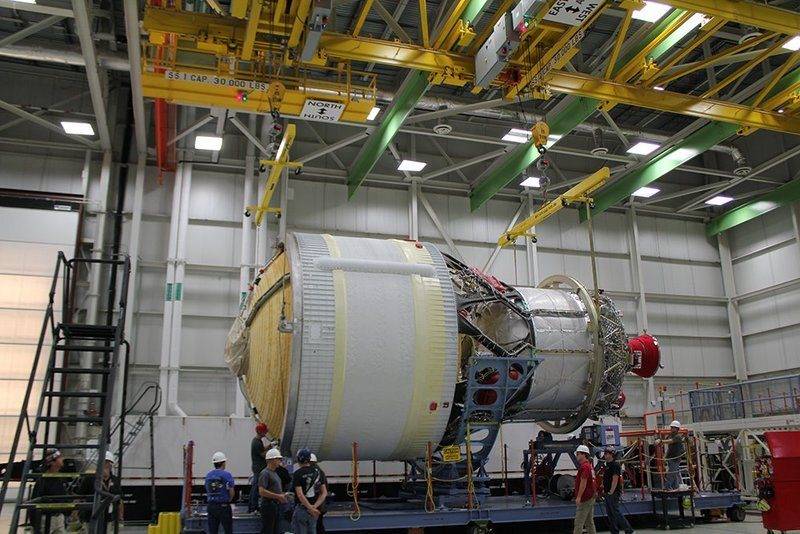
Edit: Very high resolution image.
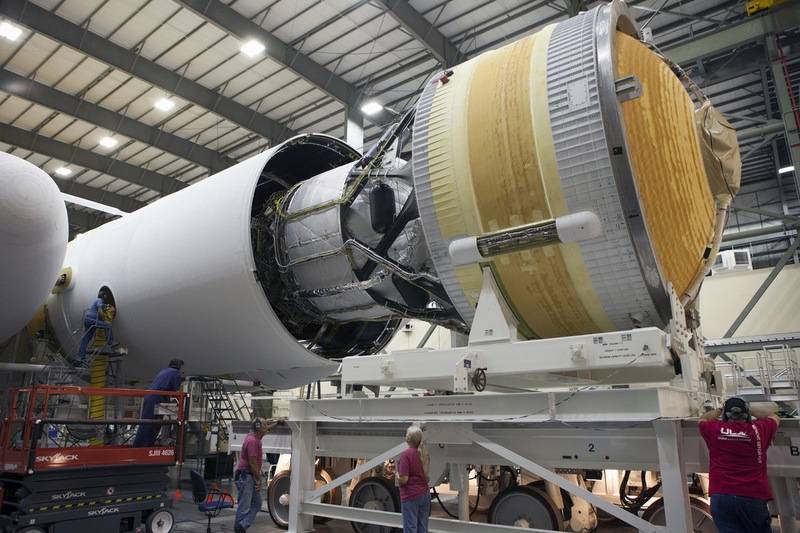
As can be seen here, this design, awesome as it looks, means that a fairing structure has to reach up to the upper Liquid Hydrogen (LH2) tank.
Typically, launch vehicles will combine the walls of the tanks with the structural walls of the vehicle. But for some reason they opted to make the Liquid Oxygen (LOX) tank significantly thinner than the vehicle so its walls are not structural supports for the rocket until the upper stage engine fires.
It seems very counter-intuitive to do this. It means you need a second structure - you need the structural elements connecting the LOX and LH2 tank as well as the fairing walls that support the LH2 tank during the first stage burn.
It just seems like it adds a lot of completely unnecessary dry mass. So why did they design it this way instead of the more usual way? Does anybody know or have any ideas?
I was going to ask why it was so unoptimized, in terms of being so much smaller than the stage before it/having a much lower mass fraction, but in hindsight it somewhat makes sense - perhaps to drop the first stage just before orbit, then do orbit and orbit adjustment operations (adjustment or placement into GTO) using the tiny thrust, but high-efficiency RL10-B2?
Still doesn't explain the odd design, though.
EDIT: Perhaps it's related, though - that the LOX tank walls would have to be much stronger to take the peak G forces just before first stage cutoff, but this way they can be much lighter since they don't take the pressure from supporting the entire vehicle under high g-forces, and don't need to since the second stage has such low thrust?
But looking into it (and building a replica of one in Realism Overhaul of Kerbal Space Program...), I found the ICPS (Interim Cryogenic Propulsion Stage), which is a modified DCSS (Delta Cryogenic Second Stage), and I think it looks incredibly awesome, but I can't help but wonder why they built it like this:
Edit: Very high resolution image.
As can be seen here, this design, awesome as it looks, means that a fairing structure has to reach up to the upper Liquid Hydrogen (LH2) tank.
Typically, launch vehicles will combine the walls of the tanks with the structural walls of the vehicle. But for some reason they opted to make the Liquid Oxygen (LOX) tank significantly thinner than the vehicle so its walls are not structural supports for the rocket until the upper stage engine fires.
It seems very counter-intuitive to do this. It means you need a second structure - you need the structural elements connecting the LOX and LH2 tank as well as the fairing walls that support the LH2 tank during the first stage burn.
It just seems like it adds a lot of completely unnecessary dry mass. So why did they design it this way instead of the more usual way? Does anybody know or have any ideas?
I was going to ask why it was so unoptimized, in terms of being so much smaller than the stage before it/having a much lower mass fraction, but in hindsight it somewhat makes sense - perhaps to drop the first stage just before orbit, then do orbit and orbit adjustment operations (adjustment or placement into GTO) using the tiny thrust, but high-efficiency RL10-B2?
Still doesn't explain the odd design, though.
EDIT: Perhaps it's related, though - that the LOX tank walls would have to be much stronger to take the peak G forces just before first stage cutoff, but this way they can be much lighter since they don't take the pressure from supporting the entire vehicle under high g-forces, and don't need to since the second stage has such low thrust?