Why we rejected inclined (drafting style) table for studying?

18 replies · 5K views · last reply
user079622
Messages
449
Reaction score
29
Wouldn't it be better for people how study, read/write 8hours every day, to have inclined table?
Today table is not good for your neck.
Monitors stay vertical and will never stay horizontal...


Why we rejected inclined table in school system?

Black and white woodcut of a scholar in a robe and cap seated at a sloped reading desk, writing in a large open book, with shelves of books behind him.


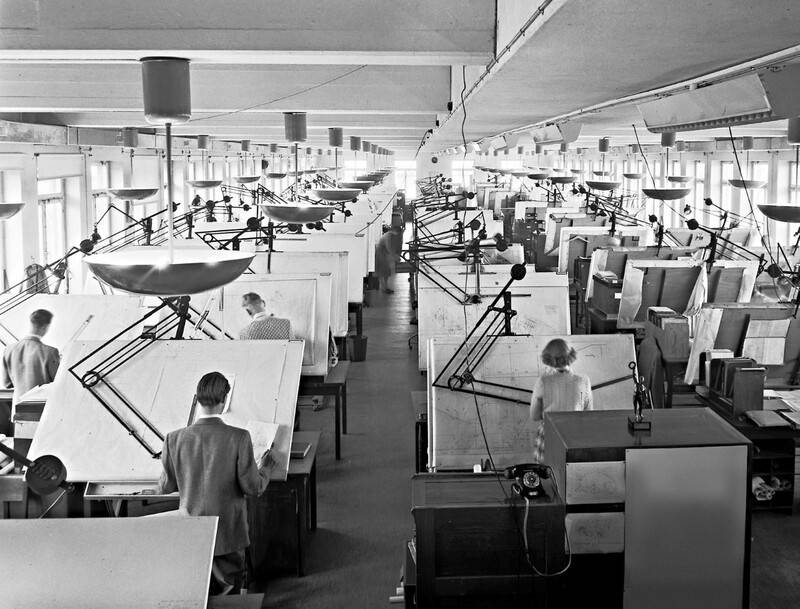
Black-and-white photo of a large drafting room with rows of slanted drafting tables, each with a hanging dome lamp on a jointed arm, and people working at them.
 
Last edited:
I always thought it was to minimize visual distortion.
 
Frabjous said:
I always thought it was to minimize visual distortion.
Imagine how much pain will people have if monitors stay horizontal in office!
 
user079622 said:
Why we rejected inclined table in school system?
Because the books keep falling off... :smile:
 
  • Like
Likes   Reactions: mcastillo356
user079622 said:
Imagine how much pain will people have if monitors stay horizontal in office!
Let me expand. Incline is to minimize visual distortion when drawing.
 
Frabjous said:
Let me expand. Incline is to minimize visual distortion when drawing.
I think in middle age they didnt know that, but it was more about comfortable posture.
 
My coffee cup (as well as the pile of everything else) says "NO WAY".
 
  • Like
Likes   Reactions: mcastillo356, russ_watters and berkeman
user079622 said:
I think in middle age they didnt know that, but it was more about comfortable posture.
They spent a lot of time copying things. I believe they were very aware of distortion.
 
user079622 said:
No they dont :smile:
I used a drafting table for my home work surface for many years. There was a raised stop at the lower edge like you show, but that was about waist-height for me in my normal drafting chair. Not a comfortable height for reading a book.

Work sheets were hand-held or taped in the middle of my drafting table, and I did not use it for reading books. A better solution to your original question would be to just use an adjustable "standing desk" arrangement. Those are pretty common now, where you can use them as a regular sitting desk and then push a button to have them raise up to standing work height.

Man in a plaid shirt and glasses standing at a sit-stand desk converter on a wooden desk, with two monitors, a laptop and a keyboard on the raised black platform.

https://www.ebay.com/itm/134859017172
 
user079622 said:
Why we rejected inclined table in school system?
Cost versus ergonomics versus taxes versus workmanship has something to do with it.
With the advent of education for the masses cost ( and taxes ) won out with the cheaper is better mentality that hit manufacturing and business.
Some early desk designs ( 60s or so ) even had arm rests for the writing hand.
Most early designs did have a slight incline for the writing surface.
Better than the plank that they replaced.
 
  • Like
Likes   Reactions: Klystron and Lnewqban
A large document of a tilted surface will also allow easier access (reach) for drawing (or whatever) on the farthest parts of the document.
 
256bits said:
Cost versus ergonomics versus taxes versus workmanship has something to do with it.
With the advent of education for the masses cost ( and taxes ) won out with the cheaper is better mentality that hit manufacturing and business.
Some early desk designs ( 60s or so ) even had arm rests for the writing hand.
Most early designs did have a slight incline for the writing surface.
Better than the plank that they replaced.
What is the best angle for writing?
Does writing and drafting demand same angle?
 
user079622 said:
Why we rejected inclined table in school system?
I believe it was about efficiency. A school table has multiple functions: reading, storage and writing: for multiple types of lectures: for various ages/sizes of pupils: had to be able to provide oversight.
And, when school system become mandatory/mainstream, they had to be cheap => simple, flat tables.

By the way, for more specialized, higher level education inclined tables never went away.
Medieval manuscript miniature of a lecture: a robed professor speaks from a raised pulpit on the left while students sit at sloped reading desks with open books on the right, and a row of seated scholars in red and blue robes watches in the foreground.

At university/college level lecture theatres with a bit classical vibe still happen to have inclined tables.
 
Last edited:
user079622 said:
What is the best angle for writing?
Does writing and drafting demand same angle?
I don't know that answer, but I know that the height is as important as the angle for standing-only working tables.

Rustic tables are normally built in construction sites to open and study drawings and to have group discussions about the specified in them.
The slanted area is generous in size in order to accommodate thick folds of opened plans.

Contractors do not do drawing work, but markups and notes are common occurrences, as well as measurements with scale rules (of triangular cross-section).
That is where the shapes of hexagonal and carpenter pencils become relevant.
I have not seen one of those tables with a horizontal surface.

The builder's and inspector's alternatives are kneeling on the floor or leaning over the tailgate of a pickup truck to review construction drawings.


Exploded diagram of a slanted drafting table with a 3/4" plywood top held by 1/4" dowels in holes, a 2x4 stock frame, butt hinges and pocket screws, labeled width less than half the length of the base.

Triangular architect's scale ruler with a 1:100 scale marked on one face, numbered graduations from 0 to 10 and a red stripe along the middle.

Four orange hexagonal carpenter pencils with black tips lying on a pale wooden board, each printed with THE HOME DEPOT and a barcode.


A construction worker in a hard hat, high-visibility vest and tool belt leans over a sloped drafting-style table on a mobile base, marking up printed plans with a pencil in an unfinished interior.


Freestanding white PVC-pipe table on casters with a tilted plywood top, with a large construction drawing sheet lying on the slanted surface, in an unfinished concrete-floored warehouse.
 
Last edited:
When I was a wee lad, I had a desk at home that was school surplus from a long time ago - perhaps the 1920's. It had an angle about the same as the picture of the one with the guy with a hard hat. It also had places for bottles of ink. :smile:

In high school, the desks looked flat, but were slightly tilted. A round pencil would roll towards the student. Fortunately, I used Eberhard Faber Mongol 462 #2's which were hexagonal.