Will steam generated inside an oven not break it?

Click For Summary
SUMMARY

This discussion centers on the feasibility of using an electric oven to steam rice cakes, addressing concerns about pressure buildup and steam management. Participants confirm that typical ovens are not airtight and thus cannot create significant pressure, as steam escapes through door seams and other small openings. The consensus is that while using an oven for steaming is possible, it is not ideal due to potential issues with radiation heat and condensation. The user successfully prepared rice cakes in the oven, noting that the top layer was hard due to radiation heat.

PREREQUISITES
  • Understanding of basic cooking techniques, particularly steaming.
  • Familiarity with the operation of electric ovens.
  • Knowledge of steam generation and its effects on cooking.
  • Awareness of the differences between pressure cookers and conventional ovens.
NEXT STEPS
  • Research the differences between steaming in an oven versus a stovetop steamer.
  • Learn about the effects of radiation heat in cooking, particularly in electric ovens.
  • Investigate the design and function of convection ovens and their ventilation systems.
  • Explore techniques for managing moisture and condensation in baking and steaming processes.
USEFUL FOR

Cooks, home chefs, and anyone interested in alternative steaming methods using electric ovens, particularly those looking to replicate traditional recipes in non-traditional settings.

k.udhay
Messages
167
Reaction score
13
Disclaimer first: Though the question is around cooking, IMO it certainly is to with physics / engineering. Yet, if the admins find this post inappropriate, pl. delete it.

I am planning to make some rice cakes which is prepared by steaming a mix of rice powder and water. Because I don't have the special cooker used for that at my current location, I though of using the electric oven in my house. While google search tells me it is possible to use oven as a steamer, I am a bit scared of two reasons:

1. The procedure in my mind is by placing the dough and a tray of water inside the oven (shown in pic.):
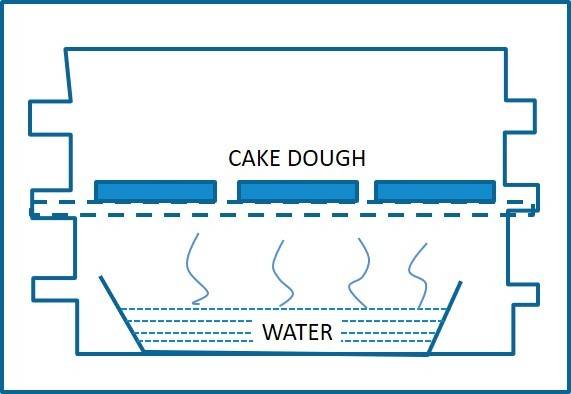
Idli.jpg


Once the oven starts generating steam, will it not create a high pressure inside? This looks more like a pressure cooker to me. How do ovens handle this extreme force? I see the front door is made of glass.

2. The steam generated will settle on the walls and ceiling of the oven. Does it cause any problem to the oven. Once cooled down, they will drip down as water. Is there a draining system?
 
Physics news on Phys.org
Not a good idea, in my opinion.
The dough will receive radiation heat in addition to any cooking effect from 100°C steam.
Not sure how well isolated from the steam the electrical staff is.
Pressure may build up inside the cavity.
No place to go for condensation.
 
  • Like
Likes   Reactions: k.udhay
How is this different than, say, roasting a turkey with water at the bottom of the roasting pan, or any number of casserole type things where steam is released while it cooks?
 
  • Like
Likes   Reactions: BillTre, Astronuc, russ_watters and 1 other person
BWV said:
How is this different than, say, roasting a turkey with water at the bottom of the roasting pan, or any number of casserole type things where steam is released while it cooks?

I really have no idea. And that's exactly my question.
 
Lnewqban said:
Not a good idea, in my opinion.
The dough will receive radiation heat in addition to any cooking effect from 100°C steam.
Not sure how well isolated from the steam the electrical staff is.
Pressure may build up inside the cavity.
No place to go for condensation.

Radiation is not wanted here. I agree that this is a bad idea then.
 
  • Like
Likes   Reactions: russ_watters
What about those stovetop bamboo steamers which sit on top of a pan of water, like you make Chinese dumplings with?
 
No idea what kind of the oven you are talking about, but unless it is really airtight when closed there is no way for the pressure to go up. Most ovens I can think of will just freely release the steam long before any real pressure builds up.
 
  • Like
Likes   Reactions: hutchphd, phinds, Klystron and 5 others
BWV said:
What about those stovetop bamboo steamers which sit on top of a pan of water, like you make Chinese dumplings with?
Hi... I am really sorry, I don't know the dishes or recipes you are talking about. The way I used to cook these rice cakes is by allowing a continuous steam leakage. Do ovens also have that leakage possibility?
 
Borek said:
No idea what kind of the oven you are talking about, but unless it is really airtight when closed there is no way for the pressure to go up. Most ovens I can think of will just freely release the steam long before any real pressure builds up.
Is there a way we can check? Are these vents (or leakage points) visible?
 
  • #10
Can you post a picture of the oven?

In most cases there are no vents nor anything like that, as the lid itself is not even remotely airtight, nor is the case. Trying to pump up typical oven is a bit like using colander to carry water, plenty of small holes and leaks that won't let to keep the gas in.

Compare typical oven with a pressure cooker. The latter is built of a single piece of metal, with a carefully shaped lid and a strong seal. Otherwise it wouldn't work.
 
  • Like
  • Love
Likes   Reactions: BillTre, k.udhay and russ_watters
  • #11
k.udhay said:
Hi... I am really sorry, I don't know the dishes or recipes you are talking about. The way I used to cook these rice cakes is by allowing a continuous steam leakage. Do ovens also have that leakage possibility?
 
  • #12
k.udhay said:
I really have no idea. And that's exactly my question.
If this is a normal oven, it is not a sealed pressure vessel. It is incapable of holding pressure. The extra air/steam volume simply escapes through the door seam.

Try this exercise:
-Pull on the door handle. Estimate the force it took to crack open.
-Divide by half the area of the door to get the pressure. You'll see it is tiny.

For condensation, it should not be an issue because the steam is being generated slowly and shouldn't cause the humidity to be high enough for condensation on the hot, insulated walls.
 
  • Love
Likes   Reactions: k.udhay
  • #13
Your oven isn't airtight. Pretty much everything you might think to bake has a lot of moisture. And even lacking that the air itself would expand when heated. It's vented, trust me.

Just the same, a stovetop steamer sounds like a better way to do it.
 
  • Like
  • Informative
Likes   Reactions: mfb, BillTre, k.udhay and 1 other person
  • #14
Borek said:
Can you post a picture of the oven?

In most cases there are no vents nor anything like that, as the lid itself is not even remotely airtight, nor is the case. Trying to pump up typical oven is a bit like using colander to carry water, plenty of small holes and leaks that won't let to keep the gas in.
Quick clarification: for insulation and fire safety i would hope a typical oven is an airtight, steel chamber -- except for the softly-closing, hinged door.
 
  • Like
Likes   Reactions: hutchphd
  • #15
Making steam in an oven sounds like a decent way to clean the oven.
 
  • Like
Likes   Reactions: k.udhay and russ_watters
  • #16
russ_watters said:
Quick clarification: for insulation and fire safety i would hope a typical oven is an airtight, steel chamber -- except for the softly-closing, hinged door.
I have never seen an oven that is not ventilated. For example:
9uM8AWQ.jpg
 
  • Like
Likes   Reactions: k.udhay and jim mcnamara
  • #17
Borek said:
Can you post a picture of the oven?

In most cases there are no vents nor anything like that, as the lid itself is not even remotely airtight, nor is the case. Trying to pump up typical oven is a bit like using colander to carry water, plenty of small holes and leaks that won't let to keep the gas in.

Compare typical oven with a pressure cooker. The latter is built of a single piece of metal, with a carefully shaped lid and a strong seal. Otherwise it wouldn't work.

Clear! I am planning to take a trial today. Will update here tomorrow :)
 
  • #18
DrClaude said:
I have never seen an oven that is not ventilated. For example:
View attachment 269935
Is that an electric? Clearly a gas oven needs ventilation, but I can't think of a reason to ventilate an electric oven.
 
  • #19
russ_watters said:
Is that an electric? Clearly a gas oven needs ventilation, but I can't think of a reason to ventilate an electric oven.
Yes, electric. See
 
  • #20
k.udhay said:
Once the oven starts generating steam, will it not create a high pressure inside?
No.
russ_watters said:
Clearly a gas oven needs ventilation, but I can't think of a reason to ventilate an electric oven.
There is a sealing gasket on the oven door, but it's not airtight.
 
  • Like
  • Love
Likes   Reactions: k.udhay and Astronuc
  • #21
DrClaude said:
Yes, electric. See

Hmm -- air circulation for uniform heating. Interesting. I wonder if that applies to convection ovens too (probably, if they can operate in a non-convection mode).
 
  • #22
k.udhay said:
Once the oven starts generating steam, will it not create a high pressure inside? This looks more like a pressure cooker to me. How do ovens handle this extreme force? I see the front door is made of glass.
As Mark44 inferred, as long as the interior volume of the oven communicates with the external atmosphere (air) outside (it's not air tight), the inside pressure will equilibrate with the outside (1 atm). The steam from water will be at saturated conditions (as 1 atm) while some steam will be superheated if the oven is above 212°F (100°C).
 
  • Like
Likes   Reactions: Klystron and russ_watters
  • #23
russ_watters said:
Hmm -- air circulation for uniform heating. Interesting. I wonder if that applies to convection ovens too (probably, if they can operate in a non-convection mode).
I have a convection oven and it is ventilated, not as in the picture above, but through a dedicated vent near the back of the top, the black thing you can see in this picture of a similar model:
104427_1.jpg
 
  • #24
russ_watters said:
Quick clarification: for insulation and fire safety i would hope a typical oven is an airtight, steel chamber -- except for the softly-closing, hinged door.

Steel chamber - yes, but not very airtight. All ovens I have seen were made from metal sheets screwed to metal frame, I don't remember gaskets nor even silicon sealing. So they were definitely tight enough to keep fire inside in case of some culinary disaster, but not tight enough to keep any elevated pressure - plenty of tiny gaps between elements.
 
  • Like
Likes   Reactions: russ_watters
  • #25
Borek said:
Steel chamber - yes, but not very airtight. All ovens I have seen were made from metal sheets screwed to metal frame, I don't remember gaskets nor even silicon sealing. So they were definitely tight enough to keep fire inside in case of some culinary disaster, but not tight enough to keep any elevated pressure - plenty of tiny gaps between elements.
Mostly keeps the heat in, but can slowly release steam or smoke, as I have witnessed. :rolleyes:
 
  • #26
An airtight oven would be a pressure cooker unless you were "cooking" something with little or no moisture. What kind of food would that be? Even dry air would typically increase to something like 1 bar gauge in a fully sealed oven. That's an oven that would need pretty strong walls and some sort of pressure release safety valve. That's an oven you'd want to return to the store.
 
  • Like
Likes   Reactions: k.udhay
  • #27
Thank you all! The rice cake turned better than I expected. This forum has now given me an easy and quick method to repeat my traditional food in a new place :)

Like @Lnewqban said, the upper layer of the cake was a bit hard perhaps because of the radiation it received. I plan to cover it with a well water-soaked cloth next time.

Because of the anxiety followed by excitement, I forgot to take pictures :(

Wish you a nice day!
 
  • #28
k.udhay said:
the upper layer of the cake was a bit hard perhaps because of the radiation it received. I plan to cover it with a well water-soaked cloth next time.
Not radiation - hot air circulation.

Unless you had the top element on also.
You should have Bake and Broil settings for the oven.
https://recipes.howstuffworks.com/tools-and-techniques/question228.htm
 
  • #29
k.udhay said:
The rice cake turned better than I expected.

Sigh. You were given so much help, people spent so much time discussing your oven, and you have the audacity to claim the cake is good and to not post the recipe? Shame on you! :wink:
 
  • Haha
Likes   Reactions: k.udhay and berkeman
  • #30
Borek said:
Sigh. You were given so much help, people spent so much time discussing your oven, and you have the audacity to claim the cake is good and to not post the recipe? Shame on you! :wink:

Honestly, I am pretty sure this won't be an interesting taste to the people other than the south part of India [:rolleyes:] Yet I will provide a link:

https://simmertoslimmer.com/how-to-make-soft-idlis/

P.s. - This is not a sweet one. Apologies if you were deceived by the word "cake" :-p
 
  • Like
Likes   Reactions: Borek

Similar threads

  • · Replies 12 ·
Replies
12
Views
6K
Replies
8
Views
5K
  • · Replies 1 ·
Replies
1
Views
4K
  • · Replies 25 ·
Replies
25
Views
8K
  • · Replies 1 ·
Replies
1
Views
10K