Work Done by the Gravitational Force

Click For Summary
SUMMARY

The discussion focuses on calculating work done by gravitational force on a block of ice sliding down a frictionless ramp at a 50° angle. The user initially miscalculated the work done by the applied force (Fr = 60 N) as Wt = 60 * 0.3 * cos(50) = 12 J. The correct understanding is that the force and displacement are parallel to the ramp's surface, simplifying the calculation. The kinetic energy of the block increases by 80 J, and without the rope, the kinetic energy would have been greater by 12 J, confirming the user's final understanding of the problem.

PREREQUISITES
  • Understanding of gravitational force and work-energy principles
  • Knowledge of trigonometric functions (cosine and sine) in physics
  • Familiarity with kinetic energy calculations
  • Basic concepts of frictionless surfaces in physics
NEXT STEPS
  • Study the work-energy theorem in classical mechanics
  • Learn about the role of friction in energy loss during motion
  • Explore advanced applications of trigonometry in physics problems
  • Investigate the effects of different angles on work done by forces
USEFUL FOR

Physics students, educators, and anyone interested in understanding the principles of work and energy in mechanics, particularly in scenarios involving inclined planes and forces.

AtlBraves
Messages
11
Reaction score
0
I can not figure out what I am doing wrong for this problem. Right now I have Wt = 60*.3*cos(50) = 12 J. If that is taken away, then it should be a 12 J difference right?

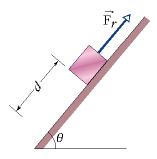
In Figure 7-33, a block of ice slides down a frictionless ramp at angle = 50°, while an ice worker pulls up the ramp (via a rope) with a force of magnitude Fr = 60 N. As the block slides through distance d = 0.30 m along the ramp, its kinetic energy increases by 80 J. How much greater would its kinetic energy have been if the rope had not been attached to the block?
W0131-N.jpg
 
Physics news on Phys.org
Work = Force * distance

Remember, you only need to multiply stuff by the cos (angle) or sin (angle) to get that component of force so it matches up with movement.

In this case, the 60 N applied in the opposite direction as the movement...so you don't need to find any of its components.

Simply, you would have a force of 60 N, and a distance of .30 m. With this info, you can easily find the energy.
 
AtlBraves said:
I can not figure out what I am doing wrong for this problem. Right now I have Wt = 60*.3*cos(50) = 12 J. If that is taken away, then it should be a 12 J difference right?
The force and the displacement are both parallel to the surface of the ramp.
 
I made that problem much harder than I should have. I understand now. Thanks for the help.
 

Similar threads

  • · Replies 4 ·
Replies
4
Views
3K
  • · Replies 3 ·
Replies
3
Views
2K
  • · Replies 3 ·
Replies
3
Views
3K
  • · Replies 2 ·
Replies
2
Views
6K
  • · Replies 58 ·
2
Replies
58
Views
5K
Replies
17
Views
2K
Replies
7
Views
2K
Replies
2
Views
1K
  • · Replies 2 ·
Replies
2
Views
3K
  • · Replies 2 ·
Replies
2
Views
3K