Work done on a gas when it is compressed quasi-statically

Click For Summary
SUMMARY

The discussion focuses on the derivation of work done on a gas during quasi-static compression, specifically addressing the sign convention for displacement and force. Participants clarify that while the force applied by the piston is downward, the displacement (dy) is defined as negative when considering upward as positive. This leads to the conclusion that the work done, expressed as -PAdy, results in a positive value due to the negative dy. The conversation emphasizes the importance of understanding notation and conventions in physics.

PREREQUISITES
  • Understanding of basic physics concepts such as work, force, and displacement.
  • Familiarity with vector notation and differential calculus.
  • Knowledge of pressure-volume relationships in thermodynamics.
  • Concept of quasi-static processes in thermodynamic systems.
NEXT STEPS
  • Study the implications of quasi-static processes in thermodynamics.
  • Learn about pressure-volume work in gas systems.
  • Explore vector calculus applications in physics, focusing on differential notation.
  • Review the conventions used in physics for defining positive and negative displacements.
USEFUL FOR

Students of physics, particularly those studying thermodynamics and mechanics, as well as educators seeking to clarify concepts related to work and force in gas compression scenarios.

member 731016
Homework Statement
Please below
Relevant Equations
Pleas see below
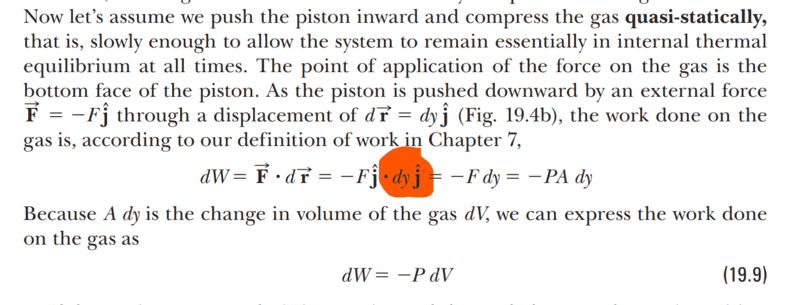
For this derivation,
1678736449418.png


I am not sure why the bit highlighted in orange is not positive since the displacement of the piston is downwards in the same direction as the force applied.

Many thanks!
 
Physics news on Phys.org
Callumnc1 said:
For this derivation,
View attachment 323568

I am not sure why the bit highlighted in orange is not positive since the displacement of the piston is downwards in the same direction as the force applied.
It appears to be a notation/convention issue.

When we write ##\vec F = -F {\hat j}## the (unadorned) letter ‘##F##’ means the magnitude of ##\vec F##. This is a common convention – shorthand for writing ##|\vec F|##. Of course, ##F## is, by definition always non-negative.

But ##dy##, it is not a magnitude. It is an (infinitesimal) change in ##y##. It can be positive (an increase in ##y##) or negative (a decrease in ##y##).

In the situation described, ##-PAdy## will be positive because ##dy## is negative.

Edit - typo's
 
  • Like
Likes   Reactions: member 731016 and MatinSAR
Callumnc1 said:
Homework Statement:: Please below
Relevant Equations:: Pleas see below

For this derivation,
View attachment 323568

I am not sure why the bit highlighted in orange is not positive since the displacement of the piston is downwards in the same direction as the force applied.

Many thanks!
It appears to me that y is taken to be positive up, so dy will be negative. That is independent of which way the force acts.
 
  • Like
Likes   Reactions: member 731016 and MatinSAR
By definition
##d\mathbf{r}=dx~\mathbf{\hat {i}}+dy~\mathbf{\hat {j}}+dz~\mathbf{\hat {k}}.##
Here, ##\mathbf{F}=-F\mathbf{\hat {j}}##.
Therefore,
##\mathbf{F}\cdot d\mathbf{r}=(-F\mathbf{\hat {j}})\cdot(dx~\mathbf{\hat {i}}+dy~\mathbf{\hat {j}}+dz~\mathbf{\hat {k}})=-Fdy.##
 
  • Like
Likes   Reactions: member 731016 and MatinSAR
Steve4Physics said:
It appears to be a notation/convention issue.

When we write ##\vec F = -F {\hat j}## the (unadorned) letter ‘##F##’ means the magnitude of ##\vec F##. This is a common convention – shorthand for writing ##|\vec F|##. Of course, ##F## is, by definition always non-negative.

But ##dy##, it is not a magnitude. It is an (infinitesimal) change in ##y##. It can be positive (an increase in ##y##) or negative (a decrease in ##y##).

In the situation described, ##-PAdy## will be positive because ##dy## is negative.

Edit - typo's
Thank you for your reply @Steve4Physics !

So are you saying that the textbook is wrong since ##\vec dr = -dy\hat j##?

Many thanks!
 
haruspex said:
It appears to me that y is taken to be positive up, so dy will be negative. That is independent of which way the force acts.
Thank you for your reply @haruspex!

The force acts downwards and the differential displacement is also in the same direction.
1678768946423.png

Many thanks!
 
kuruman said:
By definition
##d\mathbf{r}=dx~\mathbf{\hat {i}}+dy~\mathbf{\hat {j}}+dz~\mathbf{\hat {k}}.##
Here, ##\mathbf{F}=-F\mathbf{\hat {j}}##.
Therefore,
##\mathbf{F}\cdot d\mathbf{r}=(-F\mathbf{\hat {j}})\cdot(dx~\mathbf{\hat {i}}+dy~\mathbf{\hat {j}}+dz~\mathbf{\hat {k}})=-Fdy.##
Thank you for your reply @kuruman!

But why dose ##\vec dr## not equal ##-dy\hat j##?

Many thanks!
 
Callumnc1 said:
Thank you for your reply @kuruman!

But why dose ##\vec dr## not equal ##-dy\hat j##?

Many thanks!
Because ##\vec r## and ##y## are both positive upwards. ##dy## will have a negative value.
##\vec r=y\hat j##
##\vec r+\vec dr=(y+dy)\hat j##
##\vec dr=(\vec r+\vec dr)-\vec r=(y+dy)\hat j-y\hat j=dy\hat j##
 
  • Like
Likes   Reactions: member 731016
Callumnc1 said:
View attachment 323595
Many thanks!
That diagram is a little unhelpful since it makes it look as though dy is a magnitude, so positive. It would have been better to illustrate it as an upward displacement.
Callumnc1 said:
The force acts downwards and the differential displacement is also in the same direction.
Why do you keep mentioning that the force is downward? I already replied that that is irrelevant to the sign on dy in the equation.
 
  • Like
Likes   Reactions: member 731016 and MatinSAR
  • #10
haruspex said:
Because ##\vec r## and ##y## are both positive upwards. ##dy## will have a negative value.
##\vec r=y\hat j##
##\vec r+\vec dr=(y+dy)\hat j##
##\vec dr=(\vec r+\vec dr)-\vec r=(y+dy)\hat j-y\hat j=dy\hat j##
haruspex said:
That diagram is a little unhelpful since it makes it look as though dy is a magnitude, so positive. It would have been better to illustrate it as an upward displacement.

Why do you keep mentioning that the force is downward? I already replied that that is irrelevant to the sign on dy in the equation.
Thank you for your replies @haruspex!

I will do some more thinking.

Many thanks!
 
  • #11
Callumnc1 said:
Thank you for your reply @Steve4Physics !

So are you saying that the textbook is wrong since ##\vec dr = -dy\hat j##
You may have reolved this by now, given the recent posts. But if not...

I'm not saying the textbook is wrong. Nor am I saying ##\vec {dr} = -dy~\hat j##. The correct statement is ##\vec {dr} = dy~\hat j## (where ##dy## happens to be negative here).

Your Post #1 attachment says ##\vec F ·\vec {dr} = - F ~\hat j · dy ~\hat j##.

##\vec F## has been replaced by ##- F ~\hat j## (because ##F## is always positive (a magnitude) and ##\vec F## act downwards).

##\vec {dr}## has been replaced by ##dy ~\hat j## (where ##dy## is negative).
 
  • Like
Likes   Reactions: member 731016
  • #12
Steve4Physics said:
You may have reolved this by now, given the recent posts. But if not...

I'm not saying the textbook is wrong. Nor am I saying ##\vec {dr} = -dy~\hat j##. The correct statement is ##\vec {dr} = dy~\hat j## (where ##dy## happens to be negative here).

Your Post #1 attachment says ##\vec F ·\vec {dr} = - F ~\hat j · dy ~\hat j##.

##\vec F## has been replaced by ##- F ~\hat j## (because ##F## is always positive (a magnitude) and ##\vec F## act downwards).

##\vec {dr}## has been replaced by ##dy ~\hat j## (where ##dy## is negative).
Thank you for your reply @Steve4Physics!

That helps more. But if ##dy## is negative, then ##dV = A dy## then the volume would be negative?

Many thanks!
 
  • #13
Callumnc1 said:
That helps more. But if ##dy## is negative, then ##dV = A dy## then the volume would be negative?
The volume is never negative. The change in volume can be positive or negative.
 
  • Like
Likes   Reactions: PhDeezNutz, Steve4Physics and member 731016
  • #14
kuruman said:
The volume is never negative. The change in volume can be positive or negative.
Thank you for your reply @kuruman!

Thank you, you are very right. Why did the textbook not take write ##dy## as ##-dy \hat j## and assume ##dy## was positive? Is this just a matter of convention?

Many thanks!
 
  • #15
Callumnc1 said:
Thank you for your reply @kuruman!

Thank you, you are very right. Why did the textbook not take write ##dy## as ##-dy \hat j## and assume ##dy## was positive? Is this just a matter of convention?

Many thanks!
Because they defined y as the height, and dy means the change in y. The height reduced, so dy is negative.
 
  • Like
Likes   Reactions: member 731016
  • #16
haruspex said:
Because they defined y as the height, and dy means the change in y. The height reduced, so dy is negative.
Thank you @haruspex! That makes sense!
 
  • #17
Callumnc1 said:
Why did the textbook not take write ##dy## as ##-dy \hat j## and assume ##dy## was positive? Is this just a matter of convention?
To add a little more...

Yes, it is a convention on the way differentials are used. A differential (e.g. ##dy##) represents a change. We don't limit the change to be only an increase or only a decrease.

For example, you could have a problem where a piston oscillates up and down. You want a single equation - not two equations (one for up and another for down).

I guess if you knew that a differential (e.g. ##dy##) was going to turn-out to represent a decrease in ##y## for a particular problem, to be unambiguous you could write it as '##-|dy|##'. But this seems unnecessarily clumsy. And you loose generality because it would be incorrect if applied to a similar problem where ##y## happens to increase.
 
  • Like
Likes   Reactions: member 731016
  • #18
Steve4Physics said:
To add a little more...

Yes, it is a convention on the way differentials are used. A differential (e.g. ##dy##) represents a change. We don't limit the change to be only an increase or only a decrease.

For example, you could have a problem where a piston oscillates up and down. You want a single equation - not two equations (one for up and another for down).

I guess if you knew that a differential (e.g. ##dy##) was going to turn-out to represent a decrease in ##y## for a particular problem, to be unambiguous you could write it as '##-|dy|##'. But this seems unnecessarily clumsy. And you loose generality because it would be incorrect if applied to a similar problem where ##y## happens to increase.
Thank for that @Steve4Physics! That is helpful!
 
  • Like
Likes   Reactions: Steve4Physics
  • #19
Hi Everyone,

I am looking into the derivation again,
1683767923225.png

and I notice that let F = PA when ##dW = - F dy = -PA dy## does this mean that the work is actually slightly greater than ##dW = - P dV## since, initially, the force compressing the piston will be slightly greater than force from the compressed air inside the piston, in order for it to start moving inwards. Are they assuming that the piston is being compressed at a very slow (quasi-static) constant speed so that the forces are balanced?

Many thanks!
 
  • #20
ChiralSuperfields said:
Are they assuming that the piston is being compressed at a very slow (quasi-static) constant speed so that the forces are balanced?
Yes they are. It's in the description of the physical that you posted emphasized in bold.
 
  • Like
Likes   Reactions: member 731016
  • #21
kuruman said:
Yes they are. It's in the description of the physical that you posted emphasized in bold.
Great, thank you for your help @kuruman!
 

Similar threads

  • · Replies 3 ·
Replies
3
Views
1K
Replies
1
Views
1K
  • · Replies 3 ·
Replies
3
Views
2K
  • · Replies 9 ·
Replies
9
Views
4K
Replies
17
Views
2K
  • · Replies 1 ·
Replies
1
Views
3K
  • · Replies 19 ·
Replies
19
Views
1K
Replies
14
Views
1K
  • · Replies 7 ·
Replies
7
Views
8K
  • · Replies 3 ·
Replies
3
Views
3K