Work-energy v.s. impulse-momentum bar charts

  • Thread starter Thread starter otownsend
  • Start date Start date
  • Tags Tags
    Charts Work-energy
Join the discussion
Ask a follow-up here, or get your own question answered by working scientists, mathematicians and engineers — people, not an autocomplete.
Real named experts · corrections over time · the nuance an AI answer skips
9 replies · 3K views
otownsend
Messages
12
Reaction score
0
Member advised to use the formatting template for all homework help requests
My question unfortunately does not fit in the Homework template, so I hope this is okay.

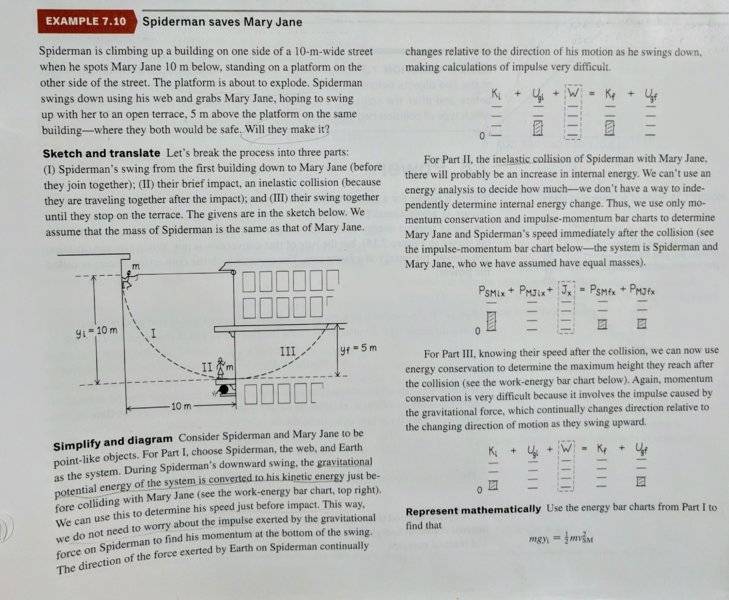
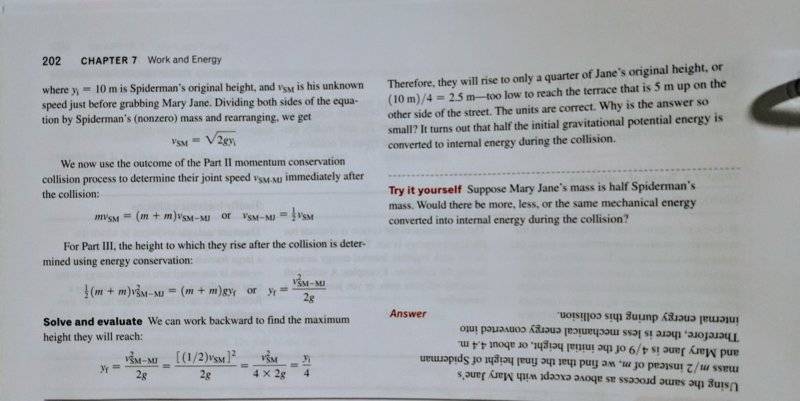
I attached a question below which involves multiple parts using the concepts related to energy, work, impulse, and momentum. Under the "Simplify and Diagram" section (you will notice it is in bold text), I want to better understand why Part II cannot be understood with a work-energy bar chart. The texts reasoning for why it is not a good idea to use a work-energy bar charts is because "we don't have a way to independently determine internal energy change". Why is this the reason? Isn't the reason more that we want to find the velocity of Jane and Spiderman after the collision occurred and using a work-energy expression (in this case the work energy expression would be something like kinetic energy = change in internal energy) wouldn't allow us to determine this velocity?
IMG_20181112_221353.jpg
IMG_20181112_223421.jpg
 

Attachments

  • IMG_20181112_221353.jpg
    IMG_20181112_221353.jpg
    74.7 KB · Views: 1,036
  • IMG_20181112_223421.jpg
    IMG_20181112_223421.jpg
    42.8 KB · Views: 612
Last edited:
on Phys.org
haruspex said:
Did you mean that? Which kinetic energy, exactly?
Well there's the kinetic energy coming from the collision, which then gets changed into internal energy (since its an inelastic collision)
 
otownsend said:
Well there's the kinetic energy coming from the collision, which then gets changed into internal energy (since its an inelastic collision)
That's the lost KE. But in that case you seem to be saying the same thing as the text, that we don't know what the lost KE is because we don't know the gained internal energy.
 
otownsend said:
The texts reasoning for why it is not a good idea to use a work-energy bar charts is because "we don't have a way to independently determine internal energy change".
In a perfectly inelastic collision the "internal energy change" is (in practise) crash energy lost. For example in a car accident it would be all the energy dissipated as the cars crumple up and deform along with various other forms of irreversible energy dissipation. So - yes - it can't be independently determined but one can use conservation of momentum to determine energy before and after collision and hence the difference. It turns out that the energy loss (internal energy change in your textbook's lexicon) in a perfectly inelastic collision (collide and coalesce collision) is given by the following relatively simple equation: $$ΔE=½μΔv^2$$ where μ is the reduced mass of the colliding objects: $$μ=\frac{m_1m_2}{m_1+m_2}$$ and Δv is their relative velocity along the line of collision. In this case $$Δv=\sqrt{2gh_1}$$ as shown in your textbook.

Using this equation you could have just one energy bar chart showing Ui and Uf with the W column showing the inelastic collision loss per formula as Spiderman swoops to the rescue!

Edit: not quite true - I guess you would still need the first work-energy bar chart to determine ##Δv=\sqrt{2gh_1}##.
 
Last edited:
Just to be annoyingly pedantic and almost entirely unhelpful :smile:, note that according to the supplied diagram Spiderman will not encounter Mary Jane at the bottom of his arc:

upload_2018-11-13_22-25-1.png
 

Attachments

  • upload_2018-11-13_22-25-1.png
    upload_2018-11-13_22-25-1.png
    8 KB · Views: 523
haruspex said:
Which, at that speed, will be a relief for all concerned.
Very much :smile:!
 
gneill said:
according to the supplied diagram Spiderman will not encounter Mary Jane at the bottom of his arc:
In the interests of appropriate drama (and Science!), I think we have to assume that Mary Jane - with precious seconds ticking away - rushes to the right hand side of the platform and launches herself into the air just as Spiderman swoops in ...
 
neilparker62 said:
In the interests of appropriate drama (and Science!), I think we have to assume that Mary Jane - with precious seconds ticking away - rushes to the right hand side of the platform and launches herself into the air just as Spiderman swoops in ...
...and smacks into her at 50 kph.