Working out the shunt resistance for a galvanometer circuit

Click For Summary
SUMMARY

The discussion focuses on calculating the shunt resistance (R_sh) for a galvanometer circuit. Participants clarify that the shunt must be connected in parallel with the galvanometer, not in series. The user initially struggles with the relationship between currents in different circuit setups but ultimately applies Kirchhoff's second law to derive a shunt resistance of 20 ohms. The importance of correctly equating circuit parameters is emphasized throughout the conversation.

PREREQUISITES
  • Understanding of galvanometer circuits
  • Familiarity with Kirchhoff's laws
  • Knowledge of electrical resistance and Ohm's law
  • Basic circuit analysis techniques
NEXT STEPS
  • Study the principles of parallel and series circuits
  • Learn more about Kirchhoff's voltage law and its applications
  • Explore the concept of shunt resistors in measurement devices
  • Investigate the effects of varying resistance on circuit performance
USEFUL FOR

Electrical engineering students, circuit designers, and anyone involved in the analysis or design of galvanometer circuits will benefit from this discussion.

Bolter
Messages
262
Reaction score
31
Homework Statement
Find shunt resistance
Relevant Equations
Ohm's law
Here is the problem

Screenshot 2020-02-07 at 14.24.02.png

I have tried to draw the set up for both cases which the question had described above, and came to these 2 equations. But I can't see how it would help me to work out the resistance of the shunt?
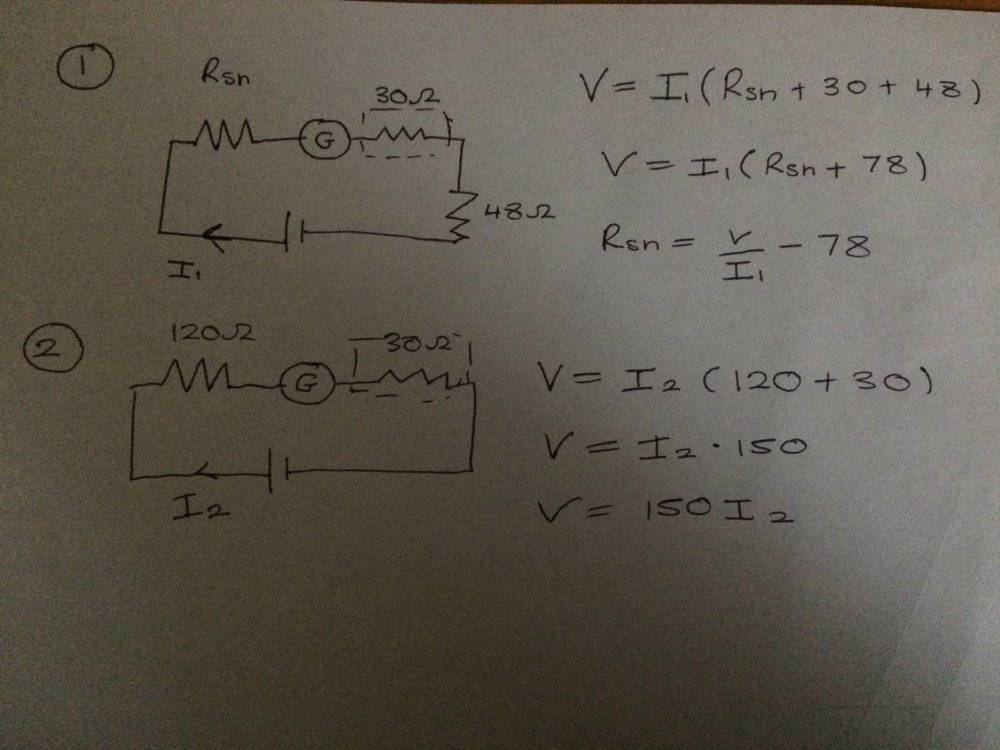
IMG_3807.JPG


Any help would be really great! Thanks
 
Physics news on Phys.org
The shunt should be in parallel with the galvanometer, not in series. See here.
 
  • Like
Likes   Reactions: etotheipi
kuruman said:
The shunt should be in parallel with the galvanometer, not in series. See here.

Ok I have made the changes to set up 1 and get these equations now

IMG_3808.JPG
 
How are ##I## and/or ##I_g## in part 1 related to ##I## in part 2?
 
kuruman said:
How are ##I## and/or ##I_g## in part 1 related to ##I## in part 2?

Sorry I believe the I value in part 1 to be different to the I value in part 2?

To go about this question, I know that the voltage of the cell stays fixed in both cases. So could I find an expression for V in both part 1 and 2. Then equate them and solve for R_sh (the shunt resistance). I don't think this would be right as I would have more than 1 unknown there
 
Bolter said:
Sorry I believe the I value in part 1 to be different to the I value in part 2?

To go about this question, I know that the voltage of the cell stays fixed in both cases. So could I find an expression for V in both part 1 and 2. Then equate them and solve for R_sh (the shunt resistance). I don't think this would be right as I would have more than 1 unknown there
It's not the voltages that you should set equal. Reread the sentence that starts with "When the shunt is removed ..."
 
kuruman said:
It's not the voltages that you should set equal. Reread the sentence that starts with "When the shunt is removed ..."

OK I have had the time to rethink about this problem again. And I have redrawn the circuits again. This time I made use of Kirchhoff's 2nd law to help me

IMG_3810.JPG


I got a shunt resistance of 20 ohms here?
 
That's what I got.
 
  • Like
Likes   Reactions: Bolter

Similar threads

  • · Replies 5 ·
Replies
5
Views
4K
Replies
2
Views
3K
  • · Replies 4 ·
Replies
4
Views
4K
  • · Replies 6 ·
Replies
6
Views
2K
Replies
13
Views
3K
Replies
10
Views
3K
  • · Replies 8 ·
Replies
8
Views
3K
  • · Replies 4 ·
Replies
4
Views
1K
  • · Replies 1 ·
Replies
1
Views
3K
  • · Replies 8 ·
Replies
8
Views
1K
