Discussion Overview
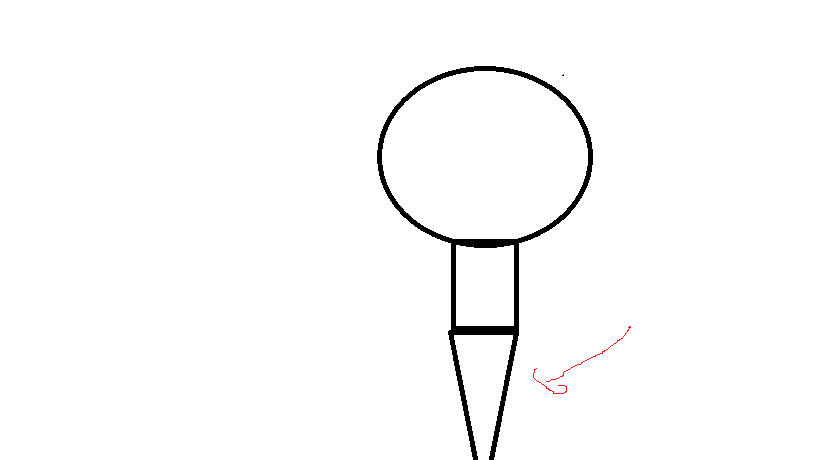
The discussion revolves around the feasibility of a turning mechanism for a robot, specifically whether rotating a tail component can effectively steer the robot. Participants explore various design considerations, including wheel configurations and stability factors.
Discussion Character
- Exploratory
- Technical explanation
- Debate/contested
Main Points Raised
- One participant suggests that steering with the rear wheel is possible if the robot has forward or backward motion, referencing a historical vehicle design.
- Another participant proposes that using the tail wheel solely as a stabilizer while equipping the main wheels with independent motors would enhance maneuverability and allow for spinning on the spot.
- A participant questions the clarity of the initial diagram and suggests that a configuration with two main wheels and one tail wheel would resemble a tricycle, albeit in reverse.
- Concerns are raised about the potential for skidding if the drive wheels are on a solid shaft, emphasizing the need for matching RPMs of the front wheels to avoid skidding during turns.
- Another participant shares historical context about the Messerschmitt KR200 and discusses the inherent instability of three-wheeled vehicles, suggesting design strategies to maintain stability, such as a low center of gravity.
Areas of Agreement / Disagreement
Participants express differing views on the effectiveness of the proposed turning mechanism, with some supporting the idea of using the rear wheel for steering while others emphasize the importance of independent motors for better control. The discussion remains unresolved regarding the optimal design for the robot's turning mechanism.
Contextual Notes
Participants mention various assumptions about wheel configurations and stability without providing detailed specifications or definitions. The discussion also highlights the importance of design choices in relation to the robot's intended purpose.