Zeh: Basics of Basics of Thermodynamics, yet really confused

Click For Summary
SUMMARY

The discussion centers on the confusion surrounding the definition of phenomenological entropy and the second law of thermodynamics as presented in Zeh's "The Physical Basis of the Direction of Time." Participants highlight a discrepancy in Zeh's notation, specifically the expression \(\left( \frac{dS}{dt} \right)_{int} \geq 0\), which contradicts the established second law stating \(\frac{dS}{dt} \geq 0\). The conversation emphasizes the implications of heat flux direction and the necessity for internal entropy to either increase or remain constant, raising concerns about the clarity and accuracy of Zeh's definitions.

PREREQUISITES
  • Understanding of the second law of thermodynamics
  • Familiarity with phenomenological entropy concepts
  • Knowledge of heat transfer principles
  • Basic grasp of thermodynamic systems and boundaries
NEXT STEPS
  • Study the implications of the second law of thermodynamics in closed systems
  • Research the concept of phenomenological entropy in classical thermodynamics
  • Examine heat transfer mechanisms and their impact on entropy
  • Explore alternative interpretations of thermodynamic definitions in literature
USEFUL FOR

Students of physics, thermodynamics researchers, and anyone seeking to clarify the principles of entropy and heat transfer in thermodynamic systems.

nonequilibrium
Messages
1,412
Reaction score
2
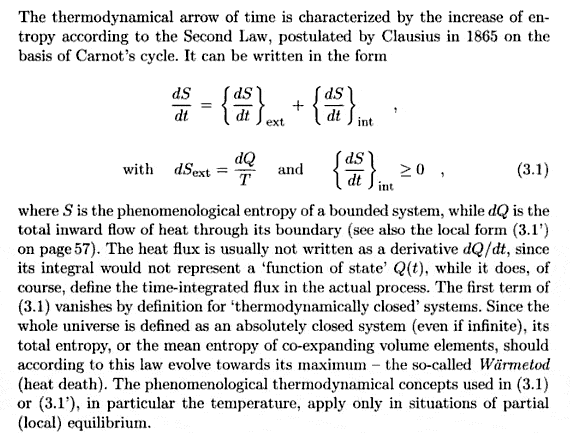
Hello, I was reading Zeh's "The Physical Basis of the Direction of Time" but I just can't understand him in chapter 1 on something really easy: the definition of the phenomenological entropy + second law. Here is a screenshot I took from the googlebooks edition:
attachment.php?attachmentid=28166&stc=1&d=1284260935.gif


Those two lines of formulas really confuse me, for several reasons. The most obvious one:

He says \left( \frac{dS}{dt} \right)_{int} \geq 0

But I thought the 2nd law clearly stated \frac{dS}{dt} \right \geq 0
After all: a system in connection to a reservoir doesn't have to go up in entropy.

Can anybody clear this up for me?
 

Attachments

  • screen_zeh.gif
    screen_zeh.gif
    26.9 KB · Views: 653
Science news on Phys.org
Agreed; Zeh should have \frac{dS}{dt}\geq 0. As written, his equation would prohibit a hot object from cooling to room temperature, since internal entropy would decrease in that scenario.
 
Zeh defined the heat flux as passing inward to the system, which would require the internal entropy increase or remain constant.

Something else appears sloppy- 'S' refers to a bounded system, which is then composed of internal S_int and external S_ext components?
 
Andy Resnick said:
Zeh defined the heat flux as passing inward to the system, which would require the internal entropy increase or remain constant.

That's a good point, but wouldn't one just take that as a sign convention - that positive dQ implies inward heat transfer - rather than a restriction that dQ remain positive? It doesn't make much sense to define your thermodynamics framework based on systems that can only gain heat. :confused:
 
Agreed, there's a lot in the blurb that does not make sense. Maybe it's covered elsewhere in the book...
 
Hm, not really covered elsewhere no (it's from the beginning of chapter 3, which I've read now, and it's the only one talking about classical thermodynamics). Oh well, I'm happy that at least I'm not the only one confused. Another thing that is weird, is that if dQ is positive if heat is going in the "interior", then I'd say dS_ext = -dQ/T (although not even that could be correct, because the "exterior" is not infinite due to the quote from Resnick about the total system being bounded...). Very weird situation.
 

Similar threads

  • · Replies 1 ·
Replies
1
Views
2K
  • · Replies 16 ·
Replies
16
Views
3K
  • · Replies 2 ·
Replies
2
Views
2K
  • · Replies 4 ·
Replies
4
Views
2K
  • · Replies 5 ·
Replies
5
Views
3K
  • · Replies 1 ·
Replies
1
Views
1K
  • · Replies 13 ·
Replies
13
Views
3K
  • · Replies 4 ·
Replies
4
Views
1K
  • · Replies 9 ·
Replies
9
Views
3K
  • · Replies 4 ·
Replies
4
Views
2K