ZigZag transformer and harmonics

Click For Summary
SUMMARY

Zigzag transformer connections effectively mitigate triplen harmonics in power systems by canceling out ampere-turns created by these harmonics, preventing them from coupling to the primary winding. According to the Schneider Electric PDF, for this cancellation to occur, the triplen harmonics must be real currents rather than mathematical constructs from Fourier Transformation. The discussion highlights the importance of understanding the nature of the harmonic currents involved, as the presence of other harmonics (like the 5th) complicates the effectiveness of this mitigation technique.

PREREQUISITES
  • Understanding of triplen harmonics in electrical systems
  • Familiarity with transformer connections, specifically zigzag configurations
  • Knowledge of Fourier Transformation and its implications in harmonic analysis
  • Basic principles of magnetic coupling in transformers
NEXT STEPS
  • Research the application of zigzag transformers in harmonic mitigation
  • Study the effects of mixed harmonics on transformer performance
  • Examine real-world case studies of triplen harmonic reduction
  • Learn about advanced harmonic analysis techniques using Fourier Transformation
USEFUL FOR

Electrical engineers, power system designers, and professionals involved in harmonic analysis and mitigation strategies in electrical distribution systems.

KraakeCrest
Messages
18
Reaction score
2
Hi again,

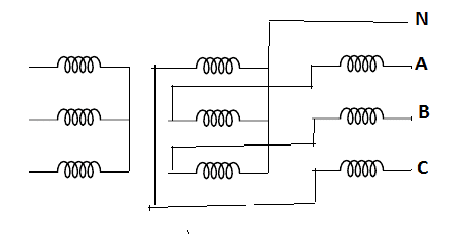
Can/are zig zag connections used on the secondary side to avoid triplen harmonics flowing further up the power system? Let's say 3rd harmonics are flowing up the power system from some loads connected to phases a,b,c and the neutral. Since 3rd harmonic are all in phase, the ampere-turn created will cancel in a zig zag connection and thus not couple to the primary and further up the power system?

This pdf: http://static.schneider-electric.us...ansformers/Harmonic Mitigating/7400DB0301.pdf says on page 12 and 13:
"With all of the triplen harmonics in phase with each other, by vector analysis, the triplen harmonic currents produce ampere-turn fluxes that cancel each other such that no currents are induced in the primary winding. For this to work, the triplen harmonics must be real currents and not mere mathematical identities derived by the Fourier Transformation."

The last sentence in bold kind of confuses me.
zig.png
 
Engineering news on Phys.org
Nice post @jim hardy , so from that post if I understand correctly, you can use a zig zag connection as secondary in a transformer to prevent triplen harmonics from coupling magnetically back to the primary.

But I am still alittle confused about the sentence in the PDF: "For this to work, the triplen harmonics must be real currents and not mere mathematical identities derived by the Fourier Transformation."

So if the current caused by the load contains fundamental + 3rd AND 5th harmonic, this would not work because the waveform is not a pure 3rd harmonic waveform? Hmm..
 
Most likely this can only be answered by an "old timer". I am making measurements on an uA709 op amp (metal can). I would like to calculate the frequency rolloff curves (I can measure them). I assume the compensation is via the miller effect. To do the calculations I would need to know the gain of the transistors and the effective resistance seen at the compensation terminals, not including the values I put there. Anyone know those values?

Similar threads

  • · Replies 4 ·
Replies
4
Views
9K
  • · Replies 13 ·
Replies
13
Views
8K
  • · Replies 20 ·
Replies
20
Views
3K
  • · Replies 3 ·
Replies
3
Views
2K
  • · Replies 16 ·
Replies
16
Views
4K
  • · Replies 11 ·
Replies
11
Views
6K
  • · Replies 40 ·
2
Replies
40
Views
21K
Replies
12
Views
2K
  • · Replies 1 ·
Replies
1
Views
2K
Replies
4
Views
3K